
Instead of manually chasing application updates and documents, manage the workflow from trademark registration to SAIP certificate through a single filing record: confirm ownership, define protection, submit, resolve examination issues, monitor publication and retain the certificate. This 2026 guide explains the handoffs for foreign companies entering Saudi Arabia, without treating a trademark application as permission to start trading.
- The trademark registration to SAIP certificate workflow requires examination, publication and completion of registration—not just submission.
- SAIP administers Saudi trademark registration; commercial registration does not replace trademark protection.
- Gofico’s business setup support suits foreign companies coordinating Saudi formation and ongoing compliance.
- Confirm the trademark owner and goods or services before filing; retain the certificate and renewal record together.
Why this matters
The Saudi Authority for Intellectual Property (SAIP) administers trademark registration. A commercial registration identifies a registered business; a trademark registration protects a qualifying mark for the goods or services covered by that registration. Neither document replaces the other.
Gofico's business setup support is best for foreign companies coordinating Saudi formation and ongoing compliance. Keep trademark decisions within that market-entry plan, but separate intellectual property approval from business licensing.
Classification deserves attention before submission. The Nice Classification contains 45 classes: 34 for goods and 11 for services. Your company's commercial activities do not automatically establish which trademark classes you need; use the trademark classes guide for foreign brands to frame that review.
Likewise, coordinate the filing with your MISA-to-commercial-registration workflow. MISA means the Ministry of Investment of Saudi Arabia. The trademark owner and the Saudi operating company need not be the same entity, but that choice must be deliberate and documented.
Before you start
- Confirm ownership and authority. Identify the legal applicant, its jurisdiction and its relationship to the Saudi business. Establish who can access the filing service and whether an authorised Saudi representative must act for the foreign applicant.
- Prepare the filing materials. Assemble the mark representation, applicant documents, goods or services specification, and any required translations or representative authorisation. Check the current SAIP requirements for document authentication before arranging it.
- Resolve the ownership trap first. Do not default to a founder, distributor or proposed subsidiary as applicant merely because that person can submit documents. The registered owner controls the right; changing ownership later requires a separate legal process.
For a 2026 application, check the current SAIP trademark registration service instructions and the applicable GCC Trademark Law and implementing regulations. Use the live service requirements for attachments and submission fields rather than an old screenshot or another country's checklist.
Applicant and protection scope
- Choose the applicant. Decide whether the foreign parent or another eligible legal entity will own the trademark. Record the exact legal name and reconcile it with supporting corporate documents before anyone starts entering application data.
- Define the mark. Identify the exact wording, lettering and visual elements you intend to protect. Review Arabic wording or transliteration deliberately rather than assuming an English-language filing automatically covers every Arabic presentation.
- Search for conflicts. Search the relevant Saudi trademark records for identical and similar marks. Include similar wording, pronunciation and relevant goods or services; an exact-name search alone does not resolve the risk of confusing similarity.
- Set the specification. Describe the goods or services that the mark will identify and map them to the appropriate Nice classes. Distinguish what your business sells from what it merely uses internally.
- Approve the filing brief. Give the filing owner a written record containing the applicant, mark, specification, intended classes and representative details. Resolve inconsistencies before submission.
Expected result: you have an approved filing scope that identifies who owns the mark and what protection the application seeks. A search supports that decision; it does not guarantee registration.
For example, a company selling equipment and providing installation services should assess both activities rather than assuming the equipment description covers the service. The right classification follows the actual offering, not the breadth of the company's ambitions.
Application submission and tracking
- Open the official service. Access the trademark registration service through SAIP's official channels. Confirm whether the applicant or its authorised representative should submit; do not share personal access credentials to bypass authority requirements.
- Enter the applicant details. Match the legal name, address and entity information to the supporting documents. Keep the trademark applicant distinct from any local contact or representative identified elsewhere in the application.
- Upload the approved materials. Use the approved mark representation and the documents required for that applicant. Check legibility, completeness and consistency before moving to the submission stage.
- Review the scope. Compare the goods or services entered in the application against the approved filing brief. Do not replace a precise specification with a broad description simply to finish the form.
- Complete submission and save evidence. Follow the service's payment and submission instructions, then retain the application reference, submitted documents and acknowledgement. A saved draft or payment record alone is not proof of registration.
Expected result: the application has a traceable reference and a retained submission record. You can identify exactly what was filed without reconstructing it from emails.
Create a shared register with the application reference, owner, mark, class, submission date, current status, next action, responsible person and deadline. Government requirements and payments remain separate from Gofico's business setup services; keep those categories distinct in your internal approvals.
Examination and response management
- Assign monitoring responsibility. Name the person responsible for checking official notices and informing the applicant. Arrange cover when that person is unavailable; a shared inbox is not a substitute for ownership of the task.
- Read each notice completely. Identify whether SAIP is requesting documents, clarification, amendments or a response to a substantive objection. Record the deadline stated in the notice rather than applying a generic response period.
- Prepare a targeted response. Address the actual issue and attach supporting material where required. Obtain specialist advice before changing the mark or specification in a way that affects the protection sought.
- Submit and retain evidence. Keep the response, attachments and submission acknowledgement with the original application. Check that the service records the response rather than assuming an uploaded document was submitted successfully.
Expected result: every examination notice has an accountable owner, a recorded deadline and a documented response. The case remains under examination until the authority's decision establishes the next stage.
Acceptance, a request for clarification and refusal are different outcomes. Do not describe an application as registered because it has passed an internal review or because supporting documents were accepted. If a refusal is issued, review the available challenge procedure and its deadline immediately.
Publication and certificate control
- Confirm publication. When the application reaches publication, retain the official publication details and verify that the applicant, mark and scope match the case record.
- Monitor the opposition period. The GCC Trademark Law provides a 60-day opposition period following publication. Record the applicable dates from the official publication and seek advice promptly if an opposition is filed.
- Complete the remaining formalities. Follow SAIP's instructions after publication and any opposition proceedings. Do not assume that expiry of the opposition period automatically completes every registration requirement.
- Obtain and check the certificate. Once registration is completed and the certificate is issued, retrieve it through the official service or authorised representative. Verify the owner, mark, registration details, goods or services and protection dates.
- Archive and assign responsibility. Retain the certificate, application history and correspondence together. Assign responsibility for renewals, ownership changes and updates affecting the registration.
Expected result: you hold the issued certificate, have checked it against the approved filing scope and have entered the relevant dates into your compliance calendar.
The core sequence is Filing scope, Application, Examination, Publication and Certificate. These are separate control points, not interchangeable descriptions of approval.
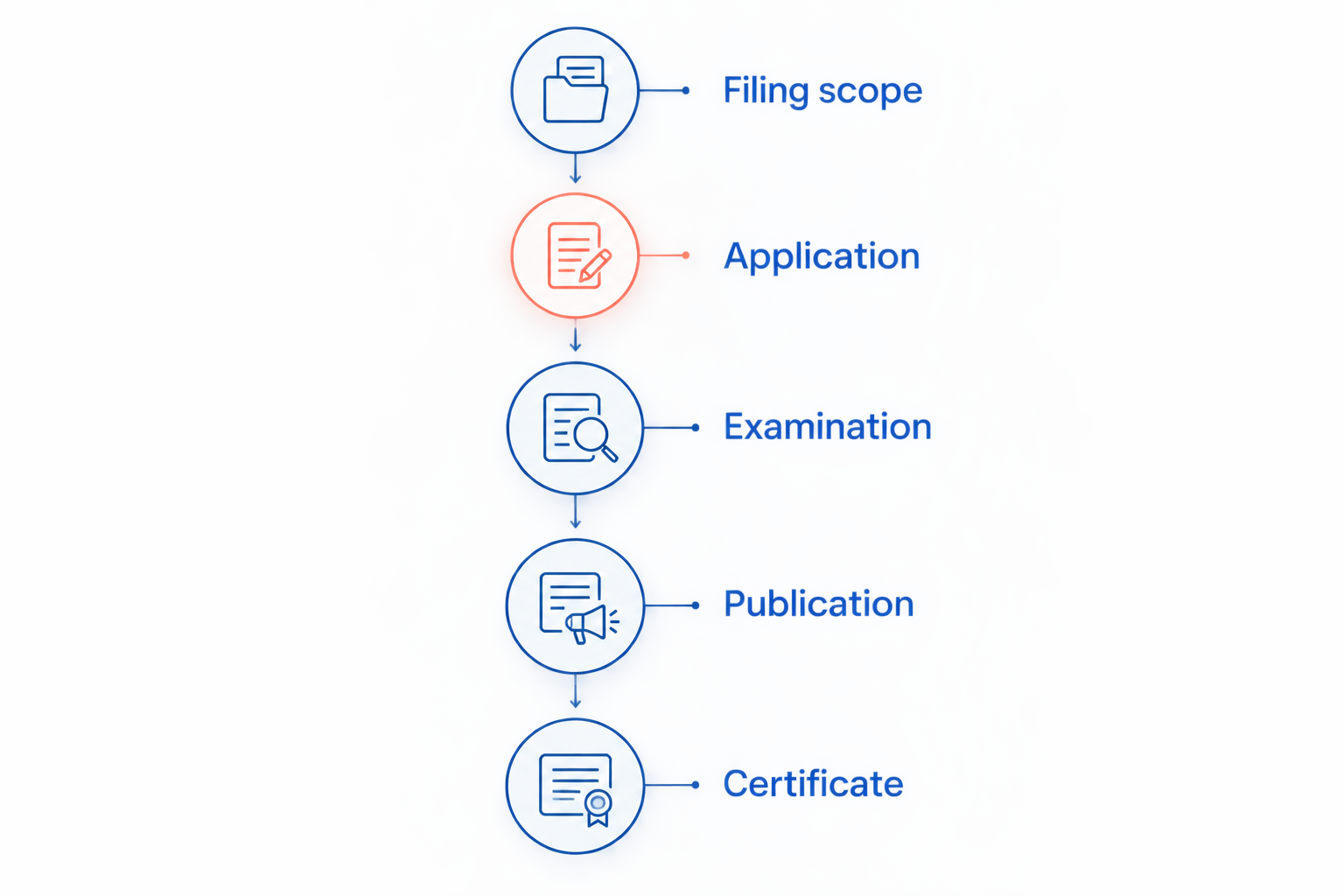
Renewal workflow for an existing Saudi trademark
An existing registration needs a renewal workflow, not a repeat of the original application process. For your 2026 portfolio review, first establish whether the business already owns a Saudi registration and whether its recorded scope still matches the business.
| Workflow | Best for | Main benefit | Main limitation |
|---|---|---|---|
| Initial registration | A mark without an existing Saudi registration covering the intended scope | Establishes a registered right after the required process | Requires examination and publication; approval is not guaranteed |
| Renewal | An existing Saudi registration approaching its renewal window | Maintains the existing registration when requirements are met | Does not expand protection to a different mark or additional goods or services |
- Retrieve the certificate and confirm the recorded owner and registration details.
- Check the protection dates and current SAIP renewal requirements.
- Reconcile ownership changes before treating renewal as a routine administrative task.
- Submit through the applicable renewal service and retain confirmation.
- Update the portfolio register with the renewed protection details.
The statutory protection term is 10 years, calculated from the application filing date, and registration is renewable. Use the recorded protection dates, not the certificate download date, to manage renewal.
A changed logo or expanded service offering also needs a scope review. Renewal preserves the registration; it does not turn the original filing into protection for every later brand variation.
Troubleshooting
The applicant name differs across documents
Reconcile the legal name against the applicant's corporate records and required translations. Before submission, correct the application materials; after submission, check the appropriate correction procedure rather than creating a second application to conceal the mismatch.
The application shows no certificate
Read the actual status and correspondence. The case may still be under examination, publication, opposition or a remaining registration formality; an application acknowledgement is not a missing certificate.
A similar trademark appears in the search
Compare the marks and their relevant goods or services with qualified intellectual property advice. Changing a spelling or adding a descriptive word does not automatically remove a conflict.
A notice was overlooked
Check the official notice and available procedural remedies immediately. Do not assume an extension or reinstatement is available, and do not rely on an email reminder as the authoritative deadline record.
The business uses more than the certificate covers
Compare actual use with the registered mark and specification. Assess whether additional filings are needed rather than assuming a broad commercial registration expands trademark rights.
Customize your workflow
Connect the trademark register to the wider Saudi compliance calendar, but retain separate owners for intellectual property, corporate registration, tax and employment obligations. One completed filing should not close unrelated market-entry tasks.
For a 2026 handover, require the certificate, application history, representative details, next action and responsible person—not just a screenshot of the latest status. Give the operating team a clear escalation route for rebranding, new product categories and changes of ownership.
Gofico supports foreign investors with formation, public relations officer (PRO) services, compliance and consulting. Ask for a coordinated business setup scope that identifies dependencies and distinguishes company formation work from specialist trademark advice or representation.
Plan your Saudi business setup
Discuss formation, licensing and ongoing compliance alongside your trademark filing responsibilities.
FAQ
How do I go from trademark registration to a SAIP certificate?
Confirm the applicant and filing scope, submit through SAIP’s trademark service, address examination notices, complete publication and remaining registration requirements, then retrieve the issued certificate. Keep the application reference and official correspondence throughout the process.
Does a Saudi commercial registration protect my trademark?
A Saudi commercial registration does not replace trademark registration. Business registration and trademark protection serve different purposes, so coordinate them without treating either as a substitute for the other.
Can a foreign company own a Saudi trademark?
A foreign company can own a Saudi trademark subject to the applicable eligibility and filing requirements. Confirm the applicant’s eligibility, supporting documents and representation requirements before submission.
How long is the Saudi trademark opposition period?
The GCC Trademark Law provides a 60-day opposition period following publication. Record the relevant dates from the official publication and obtain advice promptly if an opposition is filed.
How long does a Saudi trademark registration last?
The statutory protection term is 10 years from the application filing date, and registration is renewable. Check the recorded dates and current renewal requirements rather than calculating the term from when you downloaded the certificate.
Does SAIP acceptance mean my trademark is registered?
Acceptance during the application process is not the same as completed registration. Check publication, any opposition proceedings and the remaining formalities before describing the mark as registered.
Should I register the trademark under my parent company or Saudi subsidiary?
Choose the owner according to the group’s intellectual property ownership and operating arrangements. Review licensing, future transfers and authority to file before naming either entity as applicant.
One last thing
A certificate can be valid yet fail to cover the goods or services your business now sells. Before a Saudi launch or rebrand, compare the actual mark and offering against the registration—not merely the company name.
For 2026 decisions, use SAIP's current service instructions for procedure, the applicable GCC Trademark Law and implementing regulations for legal requirements, and WIPO's Nice Classification for classification. Keep that review separate from promises about approval or completion dates.
Related guides
- Compliance obligations for foreign companies in Saudi Arabia
- Professional services to arrange before Saudi market entry
- Business structures for foreign investors in Saudi Arabia