
Best overall for a standalone Saudi subsidiary: a limited liability company (LLC). Best for extending an existing foreign company: a branch. Best for flexible share-based ownership: a simplified joint-stock company. Best for a formal board-led structure: a joint-stock company. This 2026 guide compares their ownership, liability, governance and compliance implications for foreign investors.
- The best business structure for foreign investors in Saudi Arabia depends on ownership, liability and funding plans.
- An LLC is the default shortlist choice for a standalone Saudi subsidiary with closely held ownership.
- A foreign company branch extends the parent company rather than creating a separate subsidiary.
- Gofico supports foreign investors with business setup and ongoing compliance; structure selection starts with the intended activity.
Why this matters
Your legal structure determines who signs contracts, where liability sits and how ownership changes. It does not, by itself, establish whether your proposed activity is open to foreign investment or whether additional approvals apply.
For foreign companies planning market entry in 2026, confirm activity eligibility before choosing the entity. Gofico provides company formation, compliance and consulting services for foreign investors setting up in Saudi Arabia.
Separate the legal form from the investment process. The Ministry of Investment of Saudi Arabia (MISA) handles the foreign-investment framework, while the Ministry of Commerce administers company-law and commercial-registration matters. Sector regulators impose additional requirements where applicable.
What makes the best business structure?
Use these criteria before comparing the options:
- Activity eligibility: Confirm that the intended business activity and ownership arrangement satisfy applicable foreign-investment and sector rules.
- Liability separation: Decide whether the Saudi operation needs a separate legal personality from the foreign parent.
- Ownership changes: Consider whether ownership will remain closely held or require share transfers, new investors and different share rights.
- Governance: Match management authority, board requirements and shareholder decisions to the actual business.
- Ongoing compliance: Plan for accounting, tax, employment, registration and activity-specific obligations after incorporation.
- Exit route: Consider a future sale, restructuring or closure before selecting the initial form.
The best structure is the one that fits your operating model without imposing unnecessary governance or restricting a planned transaction.
Saudi business structures at a glance
| Structure | Best for | Standout feature | Key limitation |
|---|---|---|---|
| Limited liability company | Closely held standalone subsidiary | Separate company with flexible management arrangements | Ownership interests are not designed around the same share framework as joint-stock forms |
| Foreign company branch | Direct extension of an established foreign parent | Saudi operations remain part of the foreign company | No separate liability boundary between branch and parent |
| Simplified joint-stock company | Flexible share-based ownership and governance | Articles can tailor management arrangements and permitted share rights | Requires deliberate drafting of investor and decision-making rights |
| Joint-stock company | Formal board-led ownership arrangements | Established share-capital and board-governance framework | More prescriptive governance than an LLC or simplified joint-stock company |
These are legal-form comparisons, not approval recommendations. In 2026, the selected activity, investor profile and applicable official requirements still determine the available route.
1. Limited liability company: best for a standalone subsidiary
A Saudi limited liability company is a separate legal entity whose owners generally bear liability within their capital contributions. It suits a foreign investor that wants the Saudi business to operate through a distinct subsidiary rather than an extension of the overseas parent.
An LLC can have 1 shareholder and can be managed by 1 manager or multiple managers. Those features make it a practical starting point for a wholly owned subsidiary where the intended activity permits the proposed foreign ownership.
LLC pros:
- Separates the subsidiary's legal identity from its shareholder.
- Supports single-shareholder ownership without requiring a local equity partner solely because the entity is an LLC.
- Allows management arrangements suited to a closely held business.
- Provides a defined entity for local contracting and employment.
LLC cons:
- Ownership transfers and new investment require attention to company documents and applicable procedures.
- A share-based investment plan can call for a different structure or a later conversion.
- Separate legal personality does not remove exposure created by guarantees, misconduct or statutory exceptions.
Best for: A foreign company establishing a closely held Saudi operating subsidiary.
Before incorporation, settle management powers, signing authority and reserved shareholder decisions. Where several owners participate, document how they resolve disagreements and approve an exit; a basic incorporation document is not a substitute for an agreed ownership arrangement.
Gofico's business setup support covers formation and ongoing compliance. For an LLC enquiry, provide the proposed activity, parent ownership and intended management arrangement.
Verdict: Choose an LLC as the default shortlist option for a standalone subsidiary, then confirm activity eligibility.
2. Foreign company branch: best for a parent-led Saudi operation
A branch enables an existing foreign company to conduct authorised activities through a Saudi establishment. It is not a separate subsidiary: the foreign company remains the underlying legal entity.
That distinction matters when deciding which entity should carry contractual obligations and business risk. Choose a branch because direct parent participation fits the operating model, not because it appears to remove local compliance work.
Foreign company branch pros:
- Preserves a direct legal connection to the established foreign company.
- Fits operations where the parent intends to remain the contracting business.
- Avoids creating a separate Saudi shareholder ownership arrangement.
Foreign company branch cons:
- Does not create a separate liability boundary protecting the parent from branch obligations.
- Does not provide subsidiary shares that a local investor can acquire.
- Requires parent-company documentation and authority arrangements for the Saudi operation.
Best for: An established foreign company that deliberately wants direct responsibility for its Saudi business.
Review the branch's intended activities against the parent's constitutional documents and applicable Saudi requirements. Also identify who can bind the parent and which decisions require overseas approval; authority gaps create practical problems even when the legal form is appropriate.
Verdict: Choose a branch only when direct parent-company exposure and control are intentional.
3. Simplified joint-stock company: best for flexible share ownership
A simplified joint-stock company combines a share-based ownership structure with more adaptable governance than a conventional joint-stock company. Saudi company law allows its constitutional documents to specify management arrangements within the applicable legal framework.
It can be established by 1 shareholder. Its value lies in the ability to design ownership and governance around the business, rather than assuming that every share-based company needs a conventional board structure.
Simplified joint-stock company pros:
- Supports share-based ownership for current and future investors.
- Allows tailored management arrangements through its articles.
- Provides a framework for permitted share classes and associated rights.
Simplified joint-stock company cons:
- Flexibility increases the importance of precise legal drafting.
- Investor rights, transfer restrictions and decision thresholds need agreement before incorporation.
- The legal form alone does not make a company ready for investment.
Best for: Foreign founders or corporate investors expecting ownership changes and needing tailored share and governance arrangements.
For a 2026 market-entry plan, compare this structure with an LLC before committing to a future fundraising route. Specify the rights investors actually need: economic entitlements, voting powers, information access and approval rights. Then check which provisions belong in the articles and which require separate agreements.
Verdict: Choose a simplified joint-stock company when share rights and governance flexibility are defined business needs.
4. Joint-stock company: best for formal board-led governance
A joint-stock company divides its capital into shares and operates under a more prescribed corporate-governance framework. Its board must have at least 3 members, making board composition an incorporation decision rather than an issue to address later.
This structure fits investors that require a conventional board-led company. It is not automatically the right choice simply because the foreign parent is large or the Saudi business has ambitious growth plans.
Joint-stock company pros:
- Provides a recognised share-capital framework.
- Establishes a formal board structure and shareholder decision process.
- Separates the company's legal identity from its shareholders.
Joint-stock company cons:
- Requires more formal governance than an LLC or simplified joint-stock company.
- Board and shareholder procedures add administration.
- Incorporation as a joint-stock company does not itself permit a public offering or listing.
Best for: Investors with a specific requirement for conventional board-led governance and share ownership.
If a public-market transaction forms part of the long-term plan, assess the Capital Market Authority's separate requirements. Company formation and securities-market eligibility are different questions; the legal form does not settle both.
Verdict: Choose a joint-stock company when its governance framework serves a defined ownership or regulatory requirement.
Turn the structure decision into a setup plan
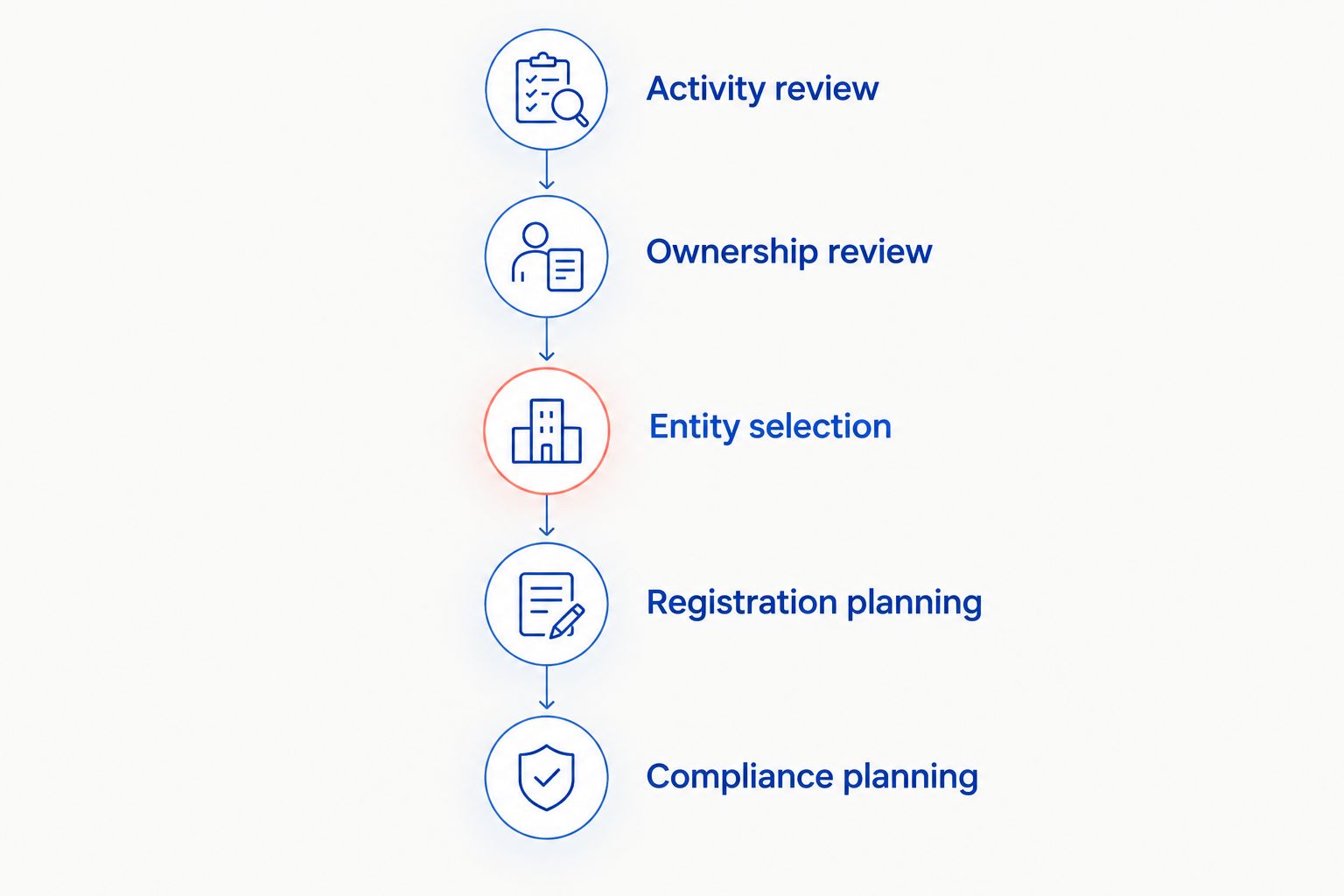
Use this sequence to connect your preferred structure with the actual market-entry process. Avoid treating incorporation as the final permission to trade.
- Activity review: Define what the Saudi business will sell or deliver and identify relevant sector restrictions or approvals.
- Ownership review: Map direct shareholders, ultimate ownership and the relationship with the foreign parent.
- Entity selection: Compare liability, management authority and future ownership changes across the eligible forms.
- Registration planning: Confirm applicable MISA procedures, commercial registration and activity-specific permissions.
- Compliance planning: Assign responsibility for accounting, tax, employment administration and continuing filings.
For 2026 applications, use the live official service requirements rather than an old document checklist. Parent-company evidence, authorisations and document authentication requirements depend on the applicant and procedure.
Ask for a written scope that separates government requirements from professional support. Gofico's services cover initial setup and ongoing compliance; an enquiry should identify both the formation work and the post-registration responsibilities you need addressed.
Discuss your Saudi entity structure
Share your activity, ownership and operating plan to discuss setup and ongoing compliance support.
Compliance does not end with commercial registration
A commercial registration records the business; it is not a substitute for every operational permission. Premises, sector approvals and employment arrangements need separate attention where applicable.
The Zakat, Tax and Customs Authority (ZATCA) administers relevant tax and zakat obligations. Do not assume that selecting an LLC, branch or joint-stock form determines the entire tax result: ownership, activities, transactions and applicable rules also matter.
Employment planning also needs its own workstream. Saudization means the applicable employment-localisation requirements, while Qiwa is the Ministry of Human Resources and Social Development's platform for business labour services. Assess the requirements relevant to your activity and workforce rather than treating them as an incorporation-only task.
Trademark protection is separate from company formation. A commercial name and commercial registration do not replace a trademark assessment through the Saudi Authority for Intellectual Property.
How the structures are ranked
The LLC ranks first for a closely held standalone subsidiary because it combines separate legal personality with straightforward ownership and management choices. The branch, simplified joint-stock company and joint-stock company each rank first for a different requirement, not as universally better or worse alternatives.
The legal distinctions follow the Saudi Companies Law administered by the Ministry of Commerce, with foreign-investment eligibility assessed separately under the MISA framework. For a 2026 decision, consult the current official law, implementing regulations and service requirements for the proposed activity; the comparison is not a substitute for transaction-specific legal advice.
Which business structure should you choose?
Start with an LLC if you need a standalone Saudi subsidiary with closely held ownership. Compare a branch when the parent should remain directly responsible, a simplified joint-stock company when tailored share rights matter, and a joint-stock company when formal board governance is a defined requirement.
Gofico is best suited to foreign investors seeking Saudi business setup and ongoing compliance support. Bring an activity description and ownership plan to that discussion, rather than requesting incorporation before the structure has been assessed.
FAQ
What’s the best business structure for foreign investors in Saudi Arabia?
An LLC is the default shortlist choice for a closely held, standalone Saudi subsidiary. A branch or joint-stock form fits different liability, ownership and governance requirements, subject to activity eligibility.
Can a foreign investor own a Saudi company without a local shareholder?
Full foreign ownership is permitted for eligible activities and investment arrangements. Confirm the requirements for the exact activity rather than assuming that every business needs a Saudi equity partner or that every activity permits full foreign ownership.
Is a Saudi branch legally separate from its foreign parent?
No. A foreign company branch is an extension of its parent, so it does not create the separate liability boundary associated with a subsidiary.
Is a simplified joint-stock company better than an LLC?
A simplified joint-stock company is better suited to a defined need for share-based ownership and tailored governance. An LLC remains the more direct shortlist choice when ownership is closely held and those share arrangements are unnecessary.
Does commercial registration let a foreign company start every activity?
No. Commercial registration does not replace applicable foreign-investment procedures, sector approvals or operational permissions. Confirm the requirements for the intended activity before trading.
Does the legal structure determine Saudi tax obligations?
The legal structure alone does not determine the full tax position. Ownership, activities and transactions also affect the applicable ZATCA obligations and require separate assessment.
Can I change the company structure after incorporation?
Saudi company law provides for company conversions subject to applicable conditions and procedures. Assess the effect on approvals, ownership rights and contracts before treating conversion as a simple administrative change.
One last thing
Write the intended exit before approving the entry structure. Decide whether a future buyer should acquire Saudi subsidiary ownership, whether another investor needs shares, or whether the foreign parent intends to retain the operation directly. That decision exposes structural mismatches before incorporation documents make them expensive to unwind.
Related guides