
Instead of repeatedly correcting mismatched investment and incorporation documents, follow a single MISA license to commercial registration workflow: confirm your investment registration route, align the company documents, complete incorporation, and activate the relevant operating accounts. For a 2026 application, distinguish the legacy term MISA license from investment registration under Saudi Arabia’s updated Investment Law.
- The MISA license to commercial registration workflow starts with confirming the current foreign-investment registration route.
- Gofico supports foreign-company business setup and ongoing compliance; government authorities decide applications.
- Investment registration, commercial registration, and sector permissions serve different purposes; completing one does not replace the others.
- Match ownership, activities, and representative authority before submitting incorporation documents.
Why this matters
Investment registration records the foreign investor’s position under the investment framework. Commercial registration records the business in the commercial register. Neither should be treated as blanket permission to conduct every proposed activity.
Gofico is best for foreign companies seeking business setup support that connects formation with ongoing Saudi compliance. Its services cover company formation, PRO support—administrative liaison with government authorities—compliance, and consulting; government authorities retain approval decisions.
For your 2026 market-entry plan, use official sources according to their scope: the Ministry of Investment of Saudi Arabia, or MISA, for investment registration; the Ministry of Commerce and Saudi Business Center for incorporation and commercial registration; and the relevant regulator for restricted or regulated activities. A registration certificate is evidence of a completed stage, not proof that every operating obligation is complete.
Before you start
- Confirm the applicant and authority. Identify the foreign shareholder, proposed Saudi entity, manager, and authorised representative. Assemble the relevant corporate records, ownership information, resolutions, and powers of attorney required for your application.
- Confirm document formalities before arranging them. Check the receiving authority’s requirements for authentication, translation, validity, and electronic submission. Do not assume a document accepted for investment registration also satisfies incorporation requirements.
- Resolve the activity mismatch first. Your intended services or trading activities must fit the investment route, incorporation documents, and commercial registration. A broad description in the parent company’s documents does not establish permission for a regulated Saudi activity.
Investment route and entity structure
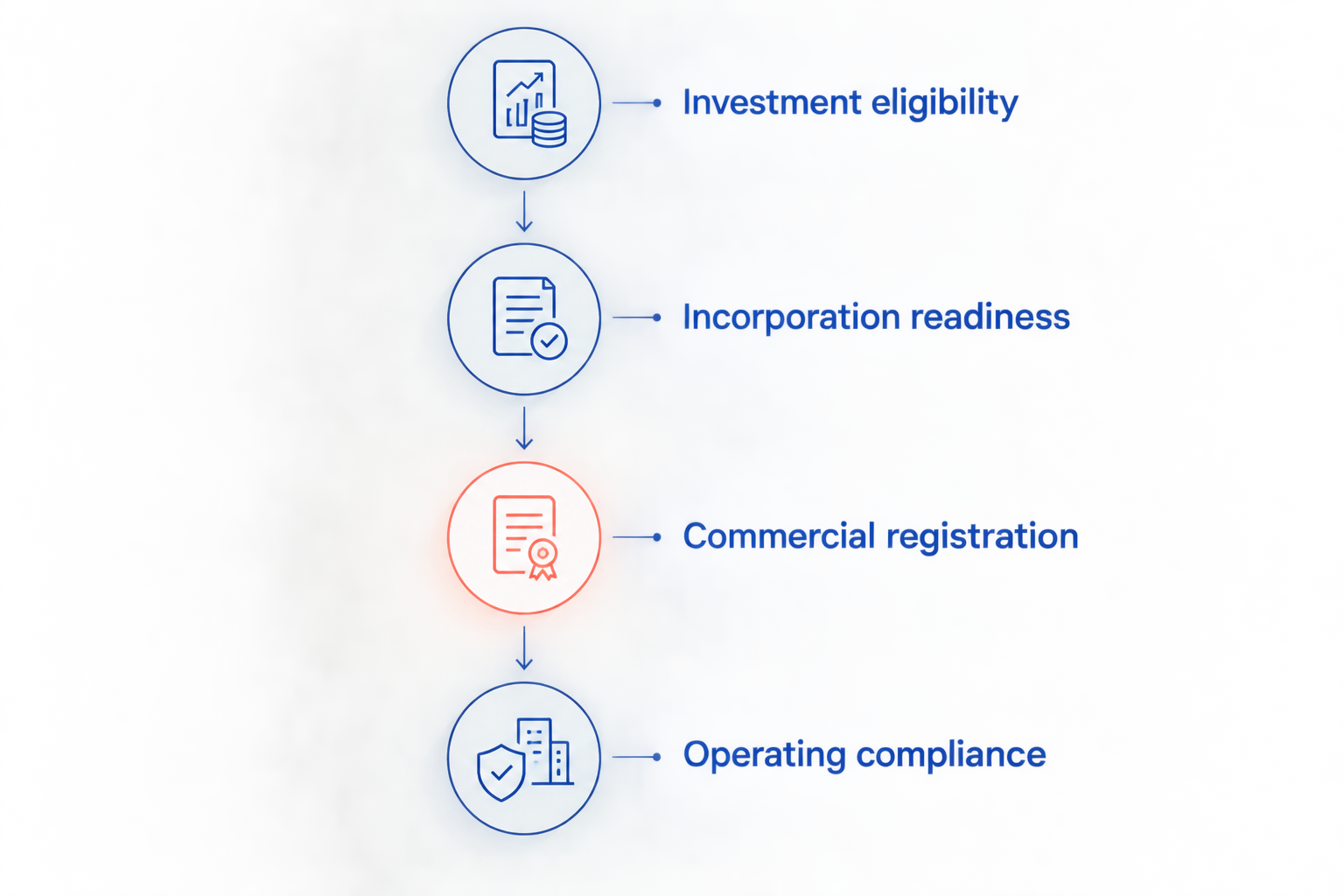
Treat the process as 4 checkpoints: investment eligibility, incorporation readiness, commercial registration, and operating compliance. Assign an owner to each checkpoint so that document preparation does not become confused with regulatory approval.
Confirm the investment route
- Define the activity. Describe what the Saudi business will actually sell or deliver, who contracts with customers, and whether it needs premises or regulated personnel.
- Check investment eligibility. Consult MISA’s current investment registration requirements and the rules governing excluded or restricted activities. Identify any approval needed before the proposed investment can proceed.
- Choose the legal structure. Decide whether the foreign business needs a Saudi subsidiary or a branch, then check the requirements attached to that structure and activity.
- Confirm representation. Establish who can submit applications, approve constitutional documents, appoint management, and act for the shareholder.
Expected result: you have an agreed activity description, entity route, applicant identity, and list of required approvals. You have not yet established that the company can operate.
Compare the structure before preparing documents
The business structures for foreign investors decision changes the documents you prepare and the legal relationship with the foreign parent.
| Structure | Best for | Main benefit | Main limitation |
|---|---|---|---|
| Saudi limited liability company | Foreign investors seeking a separate Saudi legal entity | Separates the subsidiary’s legal identity from its shareholders | Requires company constitutional documents and its own governance arrangements |
| Foreign company branch | Foreign companies seeking a Saudi presence through the existing parent | Operates as an extension of the foreign company | Does not create the same legal separation from the parent as a subsidiary |
Neither route is universally better. Choose according to liability, ownership, contracting, activity eligibility, and governance—not merely the apparent length of the application form.
Investment registration file
For a 2026 filing, start with the current MISA service requirements rather than copying an old investment-license checklist. The updated Investment Law uses investment registration; a legacy license holder must check the treatment of its existing record before starting a fresh application.
Prepare the investment application
- Create a source record. Record the foreign shareholder’s legal name, registration details, ownership, representative, proposed Saudi activity, and intended structure in a controlled document.
- Collect the applicable evidence. Use the current MISA requirements for your investor category and activity. Do not assume every applicant needs identical financial records, corporate documents, or approvals.
- Prepare translations and authentication. Follow the requirements for the specific documents and receiving authority. Keep the original, authenticated version, and translation clearly associated.
- Submit through the official route. Use MISA’s current investor services process or an appropriately authorised representative. Follow the live service instructions rather than labels shown in an older tutorial.
- Resolve requests against the source record. If an authority requests clarification, update the master information and all affected documents before resubmitting.
Expected result: the investment stage has a confirmed status, and you retain the issued evidence, application reference, approved scope, and any conditions requiring further action. A submission acknowledgement alone is not completion.
Reconcile the information before handover
Check 3 fields particularly closely: legal name, ownership, and business activities. Compare them across the foreign corporate documents, investment record, and proposed Saudi incorporation documents.
Also verify that the representative’s authority covers the next action. Permission to submit an investment application does not automatically establish authority to sign incorporation documents or open a bank account.
Keep a handover file containing the investment evidence, source documents, translations, representative authority, and unresolved conditions. This gives the incorporation owner a defined starting point rather than a collection of email attachments.
Incorporation and commercial registration
Commercial registration is not simply a document exchange after MISA. The Saudi company or branch must satisfy the applicable establishment requirements through the competent official services.
Complete the establishment file
- Select the correct establishment service. Use the Saudi Business Center’s current route for the chosen entity and foreign-investment status. Confirm any prerequisites shown for that service.
- Resolve the trade name. Complete the applicable trade-name process and use the accepted name consistently in the establishment file. Do not confuse a trade name with a registered trademark.
- Prepare the legal documents. For a subsidiary, prepare the required constitutional documents and shareholder decisions. For a branch, prepare the applicable parent-company and branch-establishment documents.
- Confirm management and ownership details. Check the manager’s authority, shareholder information, ownership disclosures, and any beneficial-owner information required by the applicable rules.
- Complete approvals and execution. Arrange the required signatures, authentication, and any activity-specific prerequisites. Submit through the official establishment process and respond to formal requests.
- Verify the issued commercial record. Check the legal name, entity form, activities, management information, and other recorded particulars before using the record in downstream applications.
Expected result: the establishment process is complete and the commercial registration details match the intended business. Any remaining sector, premises, employment, or tax requirements remain visible as separate tasks.
The workflow below shows the handover between stages. Each stage needs its own evidence; the final commercial record does not erase conditions attached to an earlier approval.
Separate the government process from advisory support
Government authorities set requirements, assess applications, and issue official records. Gofico provides formation, PRO, compliance, and consulting support; an advisory engagement does not transfer approval authority to the adviser.
Request a written scope that distinguishes document coordination, application assistance, government charges, third-party work, and ongoing compliance support. It should also identify information and signatures that remain your responsibility.
Operating accounts and compliance calendar
For a 2026 launch, define readiness by the activities the business can legally perform—not simply by possession of a commercial registration. Use the issued company details consistently across subsequent registrations.
Build the post-registration handover
- Assess tax registration. Review obligations with the Zakat, Tax and Customs Authority, or ZATCA. Ownership and activities affect the treatment; foreign ownership alone is not a complete tax assessment.
- Prepare the banking file. Assemble the bank’s requested corporate, ownership, management, and business information. Commercial registration does not remove the bank’s customer due-diligence requirements.
- Establish employment compliance where applicable. Review Ministry of Human Resources and Social Development requirements, Qiwa labour services, and General Organization for Social Insurance registrations. Assess Saudization—the employment of Saudi nationals—against the applicable activity and workforce rules.
- Complete operating permissions. Check municipal, premises, professional, and sector approvals relevant to the actual business. Identify any restriction on beginning work before those permissions are issued.
- Assign recurring obligations. Record commercial registration annual confirmation, investment-record obligations, tax filings, employment updates, and licence-specific requirements where applicable. Give each task an owner and retain completion evidence.
Expected result: you have an operating-readiness checklist and compliance calendar, with unresolved permissions clearly marked. Incorporation is complete only as an incorporation milestone; operational readiness requires its own assessment.
Plan your Saudi setup handover
Discuss formation, commercial registration, and the ongoing compliance responsibilities for your proposed business.
Variant: an existing investment record or foreign branch
Best for: foreign companies with an existing MISA record, or a parent company choosing a branch rather than a new subsidiary. Start by reviewing the existing legal position instead of repeating a new-investor workflow.
For an existing record, compare the recorded investor, activity, ownership, and status against the proposed commercial registration. Resolve amendments or transition requirements with MISA before relying on an outdated document. An old certificate’s terminology does not, by itself, establish whether further action is required.
For a branch, confirm the parent company’s decision, authorised representative, branch management, and permitted scope. Replace subsidiary constitutional-document tasks with the branch documents required by the current establishment service.
The benefit is continuity with the existing investor or parent-company structure. The limitation is inherited complexity: an unresolved record mismatch or inadequate parent-company authority remains a problem in the new submission.
Troubleshooting
The investment record and incorporation activity differ
Compare the actual proposed activity with both records. Correct the relevant application or obtain the necessary amendment before proceeding; do not select an unrelated activity merely because the portal accepts it.
The representative cannot complete execution
Read the authority document against the specific action being attempted. Arrange a valid resolution or power of attorney covering that action, with the required formalities, rather than repeatedly retrying the submission.
A translated name does not match another document
Identify the authoritative source and reconcile the translation, investment record, and establishment file. Do not create a second spelling to bypass a validation issue; the same discrepancy can reappear during banking or tax registration.
Commercial registration exists, but operations remain blocked
Identify the missing permission rather than treating commercial registration as the only prerequisite. Check sector approval, premises requirements, employment access, and other applicable conditions separately.
A legacy license is being treated as a current application checklist
Use the current MISA requirements for your case. For 2026 planning, distinguish historical evidence of the investor’s status from the documents and actions required now.
Customize your workflow
Expand the handover beyond formation. Add a responsible person for corporate changes, tax filings, employment compliance, and record maintenance before the business begins making commitments.
Gofico’s business setup and ongoing compliance positioning suits this connected approach, but your engagement scope still needs to name the deliverables. Keep government decisions, company responsibilities, and adviser tasks separate so that nothing disappears between incorporation and operations.
FAQ
Do I need a MISA license before commercial registration?
Foreign investors must follow the applicable investment registration requirements before completing the relevant establishment process. MISA license is legacy terminology; confirm the current route and any activity-specific exceptions or approvals with MISA.
Is MISA registration the same as commercial registration?
No. Investment registration concerns the investor under the investment framework, while commercial registration records the business in the commercial register. Neither automatically replaces sector-specific operating permissions.
Can a foreign company open a Saudi branch instead of a subsidiary?
A foreign company can pursue a branch where its activity and applicable rules permit that structure. A branch remains an extension of the parent, so assess liability, authority, and documentation before choosing it.
Which documents should match throughout the Saudi setup process?
The investor identity, ownership, proposed activities, and representative authority must remain consistent across the relevant documents. Check translations and legal names before handing the file from investment registration to incorporation.
Can my company start operating immediately after commercial registration?
Commercial registration alone does not establish readiness for every activity. Complete the sector, premises, tax, employment, and other permissions applicable to the business before performing activities that require them.
Does an existing MISA license need to be replaced?
Check the status and treatment of the existing record directly through MISA’s current process. Do not assume either that every legacy document requires replacement or that an old document satisfies every current requirement.
Can Gofico guarantee commercial registration approval?
Government authorities decide commercial registration and related applications. Gofico provides company formation, PRO, compliance, and consulting support, not a substitute for official approval.
One last thing
Trade-name acceptance is not trademark registration. Before committing to a Saudi trading identity, assess trademark protection separately from incorporation. Commercial registration and trademark registration address different legal questions; completing the first does not establish rights under the second.
Related guides
- Compliance obligations for foreign companies in Saudi Arabia
- Professional services to arrange before Saudi market entry
- Banks for business account opening in Saudi Arabia