
The first priority is keeping your commercial registration and investment status current; tax, employment and reporting controls follow according to your activities. This 2026 guide ranks ongoing compliance obligations for foreign companies in Saudi Arabia by the business function they protect—not by whether you can choose to ignore them.
- Ongoing compliance obligations for foreign companies in Saudi Arabia extend beyond commercial registration to tax, employment and reporting.
- Prioritise registration accuracy, then assign owners for tax, accounting, employment and activity-specific approvals.
- Gofico supports foreign-company business setup and ongoing compliance; government authorities determine requirements and approvals.
- Trademark registration protects brand rights but does not replace commercial registration or permission to operate.
Why this matters
Formation establishes your legal entity. Ongoing compliance keeps its records, filings and operations aligned with the applicable rules. A commercial registration does not replace tax registration, employment administration or sector approvals.
Gofico is suited to foreign companies seeking business setup and ongoing compliance support in Saudi Arabia. Its company formation and compliance services connect market-entry decisions with the obligations that follow incorporation.
For your 2026 compliance plan, separate three questions: what applies to the entity, what applies to its activities, and what changes when it hires or makes payments. Assign each obligation to a named person rather than leaving it with an unspecified adviser.
What makes the best compliance plan?
The best plan covers applicable obligations without treating every registration as an annual renewal.
- Applicability: Identify requirements from your legal form, ownership, activities, workforce and transactions.
- Operational importance: Prioritise records and permissions connected to lawful trading and employment.
- Deadline clarity: Distinguish recurring submissions from changes triggered by business events.
- Evidence: Retain submitted returns, acknowledgements and supporting records—not just portal screenshots.
- Ownership: Name the person who prepares, approves, submits and checks each filing.
- Change control: Review compliance when activities, shareholders, premises or staffing change.
Saudi compliance priorities at a glance
These workstreams complement one another. The ranking is an administrative starting point, not permission to postpone a statutory deadline.
| Priority | Workstream | Best for | Standout control | Key limitation |
|---|---|---|---|---|
| 1 | Commercial registration | Maintaining accurate entity records | Annual confirmation and change tracking | Does not replace other approvals |
| 2 | Investment registration | Managing foreign-investor status | Review of registered investment details | Requirements depend on the investment and activity |
| 3 | Tax compliance | Controlling transaction and filing exposure | Tax calendar linked to actual payments | Different taxes use different rules |
| 4 | Financial reporting | Supporting reliable statutory accounts | Reconciled books and filing responsibility | Accounting alone does not complete submissions |
| 5 | Employment compliance | Operating a Saudi workforce | Joined-up employment and payroll records | Requirements change with workforce circumstances |
| 6 | Activity and premises approvals | Keeping operations within permitted scope | Approval register by location and activity | Commercial registration is insufficient by itself |
| 7 | Trademark management | Protecting the market-entry brand | Ownership and renewal records | Usually separate from permission to trade |
1. Commercial registration: best for entity-record control
Commercial registration, commonly called CR, records your business with the Ministry of Commerce. Under the current framework, annual confirmation of registration data is a recurring requirement; changes to company information also require attention.
Build your control around the entity's actual record and the applicable confirmation date. Do not assume that completing incorporation removes the need to update ownership, management or contact information.
Commercial registration strengths:
- Creates a central reference for entity information.
- Makes changes easier to reconcile across government records.
- Provides a recurring checkpoint for registration accuracy.
Commercial registration limitations:
- Does not establish tax compliance.
- Does not authorise every regulated activity or premises.
Best for: Companies establishing responsibility for their core legal records.
Verdict: Prioritise commercial registration accuracy, but never treat it as the entire compliance programme.
2. Investment registration: best for foreign-investor status
The Ministry of Investment, known as MISA, administers the foreign-investment framework. Review the investment registration and any applicable approvals against the entity's ownership, activities and proposed changes.
Avoid applying an old licensing checklist without checking the current framework. Investment registration, restricted activities and sector-specific approvals are separate questions, and an existing document does not answer all three.
Investment registration strengths:
- Connects foreign-investor status with the planned investment.
- Provides a checkpoint before ownership or activity changes.
- Helps distinguish investment requirements from sector permissions.
Investment registration limitations:
- Does not replace commercial registration or tax filings.
- Requires an activity-specific assessment rather than a universal checklist.
Best for: Foreign investors establishing or changing their Saudi presence.
Verdict: Review your current investment position before implementing material business changes.
3. Tax compliance: best for transaction and filing control
The Zakat, Tax and Customs Authority, known as ZATCA, administers Saudi tax obligations. Review corporate income tax, zakat, value-added tax, withholding tax and electronic invoicing separately; applicability differs.
Saudi Arabia's standard VAT rate is 15%, while the standard corporate income tax rate is generally 20% on the taxable share attributable to non-Saudi ownership, subject to applicable rules and exceptions. These rates do not determine your final liability without reviewing the taxable base and transaction treatment.
Tax compliance strengths:
- Connects filings to sales, expenses and cross-border payments.
- Identifies withholding questions before payments leave the business.
- Supports consistent invoice and return records.
Tax compliance limitations:
- One tax registration does not satisfy every tax obligation.
- Accounting profit is not automatically taxable income.
Best for: Companies invoicing customers, importing services or paying overseas parties.
Verdict: Build the 2026 tax calendar around applicable returns and real transactions, not a single annual reminder.
4. Financial reporting: best for statutory-account control
Maintain accounting records that support financial statements, tax returns and management decisions. Determine the financial reporting, audit and submission requirements that apply to your legal form and circumstances.
An audit exemption, where available, does not mean that accounting records are unnecessary. Establish who prepares the accounts, who approves them and who completes any required submission through the relevant official channel.
Financial reporting strengths:
- Gives tax filings a traceable accounting foundation.
- Supports shareholder oversight of the Saudi entity.
- Makes missing documents visible before filing deadlines.
Financial reporting limitations:
- A completed ledger is not a submitted statutory filing.
- Group reporting does not automatically satisfy local requirements.
Best for: Subsidiaries and branches reporting both locally and to overseas headquarters.
Verdict: Give statutory accounts their own owner and submission checklist.
5. Employment compliance: best for workforce administration
The Ministry of Human Resources and Social Development, known as HRSD, oversees key employment requirements. Qiwa supports employment-related services; the General Organization for Social Insurance, known as GOSI, administers social insurance requirements.
Review employment contracts, work authorisations, payroll records, applicable wage-protection requirements and Saudization—the employment of Saudi nationals under applicable localisation rules. Do not assign a universal Saudization percentage to every foreign-owned business.
Employment compliance strengths:
- Connects hiring decisions with legal and payroll records.
- Identifies work-authorisation actions before staff changes.
- Makes localisation monitoring part of workforce planning.
Employment compliance limitations:
- Portal access does not prove that every employment obligation is satisfied.
- Requirements depend on the establishment and workforce circumstances.
Best for: Companies hiring employees or transferring staff into Saudi operations.
Verdict: Check employment implications before approving a hire, transfer or workforce restructuring.
6. Activity and premises approvals: best for operational permissions
Check whether your actual operations require municipal permissions, sector approvals or other activity-specific authorisations. Match the activity, legal entity and operating location rather than relying on a broad business description.
A change in premises, service scope or operating model deserves a fresh review. The correct question is whether each current operation sits within the permissions that apply to it.
Approval-management strengths:
- Links operational decisions to the relevant authority.
- Helps identify permissions affected by relocation or expansion.
- Separates entity registration from permission to conduct regulated work.
Approval-management limitations:
- Requirements differ across activities and locations.
- An approval for one operation does not automatically cover another.
Best for: Companies opening premises, expanding activities or entering regulated markets.
Verdict: Confirm applicable permissions before committing to an operational change.
7. Trademark management: best for market-entry brand protection
The Saudi Authority for Intellectual Property, known as SAIP, administers trademark registration. A trademark addresses brand protection; commercial registration addresses the business entity. Neither substitutes for the other.
Saudi trademark registration generally provides protection for 10 years, with renewal governed by applicable rules. Record the registered owner, covered goods or services and renewal information alongside the company's wider compliance records.
Trademark-management strengths:
- Establishes a separate process for protecting brand rights.
- Helps align local brand use with ownership arrangements.
- Creates a clear renewal responsibility.
Trademark-management limitations:
- Does not provide permission to conduct business.
- Does not automatically protect every name, product or service.
Best for: Foreign companies introducing or expanding a branded Saudi presence.
Verdict: Treat trademark protection as a market-entry decision, not a substitute for operating compliance.
How these priorities are ranked
The order starts with entity records and foreign-investor status, then moves to transactions, reporting, employees and operational permissions. Trademark management follows because it protects brand rights rather than establishing general permission to trade.
An approaching deadline takes precedence over this sequence. A company with employees needs employment controls immediately; a company entering a regulated activity needs its approval assessment before commencing that activity.
Turn obligations into an operating process
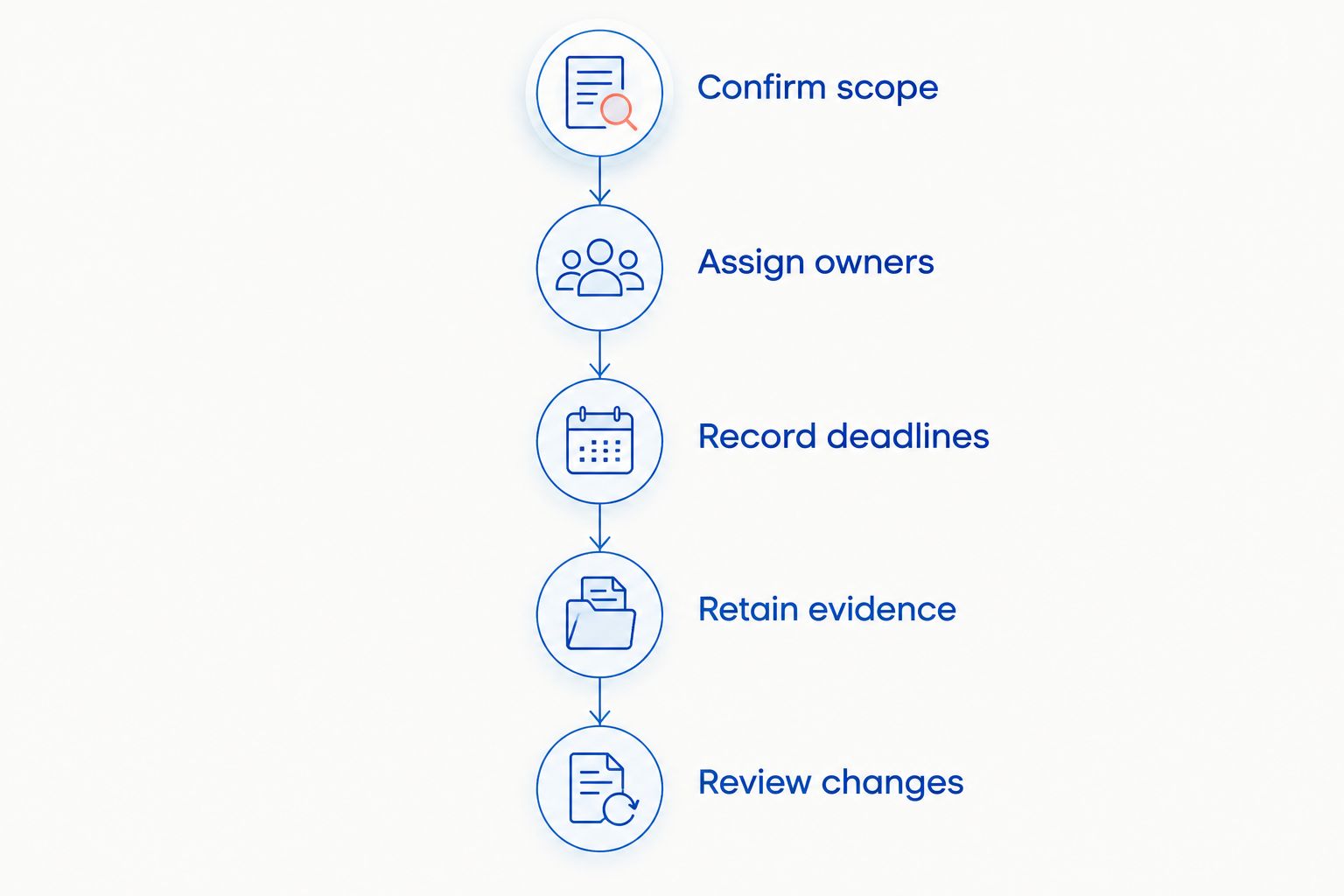
For your 2026 review, use a repeatable sequence rather than a folder of disconnected certificates:
- Confirm scope: List the legal entity, activities, locations, ownership and workforce.
- Assign owners: Name an internal decision-maker and the preparer for each obligation.
- Record deadlines: Capture filing dates, confirmation dates and change-triggered actions.
- Retain evidence: Keep submissions, receipts, approvals and supporting calculations together.
- Review changes: Reassess the register when the business changes.
This process separates responsibility from execution. An external service provider can prepare or coordinate work, but your company still needs visibility over what was submitted and what remains outstanding.
Gofico's positioning covers company formation, PRO support, compliance and consulting for foreign investors. Define the required service scope explicitly: government submissions, accounting support and legal advice are not interchangeable descriptions.
Which official sources should guide your review?
Use the responsible authority's current guidance and your entity's official records together. A general explainer cannot determine every company-specific requirement.
- Ministry of Commerce: Commercial registration confirmation, company records and statutory submission requirements.
- MISA: Investment registration and applicable foreign-investment requirements.
- ZATCA: Tax registration, returns, withholding and electronic invoicing requirements.
- HRSD, Qiwa and GOSI: Employment administration, localisation and social insurance requirements.
- SAIP: Trademark applications, ownership records and renewals.
- Relevant sector and municipal authorities: Permissions connected to activities and premises.
Record the date of each official check in your internal compliance register. A saved document without a review date does not show whether a later rule change has been considered.
FAQ
What are the main ongoing compliance obligations for foreign companies in Saudi Arabia?
The main workstreams are commercial registration, investment status, tax, financial reporting, employment and applicable operating approvals. Trademark management is a separate brand-protection consideration. The exact obligations depend on the company’s circumstances.
Does a Saudi commercial registration cover every compliance requirement?
No. Commercial registration does not replace tax filings, employment requirements or activity-specific permissions. Maintain a separate record for each applicable obligation.
Do all foreign companies have the same Saudization requirement?
No. Saudization requirements depend on the applicable classification and workforce circumstances. Review the establishment’s current position through the relevant HRSD and Qiwa services before planning recruitment.
Does every foreign-owned company pay both corporate tax and zakat?
No. Corporate income tax and zakat treatment depend on ownership and the applicable rules. Mixed ownership requires an assessment rather than applying one treatment to the entire company.
Is trademark registration the same as registering a company name?
No. Trademark registration concerns protection of a mark, while commercial registration concerns the business entity. Assess both when introducing a foreign brand into Saudi Arabia.
Can an overseas headquarters handle all Saudi compliance centrally?
Headquarters can coordinate compliance, but Saudi submissions and records must still meet local requirements. Assign responsibility for official portal access, approvals and retained submission evidence.
Can Gofico support setup and ongoing compliance?
Yes. Gofico provides company formation, PRO, compliance and consulting services for foreign investors and entrepreneurs entering Saudi Arabia. Agree the specific scope of support and distinguish service responsibilities from government requirements.
Which compliance priorities should you choose?
Choose a complete register of applicable obligations, not a favourite service or certificate. Start with commercial registration and investment status, then confirm tax, reporting, workforce and operating requirements against your actual business.
For a 2026 review, prepare your registration records, ownership information, activity list and workforce details before requesting support. Contact Gofico to discuss the setup and ongoing compliance scope your Saudi operation requires.
One last thing
Put business changes on the compliance calendar as well as dates. A new shareholder, overseas service payment, employee or location can create a question that no annual reminder captures. Require a compliance check before the change is approved—not after it reaches a government portal.
Related guides
- Business structures for foreign investors in Saudi Arabia
- Licensing options for foreign manufacturers in Saudi Arabia
- Qiwa services for foreign-company HR compliance