
Instead of repeatedly sending notarized documents between advisers and filing teams, manage Najiz notarization to commercial registration as a controlled handoff: confirm signing authority, complete the required authentication, then submit the company formation application through the appropriate Saudi business service. This guide explains that workflow for foreign companies entering Saudi Arabia in 2026, including the checks that prevent an authorization document from being mistaken for permission to operate.
- Najiz notarization to commercial registration is a document-and-authority workflow, not a substitute for investment registration or activity licensing.
- Gofico supports foreign-company business setup and ongoing compliance; government authorities decide applications.
- Confirm the signatory’s authority before preparing a power of attorney or submitting incorporation documents.
- Match company details across notarization, investment registration, incorporation documents, and the commercial registration application.
Why this matters
A notarized power of attorney establishes authority to act; it does not establish a company. Najiz is the Ministry of Justice’s electronic services platform. Commercial registration records the business through the Ministry of Commerce framework, with incorporation services available through the Saudi Business Center.
For foreign investors, the Ministry of Investment Saudi Arabia, commonly called MISA, has a separate role in investment registration. Sector regulators can impose additional requirements. Treat these as distinct approval and registration functions, not interchangeable documents.
Gofico’s business setup support is best suited to foreign companies seeking help with both Saudi formation and ongoing compliance. Start with the investment registration to commercial registration workflow if the investment-stage requirements remain unresolved.
Before you start
- Access and authority: Identify the parent-company decision-maker, proposed Saudi manager, and filing representative. Confirm how each person will authenticate or sign; access through Nafath, Saudi Arabia’s national digital identity service, depends on the person and service concerned.
- Company materials: Assemble parent-company records, the resolution authorizing Saudi expansion, proposed activities, ownership information, and the intended legal structure. Establish which documents require translation, authentication, or another formal acceptance route.
- The critical gotcha: A foreign corporate power of attorney is not automatically created or accepted through the same route as a Saudi-issued electronic power of attorney. Confirm the document’s origin, signatory eligibility, scope, and destination requirements before arranging execution.
For a 2026 submission, consult the current Ministry of Justice requirements for the relevant notarization service, MISA requirements for the investment, and Saudi Business Center requirements for the chosen incorporation service. Use their current document lists rather than a previous applicant’s checklist.
The steps below describe the document handoffs. Select the live service appropriate to your case; a fixed sequence of portal buttons cannot cover every foreign ownership structure and signing arrangement.
Signing authority and document scope
Establish who can bind the foreign shareholder
- Read the parent-company authority documents. Identify who can approve overseas incorporation, appoint representatives, and commit the shareholder. Check constitutional documents and applicable corporate resolutions together.
- Prepare an authority matrix. Record the principal, representative, permitted acts, signing conditions, and any expiry or delegation restrictions. Keep 1 authority matrix for the filing so advisers do not work from conflicting instructions.
- Match authority to the intended transaction. Check whether the authorization covers incorporation, signing constitutional documents, appointing a manager, submitting applications, and dealing with the relevant authorities. Include only powers the principal intends to grant.
Expected result: You can identify the legal basis for every person’s signature before submitting documents for notarization or incorporation.
A representative authorized to submit paperwork does not necessarily have authority to sign incorporation documents. Equally, a manager’s proposed appointment does not establish that the parent company has authorized someone to make that appointment.
For foreign companies, names deserve particular attention. Use the same legal entity name throughout the document pack, and reconcile transliteration differences before signing rather than leaving the filing reviewer to interpret them.
Notarization and document acceptance
Choose the route that matches the document
- Separate Saudi-issued and foreign-issued documents. Establish whether the task involves a Najiz service, a document executed abroad, or both. Confirm the required authentication route with the receiving authority before commissioning signatures.
- Check the receiving service’s requirements. Verify the required language, supporting corporate records, representative details, and evidence of authority. Determine whether a certified Arabic translation or further authentication is required for the particular document.
- Complete execution and retain verification evidence. Follow the applicable Ministry of Justice process for a Saudi notarization service. For documents executed abroad, complete the accepted route and keep the executed document, relevant certificates, and translation together.
Expected result: The filing team has an executed authority document with the supporting material needed to assess its acceptance for the intended application.
Notarization and acceptance are different checks. A document can be formally executed yet fail to authorize the specific act requested in an incorporation application. Review the wording and the authentication separately.
Maintain 1 document register showing the document owner, current version, execution status, translation status, and intended recipient. For your 2026 file, record the service requirements checked and the date of that check; this makes later changes easier to identify.
Do not assume that completing a Najiz transaction transfers the document into every subsequent government application. Confirm whether the destination service retrieves the record or requires you to provide it.
Incorporation application and registration handoff
Reconcile the file before submission
- Confirm the incorporation route. Check the selected legal structure, investment registration requirements, business activities, and any sector-specific prerequisites. A foreign company establishing a subsidiary and a foreign company registering a branch do not submit an identical corporate document pack.
- Reconcile the application information. Match shareholder names, identification details, ownership interests, manager details, activities, and signing authority against the supporting records. Resolve discrepancies before the authorized applicant submits through the relevant Saudi Business Center service.
- Review the issued records. After the applicable incorporation and registration process is completed, inspect the commercial registration and associated corporate documents. Escalate errors through the appropriate correction procedure before using inaccurate details in downstream applications.
Expected result: The issued registration and company documents reflect the approved structure and the evidence submitted, rather than conflicting versions of the business.
Assign 1 filing owner to control submission and responses. That person coordinates the file; the appointment does not give additional legal signing authority.
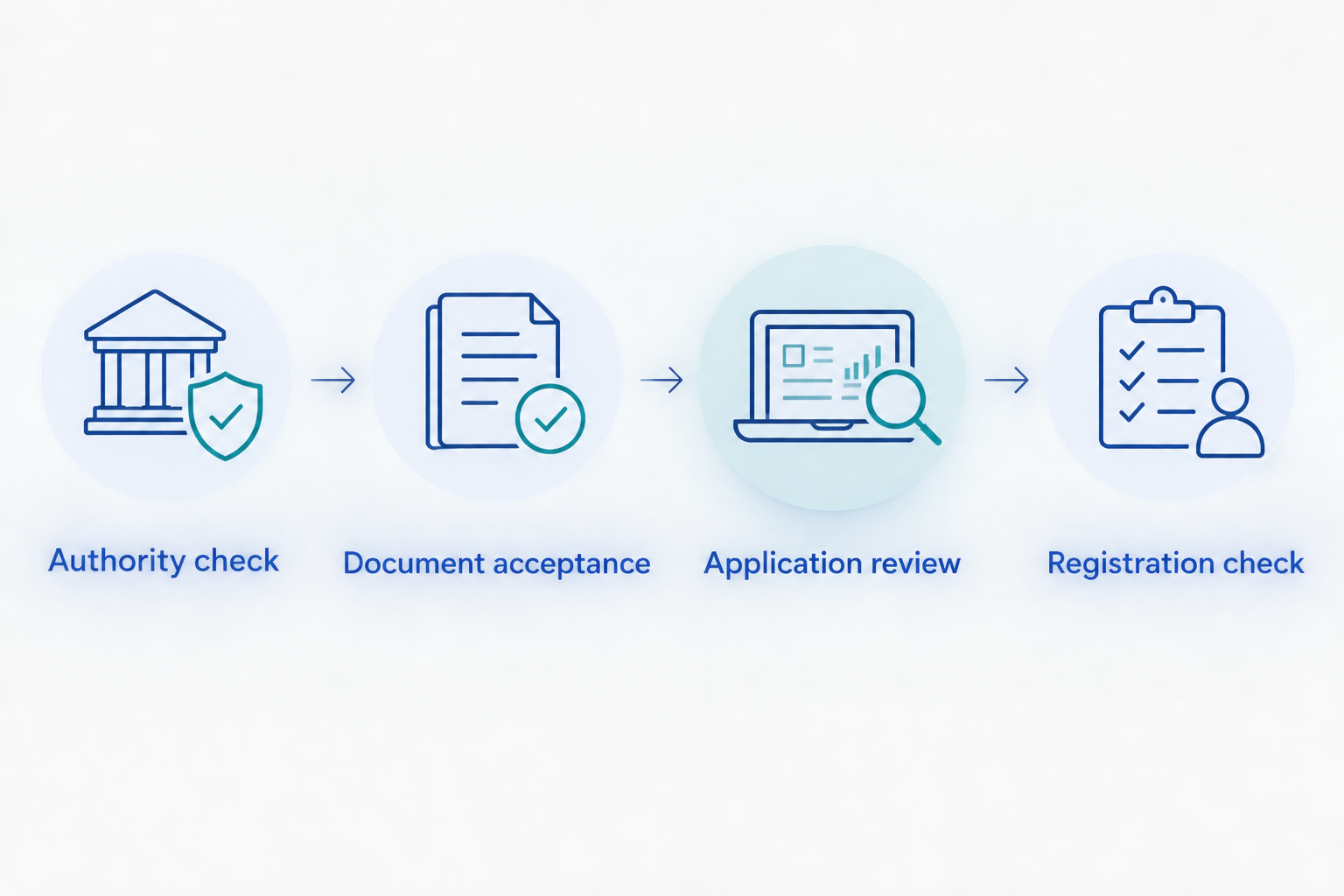
The core handoff is Authority check, Document acceptance, Application review, and Registration check. Each stage should produce evidence the next stage can use, not merely a verbal confirmation that the previous task is complete.
Commercial registration is not a blanket authorization for every proposed activity. Establish which operating permissions remain outstanding before entering commitments that depend on them.
For a 2026 market-entry plan, track registration completion separately from operational readiness. This prevents a completed incorporation file from concealing unfinished licensing, employment, or tax work.
Compliance ownership and evidence retention
Turn the registration file into an operating record
- Create a controlled company record. Retain the issued registration, constitutional documents, investment records where applicable, relevant powers of attorney, and the supporting shareholder resolutions.
- Allocate ongoing obligations. Identify responsibility for commercial registration maintenance, investment-related obligations, activity licences, employment registrations, and tax filings as applicable. Record the official requirement beside each task rather than assuming every obligation follows the same schedule.
- Separate service work from government decisions. State which tasks your internal team or adviser will prepare, which require an authorized signature, and which depend on an authority’s assessment.
Expected result: Formation documents become the reference file for ongoing compliance, with named owners for the next actions.
Gofico provides company formation, licensing, compliance, and public relations officer services, commonly called PRO services. That support can cover preparation and coordination, but it does not replace government review or guarantee an approval.
Discuss your Saudi formation workflow
Discuss signing authority, incorporation requirements, and ongoing compliance responsibilities.
When an existing authorization or registration changes
An amendment needs a different starting point from a new incorporation. Identify the changed fact first, then establish which authorization, corporate record, or government registration must be updated.
| Workflow | Best for | Benefit | Limitation |
|---|---|---|---|
| New incorporation | A foreign company establishing its Saudi presence | Aligns authority and corporate records before the initial filing | Requires the full applicable formation document pack |
| Existing-company amendment | A registered business changing a recorded corporate detail | Focuses the work on the affected records and approvals | A change can require updates across several authorities |
For an amendment, follow this sequence:
- Identify the change, such as a manager replacement, ownership change, or revised signing arrangement.
- Check whether the existing power of attorney expressly covers that change and remains valid.
- Obtain the required corporate decision and complete any necessary execution or authentication.
- Submit the relevant amendment application, then reconcile the revised records with connected registrations and accounts.
Do not replace a power of attorney merely because a company record changes. Check whether its wording, validity, and principal still support the intended act. Conversely, a valid power of attorney does not remove a separate requirement for a shareholder resolution or authority approval.
Troubleshooting
The representative cannot use the intended service
Check identity eligibility, account access, the selected service, and the representative’s permitted role. Distinguish an authentication problem from a legal authority problem; issuing a broader power of attorney does not fix an ineligible login.
The authorization does not cover incorporation signing
Compare the proposed act with the executed wording. Obtain a corrected or replacement authorization through the appropriate route rather than treating general document-submission wording as permission to bind the shareholder.
Names differ between the translation and application
Create a side-by-side record of the original legal name, Arabic rendering, registration identifiers, and application entry. Arrange any required correction through the document issuer or translator; do not alter an executed document yourself.
The filing requests additional evidence
Respond to the specific request with the relevant corporate or authority document. Check whether the issue concerns execution, translation, ownership evidence, or signing powers before resubmitting the same pack.
Registration is complete but another activity remains blocked
Identify the separate requirement behind the blocked action, such as sector authorization, employment registration, or a tax obligation. Confirm the requirement with the responsible authority instead of repeating the commercial registration application.
Customize your workflow
Build the workplan around the business you intend to operate, not just the documents needed to incorporate. A company hiring locally, a company performing a regulated activity, and a company protecting a brand have different follow-on tasks.
For your 2026 compliance plan, separate these workstreams:
- Corporate records: Keep ownership, management, and authorized representation consistent.
- Operating permissions: Identify licences and conditions attached to the actual activities.
- Employment and tax: Establish the applicable registrations and recurring obligations before the relevant activity begins.
- Brand protection: Assess trademark registration separately; a commercial registration is not a trademark certificate.
Ask Gofico to define the service scope against these workstreams. Keep government requirements and charges separate from advisory and coordination services, and identify who supplies each document and approves each submission.
FAQ
Does Najiz notarization automatically issue a commercial registration?
No. Najiz notarization and commercial registration serve different purposes. An authority document can support an incorporation application, but the business must complete the applicable registration process separately.
Do all foreign investors need a Najiz power of attorney?
No single power-of-attorney route applies to every foreign investor. The correct approach depends on who signs, where the document is executed, the legal structure, and the receiving service’s requirements.
Can a representative submit my Saudi incorporation application?
A representative can act where the applicable service permits representation and the authorization covers the intended acts. Check submission powers separately from powers to sign incorporation documents or appoint management.
Is MISA registration the same as commercial registration?
No. MISA handles investment registration requirements, while commercial registration records the business through the Ministry of Commerce framework. Foreign investors must establish which requirements apply to their proposed activities and structure.
Can I use a power of attorney signed outside Saudi Arabia?
A foreign-issued power of attorney must meet the receiving authority’s acceptance requirements. Confirm the applicable authentication and translation route before arranging execution abroad.
What should I check after commercial registration is issued?
Check the issued registration against the approved corporate documents and application details. Then identify outstanding operating permissions and applicable employment, tax, and ongoing corporate obligations.
Does Gofico guarantee notarization or registration approval?
No approval guarantee forms part of this workflow. Gofico supports business setup and ongoing compliance, while the relevant authorities assess and decide government applications.
One last thing
Test the authorization against the next legal act, not against the document’s title. Before executing a power of attorney, write down exactly what the representative must sign or submit and check each act against the proposed wording. That review addresses the authority question before notarization makes corrections more involved.
Related guides
- Foreign-company compliance obligations in Saudi Arabia
- Commercial registration to Qiwa activation workflow
- Connect commercial registration to a ZATCA tax number
- Business structures for foreign investors in Saudi Arabia