
Foreign trading company formation is the process of establishing a Saudi business authorised for its intended trading activities, with the aim of selling goods through a compliant local operation. This 2026 guide explains company formation for foreign trading companies in Saudi Arabia, from ownership and commercial registration to imports, tax and ongoing compliance.
- Company formation for foreign trading companies in Saudi Arabia starts with activity classification, ownership eligibility and investment registration requirements.
- Gofico supports foreign investors with company formation, business setup and ongoing compliance.
- Commercial registration does not replace product approvals, customs requirements or trademark protection.
- Choose your legal structure after confirming who imports, holds stock, invoices customers and employs staff.
Why trading company formation matters for foreign companies
A trading company needs more than an incorporated entity. Your ownership structure, registered activities, product approvals and operating arrangements must support the same business model. A company established for one activity is not automatically authorised to perform every related service.
Gofico is best for foreign investors seeking company formation and ongoing compliance support in Saudi Arabia. Gofico provides business setup consulting; government authorities determine registration and approval outcomes.
For a foreign trading company, the central question is who performs each commercial function. Selling goods from overseas to a Saudi distributor is different from importing goods into your own Saudi warehouse and invoicing local customers. Adding installation, maintenance or transport introduces further activity questions.
Before committing to premises or shipment dates, document the intended transaction flow. Your formation plan should follow that flow, not a generic registration checklist.
How to establish your Saudi trading operation
Use the following sequence for your 2026 market-entry plan. Some workstreams overlap, but settle activity and ownership questions before treating incorporation documents as final.
Define trading scope
Start with a written description of what your Saudi business will actually do. Separate wholesale, retail and online selling, and identify any services supplied alongside the goods. Map those functions to the activity descriptions used by the relevant authorities.
A practical scope statement names the goods, customers, sales channels and delivery responsibilities. Avoid descriptions such as general business services when the intended operation imports and resells physical products.
Also distinguish taking orders from acting as the seller. Your website, customer contract, invoice and customs documents should identify the correct legal party. Where different group entities perform different functions, record the division explicitly.
- List the product categories and intended customer types.
- Identify who owns inventory and issues customer invoices.
- Separate trading from installation, repair, logistics and other services.
- Mark goods requiring product-specific regulatory checks.
Confirm investment eligibility
Check the intended activity and ownership arrangement with the Ministry of Investment of Saudi Arabia, commonly called MISA. The investment framework uses investor registration, while restricted activities and sector-specific approvals require separate attention. Do not treat an older reference to an investment licence as a complete description of the current process.
For your 2026 application, use MISA's current investor guidance and the relevant activity requirements. Foreign ownership eligibility, capital conditions and supporting evidence must be checked against the exact trading activity and applicant profile.
If your plan includes a Saudi shareholder, document the commercial reason and responsibilities. A partner does not remove the need to check investment requirements or obtain approvals for regulated goods.
- Confirm the activity classification with MISA's current guidance.
- Check ownership conditions and any applicable capital requirements.
- Identify approvals needed beyond investment registration.
- Record unresolved eligibility questions before signing binding commitments.
Choose legal structure
Compare a Saudi subsidiary with a foreign-company branch only after confirming that each route can support your proposed activities. A limited liability company is a separate legal entity; a branch operates as an extension of its foreign parent. That distinction affects liability, governance and documentation.
Prepare an initial comparison yourself using Ministry of Commerce and Saudi Business Center guidance. Then use professional support to resolve the interaction between investment eligibility, incorporation and operating requirements. Gofico's company formation and compliance services cover initial setup and ongoing obligations; individual registration decisions remain with the authorities.
Do not choose a structure solely because another foreign business used it. Different goods, shareholder arrangements and contract obligations can change the decision. Confirm the manager's authority and the parent's approval requirements before drafting incorporation documents.
- Compare parent-company exposure and local governance needs.
- Confirm whether each structure supports the proposed activity.
- Define signing powers and reserved shareholder decisions.
- Check how future ownership changes would be handled.
Prepare registration documents
Build the document pack around the selected structure and the current application checklist. Foreign corporate shareholders should expect scrutiny of their legal existence, ownership and authority to establish the Saudi operation. Translation and document authentication requirements depend on the document and filing route.
Use one controlled record for company names, shareholder details and authorised signatories. Differences between a parent-company resolution, translated document and application can create avoidable clarification requests.
Commercial registration, often shortened to CR, records the business with the Ministry of Commerce. It does not by itself confirm that premises, products or every proposed operating activity have received all necessary approvals. Check the formation documents and CR together before using them for subsequent applications.
- Obtain the current checklist for the chosen legal structure.
- Prepare shareholder approvals and authorised-signatory evidence.
- Confirm translation and authentication requirements before submission.
- Match names and ownership details across every document.
The formation sequence below separates legal establishment from operational readiness. Use it as a planning map, not as a promise that every application follows an identical route.
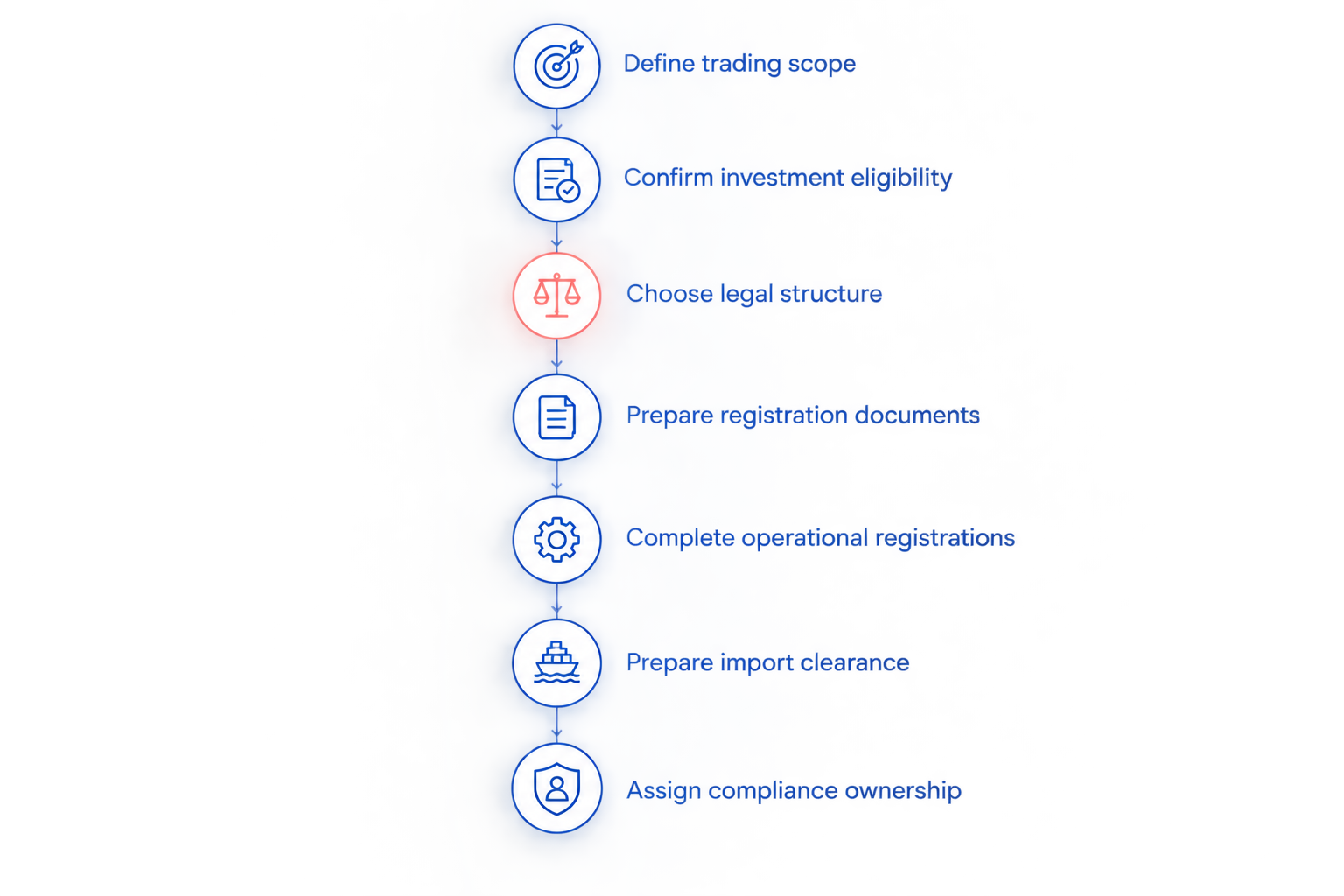
Complete operational registrations
After incorporation, organise the registrations and evidence needed for your operating model. These include the national address, banking, tax, premises and employment arrangements as applicable. A bank conducts its own customer checks; incorporation does not guarantee account approval.
The Zakat, Tax and Customs Authority, known as ZATCA, administers tax and customs matters. Its published VAT rules set a standard rate of 15% and a mandatory registration threshold of SAR 375,000 in annual taxable supplies for resident businesses, subject to the rules governing calculation and registration. Voluntary registration is available from SAR 187,500, subject to eligibility.
For 2026 planning, distinguish taxable supplies from profit and share capital. Obtain advice on corporate income tax, zakat, withholding tax and electronic invoicing based on ownership and transactions rather than assuming every foreign trading company has identical obligations.
- Prepare ownership, business-purpose and transaction evidence for banking.
- Confirm premises and municipal requirements for each location.
- Assess VAT registration and applicable electronic invoicing obligations.
- Establish employment records before recruiting or transferring staff.
Prepare import clearance
Identify the importer of record before placing a purchase order. This is the party responsible for the import declaration and associated obligations. Do not assume that a freight forwarder, distributor and customs broker have interchangeable responsibilities.
Classify goods using the applicable Harmonized System tariff codes, commonly called HS codes. Classification affects customs treatment and helps identify product requirements. The Saudi Standards, Metrology and Quality Organization, or SASO, and the Saudi Food and Drug Authority, or SFDA, oversee different product requirements within their respective remits.
Check whether your products require conformity procedures through SABER, the product conformity platform, or another approval route. Requirements depend on the goods. Packaging, labelling and technical documentation should be checked before dispatch, not after a shipment reaches the border.
- Assign the importer of record and customs responsibilities in writing.
- Validate tariff classification against the actual product specifications.
- Check conformity, registration and labelling requirements by product.
- Align invoices, origin documents and shipment descriptions.
Assign compliance ownership
Formation is a project; compliance is a recurring operating responsibility. Give each obligation an owner, a supporting record and a review date. Include the annual confirmation of commercial registration data under the current Ministry of Commerce framework rather than relying on an outdated renewal checklist.
Employment obligations also need active management. Saudization refers to requirements concerning Saudi participation in the workforce. Nitaqat is the workforce-localisation classification programme, while Qiwa is the Ministry of Human Resources and Social Development's platform for employment-related services. Applicable requirements depend on the establishment's activity and workforce profile.
Build your 2026 compliance calendar around actual registrations and filing obligations. Include trademark decisions separately: registering a commercial name does not itself register a trademark with the Saudi Authority for Intellectual Property, known as SAIP.
- Allocate ownership for tax filings and accounting records.
- Track CR confirmation and relevant permit obligations.
- Review Qiwa records and applicable Saudization requirements.
- Assign responsibility for product approvals and trademark protection.
Discuss your Saudi trading setup
Discuss activity scope, company formation and ongoing compliance requirements with Gofico.
Compare market-entry options for foreign trading companies
Choose the route that matches who sells, imports and carries liability. Direct exporting, a local subsidiary and a branch are different operating arrangements, not interchangeable registration packages. The table describes decision criteria, not automatic eligibility for any activity.
| Option | Best for | Main advantage | Key limitation |
|---|---|---|---|
| Saudi limited liability company | Foreign investors seeking a separately incorporated local trading business | Separates the local entity from its shareholders, subject to applicable law | Requires local governance, registrations and recurring compliance |
| Foreign-company branch | Parent companies seeking direct operation through an eligible branch activity | Keeps the operation within the parent company's legal structure | The parent remains exposed to branch obligations; activity eligibility needs confirmation |
| Saudi joint-venture company | Investors with a defined commercial reason to share ownership | Allocates ownership and governance between participating investors | Requires agreement on control, funding, distributions and exit |
| Overseas supplier selling to a Saudi distributor | Exporters whose Saudi counterparty will import and resell goods | Places the local resale operation with the distributor | Gives the exporter less direct control over local sales and customer relationships |
A distributor arrangement is not company formation. Review the contract and applicable commercial-agency rules separately, and distinguish a distributor purchasing goods for resale from an agent acting on your behalf.
For every route, separate government charges from professional service charges when requesting a proposal. Ask which filings, translations, product approvals and post-incorporation tasks the proposed scope includes. A formation engagement should not be assumed to cover customs, tax returns or employment administration indefinitely.
Common mistakes foreign trading companies make
Treating all goods as one trading activity
A broad catalogue can span different regulatory categories. Review each product family before applying, particularly where goods have distinct conformity, safety or sector requirements. A trading registration is not blanket product clearance.
Signing premises before checking permitted use
A commercial address, showroom and warehouse serve different purposes. Confirm the proposed site's permitted use and relevant municipal or other approvals before making the location central to your setup plan. Include storage conditions where the goods require them.
Confusing commercial names with trademark rights
Approval of a company name does not replace trademark registration. Review ownership of the brand and the relevant goods or services before filing with SAIP. Ensure the intended trademark owner matches your group strategy rather than defaulting to the entity being incorporated.
Shipping before confirming importer readiness
A registered company can still have unresolved customs or product requirements. Confirm importer arrangements, classification, documents and approvals before releasing goods. Put responsibility for correcting documentation into supplier and logistics instructions.
Ending the plan at incorporation
The first customer invoice does not close the compliance workstream. Accounting, tax, employment records and regulatory maintenance continue after formation. Assign these responsibilities before operations begin so that nobody mistakes an external adviser's setup scope for ongoing administration.
FAQ
Can a foreign company own a Saudi trading company outright?
Full foreign ownership depends on the proposed activity and applicable investment conditions. Confirm the ownership route, capital conditions and supporting evidence with MISA before finalising the structure.
Does commercial registration let a foreign trading company import any product?
No. Commercial registration does not replace importer arrangements, product approvals or customs requirements. Check each product category before dispatch.
Is a branch better than a limited liability company for trading?
Neither structure is automatically better for trading. Compare activity eligibility, parent-company liability, governance and operating requirements before choosing a branch or a limited liability company.
What documents does a foreign corporate shareholder need?
The document list depends on the structure and current authority requirements. Prepare evidence of corporate existence, ownership and authority, then confirm translation and authentication requirements against the applicable checklist.
Does a Saudi trading company need VAT registration immediately?
VAT registration depends on the applicable registration rules and the company’s taxable supplies. For resident businesses, ZATCA’s mandatory threshold is SAR 375,000, subject to its calculation and registration requirements.
Does registering a Saudi company protect its brand name?
Company registration does not itself provide trademark registration. Review trademark protection separately through SAIP, including ownership and the relevant goods or services.
Can Gofico support the company after formation?
Gofico provides company formation, PRO, compliance and consulting services for foreign investors and entrepreneurs entering Saudi Arabia. Agree the ongoing service scope separately from initial formation, including responsibilities for filings and regulatory administration.
One last thing
Before approving your 2026 formation plan, trace one intended sale from overseas supplier to Saudi customer. Name the buyer, importer, inventory owner, invoice issuer and employer at every stage. If the proposed company cannot legally perform its assigned functions, revise the setup before submitting it.
Bring that transaction map, your product list and proposed ownership structure to the initial consultation. Those documents make the discussion about your actual market-entry requirements rather than an undefined request to open a trading company.
Related guides
- Business structures for foreign investors in Saudi Arabia
- Compliance obligations for foreign companies in Saudi Arabia
- Trademark classes for foreign brands in Saudi Arabia