
Foreign real estate investors’ business setup in Saudi Arabia is the process of establishing an authorised business with the aim of carrying out eligible property investment or real estate activities. Your setup must address both the company’s permitted activities and the proposed property transaction; company formation alone does not establish property ownership eligibility.
- Business setup for foreign real estate investors in Saudi Arabia requires separate checks for company formation and property eligibility.
- Gofico suits foreign investors seeking business setup and ongoing compliance support, not a substitute for property-specific legal advice.
- Define your real estate activity before choosing an entity or submitting registration applications.
- Confirm ownership eligibility, sector permissions and banking evidence before committing to a property transaction.
Why business setup matters for foreign real estate investors
A registered company and an eligible property investment are different things. Buying an asset, developing land, managing buildings and brokering transactions raise different regulatory questions. Start with the intended activity, not a preferred company name.
For your 2026 market-entry plan, separate 3 checks: investor eligibility, business activity permissions and property eligibility. A positive answer to one does not resolve the others. This distinction belongs in your investment approval process before you commit to acquisition or operating arrangements.
Gofico provides business setup and ongoing compliance support for foreign investors. Gofico is best for foreign investors seeking coordinated formation and compliance support. Property title, contractual protections and transaction-specific legal opinions require their own professional review.
Use current official requirements from the Ministry of Investment of Saudi Arabia (MISA), the Ministry of Commerce and the Real Estate General Authority (REGA). Check the applicable rules for your particular investor, activity and location rather than treating a general market-entry summary as transaction approval.
How to structure your Saudi real estate business setup
1. Define what your business will actually do
Write a short operating description before selecting an entity. Distinguish investing for your own account from providing services to other owners. Also separate asset ownership from construction, development, leasing, brokerage and property management.
Describe the revenue-generating activity precisely. For example, holding a building and earning rental income is not the same operating model as arranging transactions for clients. Your application wording, contracts and compliance plan should reflect the actual business rather than a broad label such as real estate investment.
Prepare an activity brief containing:
- The assets or services your business intends to provide.
- Whether you will act for yourself or third-party clients.
- The intended cities and identifiable property locations.
- The entities that will sign contracts and receive revenue.
2. Verify investor and property eligibility separately
Check the current MISA investor registration requirements and any applicable activity restrictions before preparing the incorporation application. Do not assume that older descriptions of investment licensing match the process applicable to your case in 2026.
Separately, obtain confirmation of the rules governing the proposed property interest. Foreign ownership questions depend on the applicable framework, location, investor status and transaction structure. A company registration document should not be treated as evidence that a particular acquisition is permitted.
Ask your advisers to document the legal basis for each conclusion and identify unresolved conditions. Where an authority’s confirmation is needed, keep the response with the transaction file rather than relying on an informal explanation.
- Confirm the foreign investor’s eligibility for the proposed activity.
- Identify the applicable property ownership or acquisition conditions.
- Check location-specific restrictions and competent authorities.
- Record approvals or confirmations needed before signing or completion.
3. Choose the entity around control and obligations
Compare an incorporated Saudi entity with a branch where the proposed activity and investor circumstances permit either route. Consider contractual liability, parent-company exposure, governance, funding and eventual exit. Do not choose solely because one route appears simpler to register.
A special-purpose entity describes a company’s intended role; it does not remove ordinary registration or sector obligations. If you plan separate entities for different assets, explain the commercial purpose and confirm the resulting accounting, reporting and administration requirements.
Start manually with a decision sheet reviewed by your corporate and tax advisers. Gofico’s business setup services provide a coordinated route for formation and compliance support; property-specific legal conclusions remain a separate requirement.
- Map shareholders, ownership percentages and controlling parties.
- Identify who can approve borrowing, acquisitions and disposals.
- Compare parent-company exposure across eligible structures.
- Document funding arrangements and the intended exit route.
4. Build a registration and permission sequence
Create a dependency map before submitting applications. Distinguish MISA requirements, incorporation, commercial registration and any permissions attached to the actual real estate activity. A commercial registration identifies the registered business; it should not be treated as blanket permission for every property-related service.
For your 2026 filing plan, verify the current submission sequence with the relevant authorities. Brokerage, property management, development and construction should each receive an activity-specific review where they form part of your model.
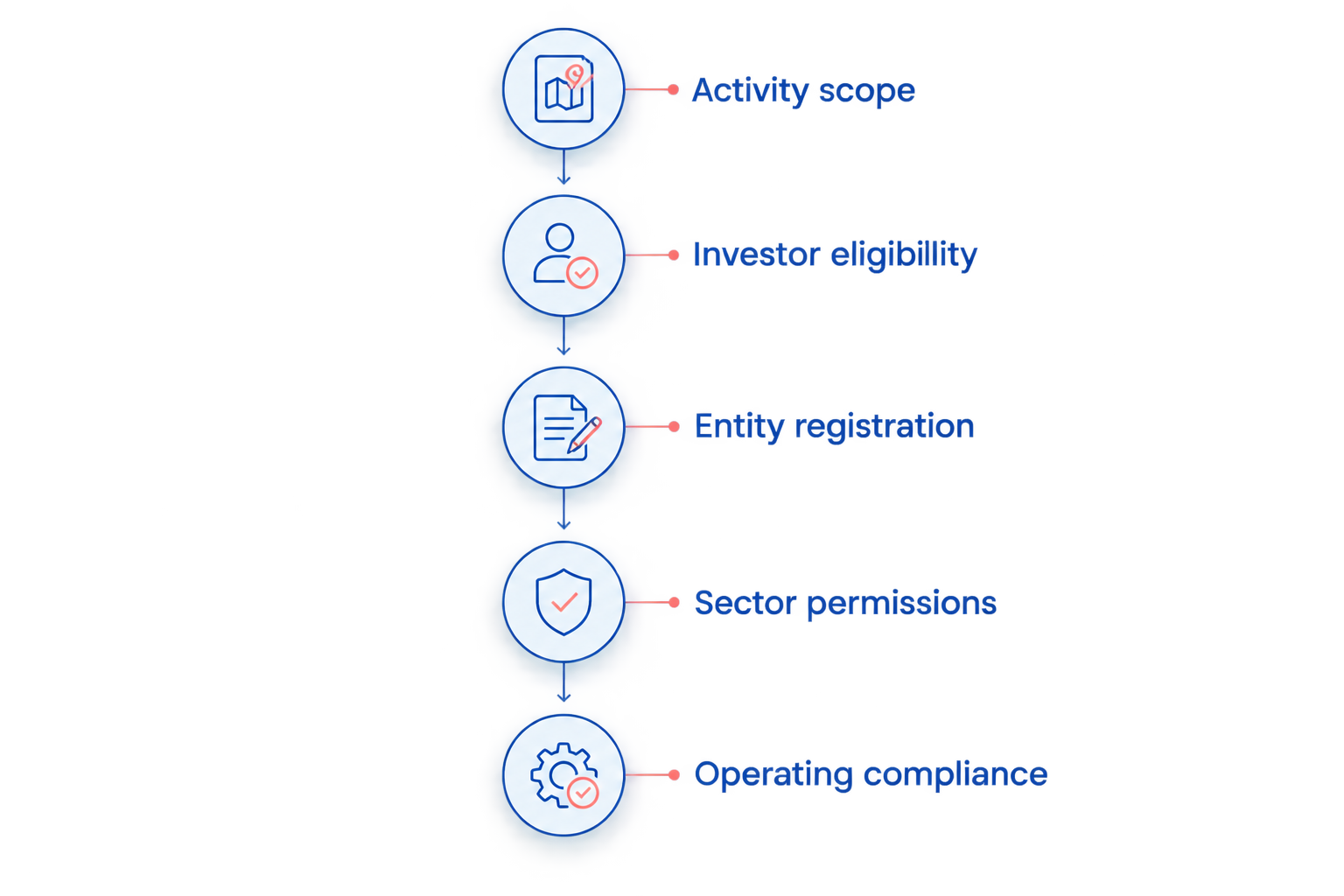
Organise the work under 5 headings: Activity scope, Investor eligibility, Entity registration, Sector permissions and Operating compliance. These are planning checkpoints, not a claim that every project follows an identical government process.
- Confirm the activity descriptions used in applications.
- List documents requiring translation, authentication or further evidence.
- Identify permissions administered by REGA or other competent bodies.
- Assign responsibility for each submission and authority response.
- Record conditions that must be satisfied before operations begin.
5. Prepare property and banking evidence together
Build a transaction file that explains who is investing, where the funds originate and how the proposed transaction relates to the registered activity. Banks conduct their own customer and transaction checks. Company formation does not guarantee account opening or acceptance of a particular transfer.
Have the property reviewed independently for title, permitted use, contractual rights and transaction conditions. Keep acquisition assumptions separate from verified documents, especially where the intended use depends on a permission or an unresolved issue.
A practical preparation method is to maintain 2 linked folders: one for corporate and banking evidence, and one for property due diligence. Cross-reference the contracting entity and authorised signatories in both.
- Prepare the ownership chart and beneficial ownership information.
- Collect source-of-funds and proposed funding documentation.
- Verify title evidence and the seller’s authority to transact.
- Review permitted use and any development or operating conditions.
- Align signing authority across banking and transaction documents.
6. Assign tax, employment and payment responsibilities
Set up a responsibility matrix before the business receives income or hires staff. The Zakat, Tax and Customs Authority (ZATCA) administers relevant tax and zakat obligations; determine the treatment applicable to your ownership structure and activities. Do not assume that every property transaction or income stream receives identical treatment.
For your 2026 operating plan, obtain advice on registration, invoicing, record retention and filing obligations. If you employ staff, review requirements administered by the Ministry of Human Resources and Social Development (HRSD), including applicable Saudization obligations. Saudization concerns the employment of Saudi nationals under the relevant workforce rules; Qiwa is an HRSD platform used for employment-related services.
For overseas funding and supplier payments, the choice of cross-border payment platforms belongs alongside banking, reconciliation and supporting-document controls. A payment channel does not resolve whether the underlying transaction is permitted or correctly recorded.
- Assign an owner for each applicable registration and filing.
- Confirm transaction-specific tax treatment before execution.
- Establish invoice, accounting and document-retention procedures.
- Check employment and Saudization obligations before recruitment.
- Define approvals and evidence for cross-border transfers.
7. Maintain compliance after incorporation
Treat incorporation as the start of the operating calendar. Changes in ownership, management, business activities or property use need review against the company’s registrations, permissions and contracts. An investment plan can change faster than the documents supporting it.
Maintain a 12-month compliance calendar with responsibilities, submission dates and evidence of completion. Use the actual deadlines applicable to your entity, not a generic schedule copied from another business.
Gofico’s business setup and compliance support covers initial establishment and ongoing obligations. Define the engagement scope in writing, including which matters remain with your accountant, property lawyer or internal team.
- Track applicable filings, confirmations and permission renewals.
- Review ownership and authorised-signatory changes before implementation.
- Reconcile registered activities with actual income-generating work.
- Retain submission receipts and supporting records centrally.
- Reassess compliance when acquiring another asset or adding services.
Compare support options for your investment
Choose support according to the unresolved risk, not just the volume of paperwork. You can use official channels directly, but application administration and legal judgement are different tasks. A provider’s scope should identify both what it handles and what it excludes.
| Option | Best for | Practical advantage | Key limitation |
|---|---|---|---|
| Direct official applications | Investors with an experienced internal team | Keeps application handling under your control | Your team must interpret requirements and coordinate dependencies |
| Gofico formation and compliance support | Foreign investors seeking coordinated market-entry administration | Connects initial setup with ongoing compliance support | Does not replace property-specific legal or tax advice |
| Saudi property legal counsel | Investors assessing a particular acquisition or lease | Addresses title, contractual protections and transaction eligibility | The engagement does not automatically include company administration |
| Internal finance team with tax advisers | Investors planning funding, reporting and distributions | Connects transaction records with tax and accounting obligations | Does not replace sector permissions or property due diligence |
Before appointing support, ask for a written allocation of responsibilities. Government requirements remain separate from the provider’s services. No adviser’s engagement should be read as a promise of regulatory approval.
Discuss your Saudi market-entry plan
Clarify your proposed activity, ownership structure and formation and compliance support needs.
Common mistakes foreign real estate investors make
Treating incorporation as acquisition permission
A company’s existence does not answer whether it can acquire a particular property interest. Resolve property eligibility separately, and record the conditions that must be met before the transaction proceeds.
Registering a holding activity while planning client services
Owning an asset is different from earning fees by managing or arranging transactions for others. Match registrations and permissions to the actual work, including services introduced after the initial setup.
Signing before identifying the correct buyer
The overseas parent, Saudi subsidiary and another investment entity are not interchangeable contracting parties. Settle the intended buyer, funding route and signatory authority before executing documents, with legal advice on any conditional arrangements.
Leaving operating obligations until after the first transaction
Accounting, tax treatment, employment requirements and filing responsibilities affect the operating model. Include them in your 2026 investment approval process rather than assigning them after revenue starts.
FAQ
Can a foreign investor set up a real estate company in Saudi Arabia?
A foreign investor must establish eligibility for the proposed activity and satisfy the applicable registration and permission requirements. Company formation and eligibility to acquire a particular property require separate review.
Does commercial registration let my company buy any Saudi property?
No. Commercial registration does not establish eligibility to acquire every property. Check the applicable ownership framework, location and transaction conditions before committing.
Should I choose a Saudi company or a branch for real estate investment?
Choose between eligible structures based on the activity, liability, governance, funding and exit plan. Confirm that the proposed route is available for your circumstances before comparing administrative convenience.
Do I need separate permissions for brokerage and property ownership?
Assess brokerage and property ownership separately because they are different activities. Confirm the requirements for each proposed activity with the competent authorities, including REGA where applicable.
What documents should I prepare before approaching a bank?
Prepare corporate records, ownership information, signatory evidence and documents explaining the source and purpose of funds. The bank determines its own requirements and whether to accept the relationship or transaction.
What should my company check after incorporation?
Check applicable tax, accounting, employment, sector and corporate filing obligations. Assign responsibility for each obligation and maintain evidence of submissions and approvals.
Who should coordinate formation and property due diligence?
Appoint a lead coordinator while keeping corporate administration, property legal advice and tax responsibilities explicit. A shared responsibility matrix helps prevent an important issue from falling outside every adviser’s scope.
One last thing
Test your intended exit before committing to the entry structure. Ask who would sell the asset or company interest, which approvals need checking and what records a future buyer would require. An entity that is straightforward to establish still needs an ownership and documentation structure that supports your investment plan.
Related guides
- Business structures for foreign investors in Saudi Arabia
- Compliance obligations for foreign companies in Saudi Arabia
- Bank account types for foreign companies in Saudi Arabia