
Foreign fintech startup business setup is the process of establishing a Saudi entity and securing applicable permissions to enter the market legally. Business setup for foreign fintech startups in Saudi Arabia requires separate decisions about company formation, financial regulation, customer funds and ongoing compliance—not just a commercial registration.
- Business setup for foreign fintech startups in Saudi Arabia starts with classifying the activity, not choosing an entity.
- Gofico supports foreign-company formation and ongoing compliance; financial regulatory permission remains a separate requirement.
- Check Saudi Central Bank or Capital Market Authority requirements before committing to a launch model.
- Compare a subsidiary, branch and licensed-provider partnership against your actual operating responsibilities.
Why business setup matters for foreign fintech startups
A foreign fintech startup needs to establish both who will conduct the business and what that business is permitted to do. A company that supplies software to a bank presents a different regulatory question from a company that holds customer balances or arranges investments.
For your 2026 market-entry plan, separate incorporation from permission to conduct financial activities. A commercial registration identifies the business and its registered activities; it does not replace an applicable financial-services authorisation.
Gofico is best suited to foreign fintech founders seeking business setup and ongoing corporate compliance support. Gofico provides company formation, public relations officer services for government procedures, compliance and consulting support. Keep specialist financial-regulatory advice distinct from that corporate setup scope.
Use official sources at each decision point
For a 2026 application, check the current requirements published by the Ministry of Investment, the Saudi Business Center, the Saudi Central Bank and the Capital Market Authority. The relevant authority depends on the activity; a fintech label alone does not establish jurisdiction.
The Saudi Central Bank, commonly called SAMA, oversees areas including banking, payments and finance. The Capital Market Authority, or CMA, regulates securities activities. Their official rules and application materials—not another startup's structure—should guide your activity assessment.
Record the source title, access date and requirement behind each decision. Recheck the relevant official materials before submitting an application or changing the product's scope.
How to set up a foreign fintech startup in Saudi Arabia
Define the financial activity before selecting a licence
Start manually with a 1-page activity brief. Describe what your Saudi business will actually do, which customers it will serve and which legal entity will sign each contract. Avoid descriptions such as financial technology solutions that conceal the underlying service.
Trace both the money and the instructions. Who receives funds, controls transfers, makes credit decisions or places investment orders? These operational facts matter more than whether your product is marketed as software, an app or an infrastructure platform.
Separate the initial launch from later features. A business-to-business software launch does not settle the regulatory position of a future wallet, lending or investment feature.
- Identify each customer group and its location.
- Describe every movement of customer money.
- Name the entity responsible for each financial service.
- Separate launch activities from planned features.
- List customer data collected and where it travels.
Confirm the regulatory perimeter before incorporation commitments
Compare the activity brief against current SAMA and CMA rules. Establish whether the proposed activity requires authorisation, falls within a specific testing framework or is genuinely limited to technology supply. Obtain specialist advice where the classification is unclear.
A regulatory sandbox is a supervised testing arrangement, not a general permission to operate. Admission, permitted activities and testing conditions depend on the relevant authority's framework. Do not describe sandbox participation as unrestricted commercial approval.
For 2026 planning, document the permission required for each activity before signing commitments that assume a particular structure. A licensed partner's authorisation does not automatically cover your startup's independent conduct.
- Identify the authority responsible for each proposed activity.
- Read the applicable licensing or testing framework.
- Check eligibility against the proposed ownership and operating model.
- Document restrictions affecting customer acquisition and transactions.
- Seek clarification before treating an activity as outside regulation.
Choose the entity and ownership structure
First compare a Saudi subsidiary with a branch of the foreign parent. A subsidiary is a separate legal entity; a branch operates as an extension of its parent. The available route must fit the activity, investment requirements and any financial regulator's conditions.
Prepare an ownership chart showing the parent company, shareholders and ultimate beneficial owners—the individuals who ultimately own or control the business. Resolve inconsistencies between corporate records before document preparation begins.
Gofico's business setup services support the company formation and compliance workstream. That support does not replace the financial regulator's assessment, and the engagement scope should clearly identify which specialist matters require separate advice.
- Compare parent-company exposure under each structure.
- Check the proposed structure against regulatory eligibility.
- Prepare the ownership and control chart.
- Identify authorised signatories and their powers.
- Confirm document certification and translation requirements.
Sequence investment registration and company formation
Build a dependency checklist from current official application requirements. Foreign investment registration through the Ministry of Investment, commonly called MISA, is distinct from commercial registration and activity-specific permissions. Check the applicable registration requirements, restricted activities and approval sequence for your proposed business.
Prepare constitutional documents and corporate approvals to match the agreed structure. Names, ownership percentages, business activities and signatory details should remain consistent across applications. Repeated corrections consume management attention even when the underlying business model is sound.
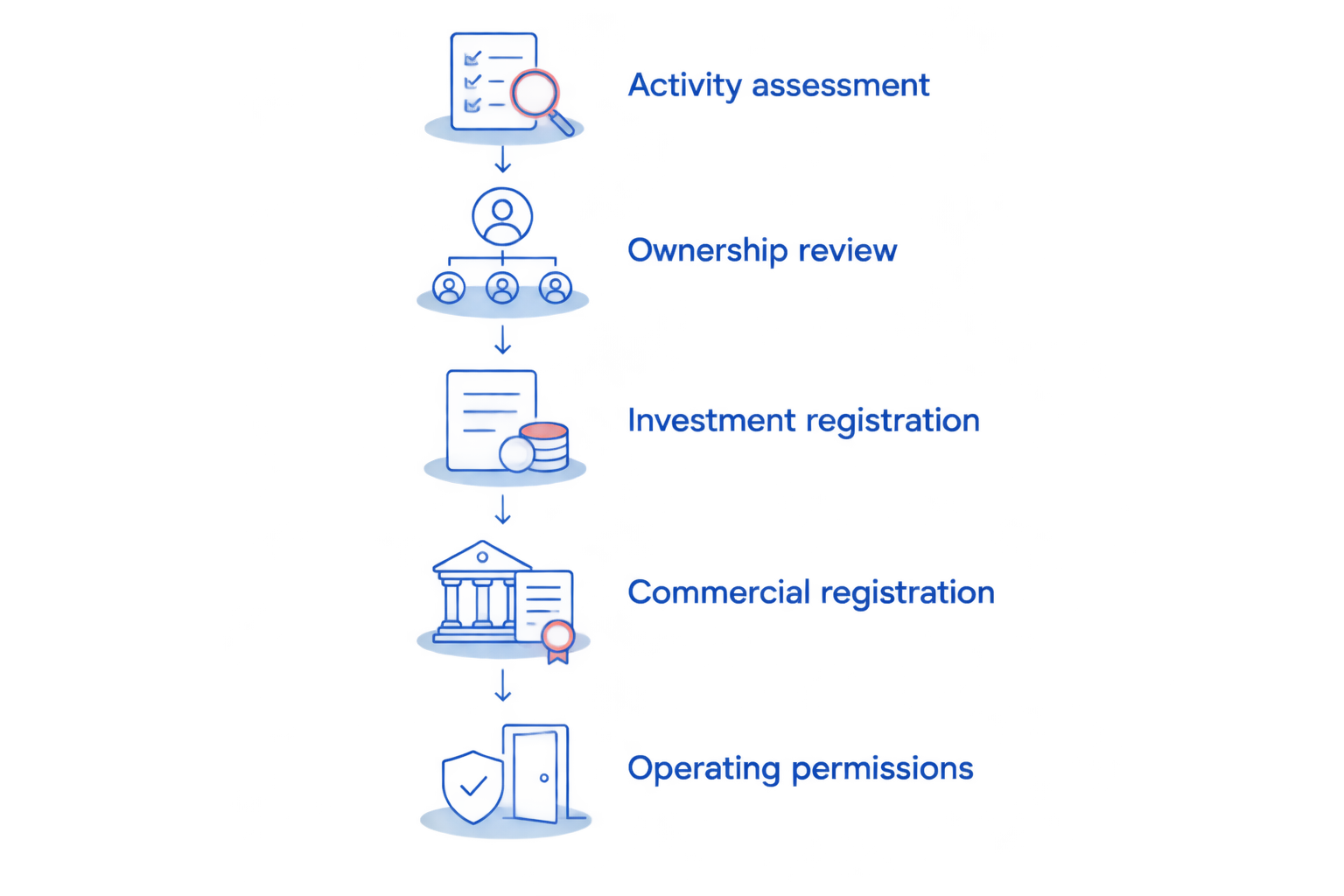
Treat the following diagram as a planning framework, not a universal filing order. Your actual submission sequence must follow the requirements for the chosen activity.
- Activity assessment: establish the proposed regulatory scope.
- Ownership review: confirm investors and control arrangements.
- Investment registration: check the applicable MISA requirements.
- Commercial registration: establish the business registration workstream.
- Operating permissions: identify remaining conditions before launch.
Separate corporate banking from customer-money arrangements
Prepare a corporate account-opening file manually before approaching banks. Explain the business model, ownership, expected transaction types and source of funds. A bank's due-diligence review is separate from company formation and does not itself authorise financial activity.
Distinguish your startup's operating money from any customer funds involved in the product. Safeguarding, settlement and account arrangements must follow the applicable regulatory framework and contractual responsibilities. An ordinary corporate account is not a substitute for those arrangements.
Build a 12-month operating budget covering establishment and recurring obligations. Separate government charges, adviser services, staffing, premises and technology expenditure so that a formation proposal is not mistaken for the full operating commitment.
- Document the purpose of each proposed bank account.
- Explain expected counterparties and transaction flows.
- Prepare ownership and source-of-funds evidence.
- Identify responsibility for customer-money arrangements.
- Separate corporate banking approval from product-launch approval.
Assign compliance ownership before hiring and onboarding
Create an obligations register with a named owner, evidence requirement and review date for each applicable duty. For a fintech startup, this register must connect corporate obligations with financial regulation, employment, tax and data handling.
Check tax and zakat treatment with the Zakat, Tax and Customs Authority, or ZATCA. Ownership and activities affect the assessment; foreign incorporation alone does not settle every Saudi tax question. Review value-added tax and electronic invoicing requirements where applicable.
Review employment obligations through the Ministry of Human Resources and Social Development and Qiwa, its business-facing labour platform. Saudization means requirements concerning the employment of Saudi nationals; check the rules applicable to your establishment rather than copying another company's staffing assumptions.
- Assign responsibility for corporate filings and confirmations.
- Assess applicable tax, zakat and invoicing obligations.
- Check Qiwa, employment and Saudization requirements.
- Map personal-data handling against Saudi data-protection requirements.
- Allocate applicable anti-money-laundering and customer-verification duties.
Gate the launch and control later product changes
Use a launch checklist that separates company readiness from product permission. Having a registered entity, employees and a bank account does not establish that every proposed financial feature is authorised.
Create a 90-day compliance calendar as an internal planning tool, then extend it across the operating year. Include actual filing dates, reporting requirements and contractual review points once confirmed. Do not use a generic calendar as evidence that obligations have been satisfied.
For your 2026 launch, require a fresh regulatory assessment when adding activities such as payments, financing or investment services. Product teams should escalate scope changes before advertising or customer onboarding—not after release.
- Verify the entity's registration details and activities.
- Record applicable permissions and operating conditions.
- Approve customer contracts and responsibility disclosures.
- Test escalation paths for complaints and compliance incidents.
- Require a regulatory check for material product changes.
Compare market-entry and setup options
Choose the route that fits responsibility, not the route that appears simplest to register. An entity structure determines how you operate corporately; a partnership determines contractual responsibilities. Neither eliminates the need to assess the financial activity.
| Option | Best for | Main benefit | Key limitation |
|---|---|---|---|
| Saudi subsidiary | Founders establishing a separate local operating entity | Separates the local entity from its foreign shareholder | Requires its own corporate administration and applicable permissions |
| Foreign-company branch | An established parent assessing direct Saudi operations | Keeps the operation within the parent entity | Parent exposure and activity eligibility need careful review |
| Licensed-provider partnership | Startups assessing a model involving an authorised provider | Allocates defined service responsibilities by contract | The provider's licence does not automatically authorise the startup |
| Regulatory sandbox | Eligible businesses seeking supervised testing | Provides a framework for testing within specified conditions | Admission and testing permission are not unrestricted launch approval |
| Gofico setup and compliance support | Foreign founders coordinating formation and ongoing corporate obligations | Connects initial establishment with continuing administration | Does not replace financial-services authorisation or specialist regulatory advice |
Before choosing a partner-led route, document who contracts with customers, receives funds, handles complaints and performs verification. A commercial agreement should reflect the actual service model, not simply call one party the technology provider.
Common mistakes foreign fintech startups make
Treating fintech as the registered activity
Fintech describes a broad category, not a complete regulatory classification. Specify whether the business supplies software, executes payments, provides financing or conducts another activity. Align the application narrative with the product's actual functions.
Copying another startup's approval route
A competitor's public launch does not establish your eligibility. Ownership, customer type, transaction flow and contractual responsibility can differ. Use your own activity brief and the current official requirements to determine the route.
Assuming incorporation permits customer onboarding
Commercial registration and financial authorisation answer different questions. Keep customer onboarding behind a documented permission check, including any conditions on marketing, testing or live operations. Do not let a completed formation milestone become an assumed launch approval.
Leaving ongoing obligations outside the setup brief
Formation is not the end of the work. Allocate responsibility for corporate administration, employment, tax and applicable financial reporting before launch. Ask advisers to distinguish their services from government requirements and identify work that remains with your team.
Delaying brand and data decisions
Commercial-name registration and trademark protection are separate matters. Review protection through the Saudi Authority for Intellectual Property alongside market entry. Also examine data collection and cross-border access before reusing the foreign parent company's existing customer journey.
FAQ
Can a foreign fintech startup set up a company in Saudi Arabia?
A foreign fintech startup can establish a Saudi business subject to applicable investment, company and activity-specific requirements. The permitted structure and financial authorisations depend on its actual services and ownership.
Does a Saudi commercial registration allow a fintech app to launch?
A commercial registration does not replace financial-services authorisation. Check the app’s activities against the relevant regulator’s requirements before marketing or onboarding customers.
Should a fintech startup approach SAMA or the CMA?
The activity determines whether SAMA, the CMA or another authority is relevant. SAMA oversees areas including payments and finance, while the CMA regulates securities activities; a mixed model needs an activity-by-activity assessment.
Is a Saudi regulatory sandbox the same as a full licence?
A regulatory sandbox is not the same as unrestricted commercial authorisation. It permits testing within the scope and conditions established by the responsible authority.
Can a fintech startup operate through a licensed Saudi partner?
A partnership requires an assessment of each party’s actual activities and permissions. The partner’s licence does not automatically cover services independently conducted by the startup.
What documents should foreign fintech founders prepare first?
Prepare an activity brief, ownership chart and the parent company’s corporate records first. Then confirm the application-specific document, certification and translation requirements before commissioning the filing pack.
Can Gofico support setup and ongoing compliance?
Gofico provides company formation, government-procedure support, compliance and consulting services for foreign investors entering Saudi Arabia. Define the engagement scope separately from specialist financial-regulatory advice and the authorities’ approval decisions.
One last thing
Review the product roadmap alongside the incorporation plan. A startup established to supply software needs a fresh assessment before adding a feature that changes its role in payments, financing or investments. Put that review into your 2026 product-release process so the registered business, permissions and customer contracts remain aligned.
Related guides
- Business structures for foreign investors in Saudi Arabia
- Compliance obligations for foreign companies in Saudi Arabia
- Professional services to arrange before Saudi market entry