
Foreign engineering firms’ business setup in Saudi Arabia is the process of establishing a local business and securing the permissions needed to deliver engineering services, with the aim of serving Saudi clients through an authorised operation. This guide separates company formation from professional authorisation, then explains how to plan staffing, contracts and ongoing compliance for a 2026 market entry.
- Business setup for foreign engineering firms in Saudi Arabia requires separate checks for company registration, engineering authorisation and workforce compliance.
- Gofico supports foreign companies with business setup and ongoing compliance; government authorities decide applications.
- Define engineering deliverables before choosing an entity or submitting licensing applications.
- Check Saudi Council of Engineers requirements separately from commercial registration and employee work authorisation.
Why business setup matters for foreign engineering firms
A registered company is not, by itself, permission to perform every engineering activity. Your proposed services determine which professional requirements need checking alongside investment registration and commercial registration. Design consultancy, technical supervision and construction execution are different scopes; do not treat them as interchangeable descriptions.
Engineering firms also need to distinguish company-level permissions from individual engineers’ professional status. A client contract, an employee’s qualification and an entity’s registration answer different questions. None should substitute for the others in your entry plan.
Gofico is suited to foreign engineering firms seeking business setup and ongoing compliance support in Saudi Arabia. Its business setup and compliance services address the administrative side of market entry; licensing decisions remain with the relevant authorities.
For a 2026 application, use the Ministry of Investment of Saudi Arabia, the Saudi Business Center and the Saudi Council of Engineers as primary verification points. Confirm the requirements for your exact activity rather than relying on a checklist prepared for another professional service.
How to establish your Saudi engineering operation
Define your engineering scope before choosing a licence
Start with a plain-language activity matrix. List what your Saudi entity will sell, what its engineers will deliver and who will take responsibility for each deliverable. Prepare this internally before commissioning applications or document translations.
Separate engineering advice from execution work. A proposal that combines design, procurement support and installation needs a scope review; a broad description such as technical services does not resolve the licensing questions attached to each component.
Use 1 activity matrix as the reference document for licensing, contracts and recruitment. For each service, record the intended customer, output and required professional review. Update the matrix whenever a bid introduces a new deliverable.
- List each engineering discipline and its deliverables.
- Separate design, supervision and execution activities.
- Identify who will approve or sign technical outputs.
- Record public-sector and private-sector customer requirements separately.
- Flag activities requiring confirmation from a professional or sector authority.
Check investment eligibility and professional requirements
Use official channels to check the proposed activity before selecting a legal structure. The Ministry of Investment, commonly called MISA, handles foreign-investment matters. The Saudi Council of Engineers, commonly called SCE, is the professional reference point for engineering accreditation and relevant engineering-office requirements.
For your 2026 submission, confirm the current investment-registration process and any activity-specific conditions directly with the responsible authority. Do not assume that terminology or requirements in an older application remain applicable.
Keep 2 approval tracks visible in your plan: establishment permissions and professional permissions. These are planning categories, not a claim that every project requires only two approvals. Sector-specific activities need their own checks.
Gofico can support business setup coordination and compliance planning. That support does not replace an authority’s assessment of your activity, ownership structure or professional eligibility.
- Confirm the activity description and applicable investment route.
- Check professional-entity requirements with SCE.
- Identify any additional sector regulator relevant to your work.
- Confirm evidence required from the overseas parent company.
- Record unresolved eligibility questions before authorising submissions.
Choose the entity and prepare corporate documents
Compare legal structures against your operating model, not just the registration process. An overseas engineering company establishing a subsidiary faces different governance questions from a parent operating through a branch. Eligibility for either route must be checked for the proposed activity.
A subsidiary is a separate legal entity; a branch forms part of its foreign parent. That distinction matters when considering contractual liability, decision-making authority and the parent’s involvement. Review the business structures for foreign investors before settling on a route.
Build 1 controlled document register covering corporate records, authorised signatories and submission status. Ask for the required document format before arranging translation, notarisation or other authentication. Preparing the wrong format creates avoidable rework.
- Compare parent liability and local governance requirements.
- Confirm which corporate records each application requires.
- Define the manager’s and representatives’ signing powers.
- Check translation and authentication requirements before processing documents.
- Keep ownership and company-name details consistent across submissions.
Coordinate registration with operational permissions
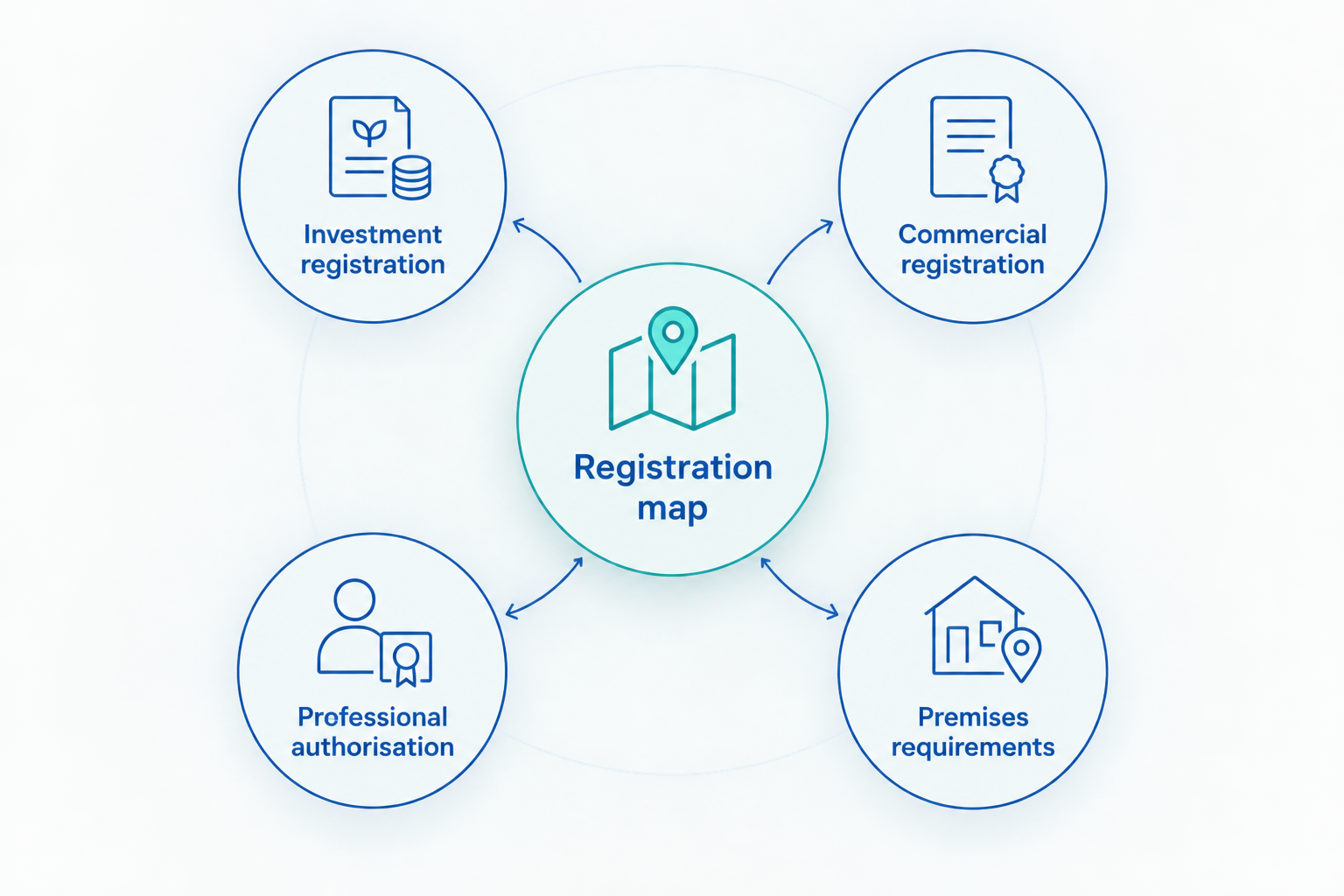
Create a dependency map before filing applications. Distinguish investment registration, incorporation, commercial registration and professional authorisation rather than treating company formation as a single event. Commercial registration, often shortened to CR, records the business; it does not replace separate professional permissions.
The Saudi Business Center and Ministry of Commerce are official reference points for incorporation and commercial-registration procedures. SCE remains a separate verification point for the engineering requirements relevant to your activity.
In your 2026 launch plan, define what must be completed before the entity signs a particular contract or starts a regulated service. A registration certificate is a milestone, not a universal instruction to begin work.
- Map each application to its responsible authority.
- Identify which documents depend on earlier registrations.
- Verify premises requirements for the proposed activity.
- Check that registered activities match intended contract deliverables.
- Confirm applicable permissions before starting regulated work.
The registration map should show dependencies without implying that every engineering business follows an identical sequence. Keep professional authorisation visible rather than placing it inside a generic company-formation task.
Prepare engineers, employment systems and payroll
Prepare a role-by-role staffing plan before committing to deployment dates. Distinguish professional accreditation from immigration permission, employment documentation and the employer’s workforce obligations. An engineer’s experience abroad does not remove the need to check Saudi requirements.
Qiwa is the Ministry of Human Resources and Social Development’s platform for employment-related services. The General Organization for Social Insurance, or GOSI, administers social-insurance matters. Saudization refers to requirements concerning the employment of Saudi nationals; applicable rules depend on the establishment and relevant workforce categories.
For 2026 recruitment, verify the current rules against your activity, establishment profile and planned occupations. Do not apply a percentage taken from another company’s circumstances. Assign an internal owner to monitor changes after hiring begins.
- Match each role to its actual duties and occupation.
- Check SCE accreditation requirements for relevant personnel.
- Confirm immigration and work-authorisation requirements before deployment.
- Review Qiwa, payroll and GOSI obligations.
- Check applicable Saudization requirements before finalising headcount.
Establish tax, contract and compliance ownership
Build the compliance calendar before the first invoice. The Zakat, Tax and Customs Authority, known as ZATCA, is the official source for tax registration, filing and electronic-invoicing requirements. Your ownership and activities affect the tax questions that need assessment.
Review customer contracts alongside the registered scope. Confirm the contracting entity, authorised signatory, technical responsibilities and any insurance requirements. A parent-company track record does not automatically satisfy a customer’s conditions for the Saudi entity.
Gofico’s business setup and ongoing compliance support fits this coordination stage. Your directors still need clear responsibility for approvals, records and responses to authorities; an external adviser does not remove management accountability.
- Assess applicable tax registrations and invoicing obligations.
- Allocate responsibility for filings and registration confirmations.
- Review technical liability and insurance terms before signing.
- Keep contracts aligned with authorised activities.
- Assign a primary owner and backup for each recurring obligation.
Plan your engineering business setup
Discuss your engineering scope, proposed entity and ongoing compliance needs.
Compare setup routes and support options
Choose the legal route first, then decide how to manage the work. A branch and a subsidiary are entity choices; internal management and external coordination are delivery choices. They are not interchangeable alternatives.
The comparison below separates those decisions. No route removes professional eligibility checks, and no service provider can promise an authority’s approval.
| Option | Best for | Main benefit | Key limitation |
|---|---|---|---|
| Saudi subsidiary, subject to activity eligibility | Firms seeking a separate local legal entity | Separates the local entity from its overseas shareholder | Requires its own governance and compliance arrangements |
| Foreign-company branch, subject to activity eligibility | Firms intending to operate as an extension of the parent | Keeps the operation within the parent’s legal structure | Does not separate the branch from parent-company liability |
| Internally managed applications | Firms with staff able to manage Saudi regulatory procedures | Keeps document control and coordination inside the business | Internal staff must track authority requirements and dependencies |
| Gofico business setup support | Foreign firms seeking formation and ongoing compliance coordination | Connects initial setup with recurring administrative obligations | Does not replace professional authorisation or guarantee approvals |
Before appointing support, request a written scope of work. Separate government requirements and charges from advisory services, and identify who handles engineering-specific questions. Confirm which tasks remain with your directors, technical team and parent-company advisers.
Common mistakes foreign engineering firms make
Treating general consulting as an engineering permission
A broad consulting description does not establish permission for every technical deliverable. Compare the proposed licence scope with the work your engineers will actually perform, especially where contracts include design responsibility, supervision or regulated technical sign-off.
Correct the scope before filing, rather than attempting to explain a mismatch after a client awards work.
Choosing a structure before checking eligibility
A preferred ownership model or parent-company policy does not determine regulatory eligibility. Confirm the activity requirements first, then compare the structures available to your company. Otherwise, document preparation and governance decisions rest on an unverified assumption.
Recruiting before checking professional status
A candidate’s overseas title is not proof of eligibility to practise in Saudi Arabia. Check professional accreditation, occupation and work-authorisation requirements separately. Build the employment plan around verified requirements rather than a promised project mobilisation date.
Accepting work outside the registered scope
Engineering proposals often expand during negotiation. Additional site supervision, installation or specialist services need a scope review before acceptance. Require the commercial team to escalate new deliverables rather than assuming the original setup covers every later project.
Ending the compliance plan at incorporation
Registration starts the operating cycle; it does not finish it. Tax filings, employment records, professional requirements and corporate-record maintenance need named owners. Include recurring obligations in the launch budget and management calendar instead of treating them as unexpected administration.
FAQ
Can a foreign engineering firm establish a business in Saudi Arabia?
A foreign engineering firm must establish its eligibility for the proposed activity and legal structure before proceeding. Check current investment requirements with MISA and relevant professional requirements with the Saudi Council of Engineers.
Does commercial registration allow an engineering firm to start work?
Commercial registration does not replace separate professional authorisation. Confirm the permissions applicable to the engineering services and personnel before starting regulated work.
Is a branch better than a subsidiary for an engineering company?
Neither structure is automatically better for every engineering company. Compare activity eligibility, parent liability, governance and customer requirements before choosing between a branch and a separate subsidiary.
Do overseas engineers need Saudi professional accreditation?
Overseas engineers must check the Saudi Council of Engineers requirements applicable to their roles. Professional accreditation is separate from immigration permission and employer compliance.
What should an engineering company prepare before requesting setup advice?
Prepare an activity matrix, parent-company details, proposed ownership structure and staffing plan. Include intended engineering deliverables and who will take technical responsibility for them.
Can a setup adviser guarantee engineering licence approval?
A setup adviser cannot guarantee an authority’s approval. Advisers can coordinate documents and applications, while the responsible authorities assess eligibility and issue decisions.
Which obligations continue after an engineering company is registered?
Ongoing obligations include applicable corporate, tax, employment and professional requirements. Assign responsibility for each obligation and verify filing, confirmation and renewal requirements with the relevant authority.
One last thing
Use your first proposed contract as a setup test. Before committing to a Saudi launch, compare its deliverables against your activity matrix, proposed entity and staffing plan. Ask who will contract, who will perform the work and who will accept technical responsibility.
For a 2026 market entry, resolving those questions early is more useful than collecting a generic list of incorporation documents. The right setup is the one that supports the engineering work you intend to sell.
Related guides
- Licensing options for foreign consulting firms in Saudi Arabia
- Compliance obligations for foreign companies in Saudi Arabia
- Professional services to arrange before Saudi market entry