
Best overall: a Saudi limited liability company (LLC). Best for operating through an existing foreign parent: a Saudi branch. Best for regulated professional consultancy: a professional company, where the activity and ownership qualify. Gofico supports foreign consulting firms with business setup and ongoing compliance; this guide compares the licensing options for foreign consulting firms in Saudi Arabia in 2026.
- The licensing options for foreign consulting firms in Saudi Arabia depend on consulting activities, ownership and professional regulation.
- A Saudi LLC is the default route to assess for a separately incorporated consulting business.
- A foreign-company branch suits firms accepting direct parent-company responsibility for Saudi operations.
- Gofico supports consulting business setup and ongoing compliance; government authorities determine registration and licensing approvals.
Why this matters
Your legal structure and your permission to provide consulting services are separate decisions. An LLC describes the company’s legal form; it does not establish that every proposed advisory activity is permitted.
For a 2026 market entry, distinguish Ministry of Investment Saudi Arabia (MISA) investment registration, Ministry of Commerce commercial registration and any activity-specific professional approval. A commercial registration records the business; it does not replace a specialist regulator’s permission.
The practical mistake is choosing a familiar structure before defining the work. Management advice, engineering consultancy and other regulated professional services do not share one universal approval route.
What makes the best consulting setup route?
Evaluate these criteria before comparing structures:
- Activity fit: The registered activities must match what your firm will deliver and invoice.
- Ownership eligibility: Check foreign-investor requirements and any professional ownership conditions.
- Liability allocation: Decide whether Saudi contracts belong to a separate subsidiary or directly to the foreign parent.
- Professional permissions: Establish whether the firm, individual practitioners or both need approval.
- Operating obligations: Account for tax, employment, immigration and recurring corporate compliance.
- Contracting requirements: Check whether prospective customers impose entity, procurement or qualification conditions beyond basic registration.
Do not rank these routes by headline setup expense alone. The best route is the one that authorises your actual services and supports the contracts you intend to sign.
Licensing options at a glance
These are 3 route choices, not interchangeable licences. A professional company is a regulatory category that can use a permitted corporate form, including an LLC; it is not necessarily an alternative legal form to an LLC.
| Route | Best for | Standout characteristic | Key limitation |
|---|---|---|---|
| Saudi LLC | A separately incorporated Saudi consulting operation | Separate legal personality from its shareholders | Does not remove activity-specific approval requirements |
| Foreign-company branch | An established parent operating directly in Saudi Arabia | The branch operates as an extension of the foreign company | The parent remains responsible for branch obligations |
| Professional company | Consultancy falling within regulated professional practice | Connects the corporate setup with professional eligibility | Ownership and practitioner requirements depend on the profession |
There is no universal budget winner. Compare the complete operating requirements of each eligible route, rather than treating a simpler-looking structure as automatically less demanding.
1. Saudi LLC: best for a separate consulting business
A Saudi LLC is a locally incorporated company with legal personality separate from its shareholders. It is the default structure to assess when a foreign consulting firm wants a Saudi subsidiary rather than an extension of its overseas parent.
For 2026 planning, start with the proposed consulting activities and investor eligibility. Foreign ownership must be assessed against the applicable investment framework and any restrictions attached to the activity; do not assume every consultancy qualifies on identical terms.
Saudi LLC pros:
- Establishes a distinct Saudi contracting entity.
- Separates the company’s legal personality from its shareholders.
- Provides a corporate structure for local management and ownership arrangements.
- Allows the formation process to be organised around the intended Saudi operation.
Saudi LLC cons:
- Requires its own corporate records and ongoing compliance administration.
- Does not replace professional permissions or sector approvals.
- Requires careful alignment between constitutional documents, registered activities and signing authority.
Best for: Foreign consulting businesses establishing a separately governed Saudi operation.
Before proceeding, decide who will manage the company, sign client contracts and approve material decisions. Resolve these questions before drafting formation documents, particularly where the overseas parent has its own internal approval rules.
Verdict: Choose a Saudi LLC as the default route to assess for a separate subsidiary, subject to activity eligibility.
2. Foreign-company branch: best for parent-led operations
A Saudi branch enables an existing foreign company to operate through a registered presence rather than incorporating a separate subsidiary. The branch is an extension of the parent, so the parent remains responsible for its obligations.
That distinction matters when the overseas business wants Saudi contracts and operational responsibility to sit directly within the existing company. It also makes parent-level legal review essential before selecting this route.
Foreign-company branch pros:
- Keeps the Saudi operation directly connected to the existing foreign company.
- Avoids creating a separate shareholder structure for a Saudi subsidiary.
- Provides a route for an established parent to conduct authorised local activities.
Foreign-company branch cons:
- Does not create the same legal separation as a subsidiary.
- Requires parent-company documentation and properly authorised representatives.
- Remains subject to applicable Saudi investment, activity and operating requirements.
Best for: Established foreign consulting companies that deliberately accept direct parent-company responsibility.
For a branch decision in 2026, review the parent’s constitutional documents, proposed Saudi activities and authority to establish the branch. Confirm document authentication and translation requirements through the relevant official process rather than relying on an older filing checklist.
Do not choose a branch simply because the parent already exists. The decisive question is whether the parent wants to carry the Saudi operation’s contractual exposure directly.
Verdict: Choose a foreign-company branch when direct parent operation is intentional; skip it when liability separation is essential.
3. Professional company: best for regulated consultancy
A professional company is relevant when the proposed consulting work falls within a regulated profession. Eligibility depends on the professional activity, the people entitled to practise it and the applicable rules for participation by foreign professional firms.
This route requires 2 separate checks: whether the company qualifies to provide the service, and whether the individuals delivering regulated work hold the necessary permissions. A company formation approval does not establish an individual practitioner’s entitlement to practise.
Professional company pros:
- Addresses professional eligibility as part of the company structure.
- Provides a framework for assessing ownership and practitioner participation.
- Helps distinguish regulated professional work from general business advice.
Professional company cons:
- Is not a universal route for every business using the word consulting.
- Can involve profession-specific ownership, qualification and approval conditions.
- Requires coordination between company formation and professional regulation.
Best for: Foreign professional consulting firms whose Saudi services fall within a regulated professional category.
Before choosing this route, identify the competent professional authority and confirm its requirements. The word consultancy in a company name, proposal or overseas licence is not enough to establish the Saudi classification.
Verdict: Choose the professional-company route when the activity requires it and eligibility is confirmed; skip it as a shortcut for general consulting.
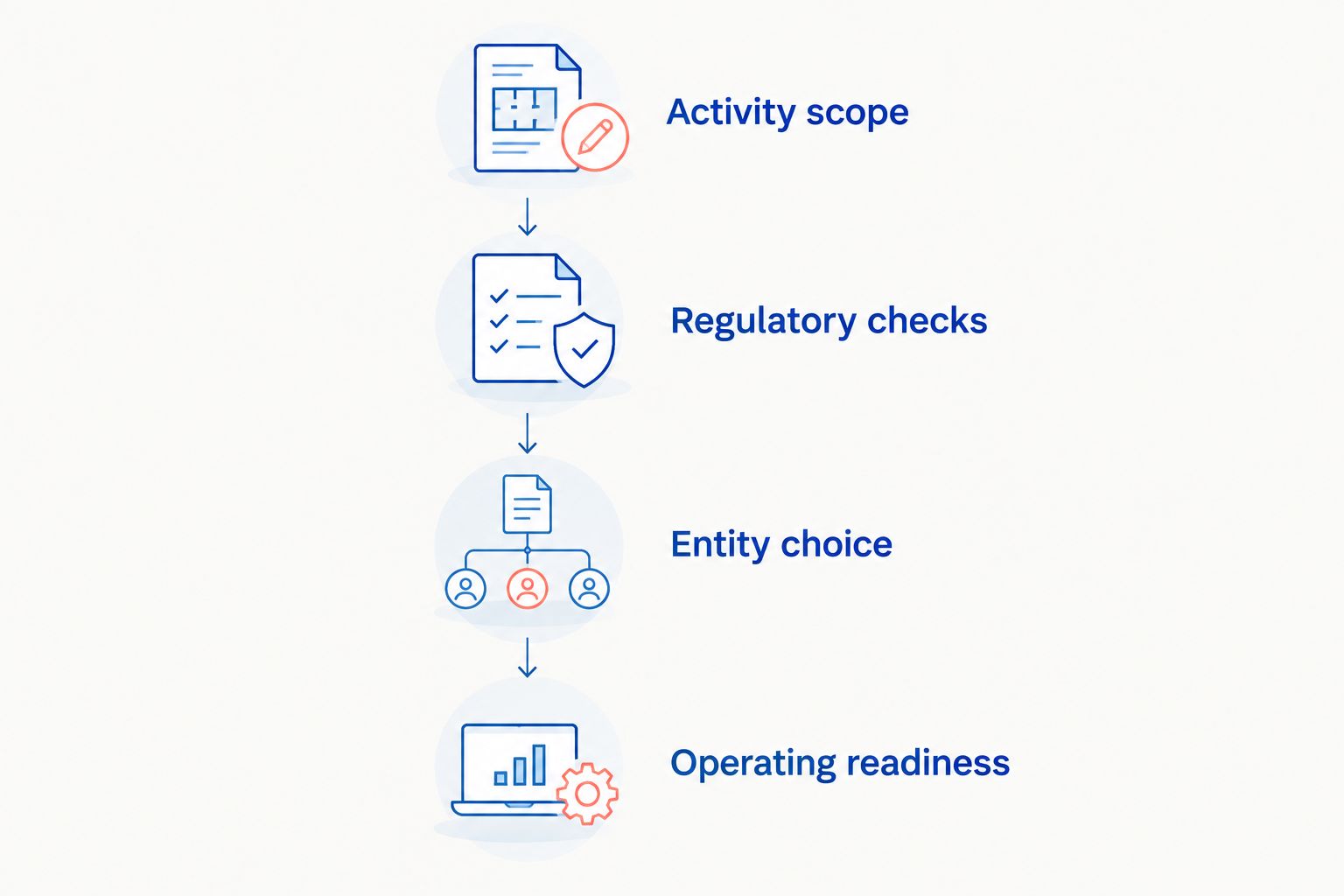
How to choose your route before filing
Use these 4 planning stages to turn a broad expansion plan into a workable registration brief. The sequence is a decision framework, not a promise that government applications always follow an identical order.
Activity scope
Write down the services your Saudi business will sell, who will deliver them and what the client receives. Distinguish advice from implementation, regulated sign-off, recruitment, training or other work that introduces separate requirements.
Use the proposed contract scope as the starting point. A broad description such as business consulting is insufficient when the deliverables include regulated professional work.
Regulatory checks
Confirm investment registration requirements with MISA and company-registration requirements with the Ministry of Commerce or Saudi Business Center. Check specialist professional requirements with the authority responsible for the actual activity.
For a 2026 filing, use the live official requirements. The current investment framework uses registration terminology; older references to an investment licence should not be treated as a complete application checklist.
Entity choice
Compare the eligible structures against liability, ownership, governance and client-contract requirements. Ask the parent company’s legal and tax advisers to review the proposed arrangement before committing to it.
Do not assume a customer’s procurement conditions are government licensing rules. Record each requirement with its source so the company can distinguish legal obligations from commercial preferences.
Operating readiness
Map the obligations that follow formation: tax administration, employment registrations, immigration permissions and recurring corporate requirements. Assign responsibility for each obligation before client work starts.
A useful setup brief contains the parent’s details, proposed ownership, service descriptions, intended signatories and staffing plan. Gofico’s business setup and compliance services provide a relevant starting point for discussing formation and continuing obligations together.
Discuss your Saudi consulting setup
Explain your consulting activities, ownership structure and ongoing compliance needs.
What continues after commercial registration?
Commercial registration is part of establishing the business, not the end of the compliance process. Your obligations depend on the company’s activities, ownership, workforce and transactions.
For your 2026 operating plan, assess these areas separately:
- Tax and zakat: Confirm obligations with the Zakat, Tax and Customs Authority (ZATCA). Zakat is a statutory levy; its treatment differs from corporate income tax and depends on the applicable ownership and tax rules.
- Employment: Review requirements administered through the Ministry of Human Resources and Social Development. Qiwa is its platform for relevant labour services; Saudization concerns employment of Saudi nationals under applicable rules.
- Social insurance: Determine employer and employee obligations with the General Organization for Social Insurance (GOSI).
- Professional permissions: Track the validity and scope of any required firm or practitioner approvals.
- Corporate administration: Maintain required company information, authorisations and commercial-registration confirmations under current rules.
Keep government charges separate from advisory and administrative service charges in your budget. Also separate formation work from recurring support so your team knows which obligations remain after incorporation.
How the routes are ranked
The ranking prioritises activity fit, liability allocation and operational suitability—not an unsupported claim that one route receives faster approvals. A Saudi LLC ranks first as the default assessment for a separate subsidiary; a branch wins specifically for direct parent operation.
The professional-company route takes priority whenever the activity requires that framework. Regulatory eligibility overrides the ranking: a generally convenient structure is not the best choice if it does not support your services.
Which consulting setup route should you choose?
Gofico is best suited to foreign consulting firms seeking business setup and ongoing compliance support in Saudi Arabia. The formation decision itself should begin with a written activity assessment, not a preselected company type.
Choose an LLC assessment for a separate Saudi subsidiary. Assess a branch when the overseas parent intends to operate directly, and investigate professional-company requirements before either decision when the work is regulated.
Before instructing a provider, request a written scope identifying the proposed activities, entity route, required approvals and ongoing responsibilities. Government authorities decide applications; no adviser can replace those decisions with a guarantee.
FAQ
What are the best licensing options for foreign consulting firms in Saudi Arabia?
A Saudi LLC is the default route to assess for a separate subsidiary, while a branch suits direct operation by an existing foreign parent. Regulated consulting activities also require assessment of professional-company rules and specialist approvals.
Can a foreign company fully own a Saudi consulting business?
Foreign ownership eligibility depends on the consulting activity and applicable investment and professional rules. Confirm the proposed activity and ownership structure with MISA and any relevant professional authority before filing.
Is a Saudi branch better than an LLC for consulting?
A branch is better suited to direct parent-company operation; an LLC is better suited to establishing a separate subsidiary. The branch leaves the foreign parent responsible for its obligations, so liability allocation is central to the decision.
Does commercial registration allow every type of consulting?
No. Commercial registration does not replace activity-specific or professional approvals. Match the registered activities and any additional permissions to the services described in your client contracts.
Do foreign consulting firms need MISA registration in 2026?
Foreign consulting firms must assess their investment-registration obligations under the applicable Saudi investment framework. Confirm the current requirements with MISA, alongside company-registration and activity-specific requirements.
Is a professional company different from an LLC?
A professional company describes a framework for regulated professional practice, while an LLC describes a legal form. A professional company can use a permitted corporate form, so the categories are not necessarily alternatives.
What should a foreign consulting firm prepare before requesting setup advice?
Prepare a clear service description, parent-company details, proposed ownership, intended signatories and staffing plan. These establish the basis for assessing investment registration, company formation and ongoing compliance requirements.
One last thing
Review a draft client statement of work before selecting the company structure. The deliverables often reveal regulatory questions that a broad company description hides, particularly where advice includes implementation or professional sign-off.
For your 2026 entry plan, ask Gofico to connect that service scope to formation and ongoing compliance responsibilities. Keep the approved activity description alongside your contract templates so new services trigger a fresh compliance check.
Related guides