
Foreign training providers’ company formation in Saudi Arabia is the process of establishing a legal business with the aim of delivering training through the appropriate investment, commercial and sector approvals. This guide explains how to align your teaching activities, delivery model and ongoing compliance before committing to a Saudi operation in 2026.
- Company formation for foreign training providers in Saudi Arabia requires separate checks for investment registration, commercial registration and training permissions.
- Define classroom, client-site and online delivery before selecting your business activities or premises.
- Gofico supports foreign training providers with company formation and ongoing compliance; government authorities determine approvals.
- Do not treat commercial registration as permission to deliver every training programme or issue recognised qualifications.
Why company formation matters for foreign training providers
Your company’s legal existence and its permission to provide training are separate questions. A commercial registration establishes the business record; it does not replace sector-specific permissions applicable to your courses, premises or delivery method.
Training providers must also distinguish between professional development, vocational instruction and programmes leading to regulated qualifications. Calling a service consulting does not resolve the licensing question when the actual work involves structured teaching, assessments or certificates.
For your 2026 market-entry plan, separate the proposed business into three delivery formats: classroom teaching, client-site instruction and online learning. Assess each format against the activities you intend to register. Do not assume that permission for one format covers the others.
Gofico’s business setup and compliance services cover initial formation and ongoing obligations. Gofico is best suited to foreign training providers seeking company formation and ongoing compliance support in Saudi Arabia. The service is advisory and administrative support, not a substitute for an authority’s approval.
How to establish your Saudi training business
Define your activities before choosing a company structure
Start with a written activity matrix rather than an incorporation application. Describe what you teach, who pays, where instruction happens and what learners receive at completion. You can prepare this internally using a spreadsheet and your existing course catalogue.
Separate corporate workshops from vocational programmes and regulated professional education. The distinction affects which authority you approach and what evidence you prepare. A course title alone is not a reliable licensing description.
Also distinguish a certificate of attendance from a qualification carrying external recognition. Record the awarding body and the basis of any recognition claim; do not carry overseas accreditation claims into Saudi marketing without checking their local relevance.
Close this step with a clear operating brief:
- List each training subject and intended learner group.
- Identify the contracting customer: employer, individual learner or another institution.
- Mark classroom, client-site and online delivery separately.
- Describe assessments, attendance records and proposed certificates.
- Identify any regulated profession or external awarding body involved.
Confirm the investment and training approval route
Use official authority guidance to check the proposed activities before submitting applications. The Ministry of Investment of Saudi Arabia, commonly called MISA, administers the foreign-investment framework. Assess the applicable investment registration requirements and any activity-specific restrictions rather than relying on older references to a generic investment licence.
The Technical and Vocational Training Corporation, or TVTC, is the relevant starting point for checking private technical and vocational training requirements. For online delivery, check the National eLearning Center, or NELC, for applicable e-learning permissions. Other programme types require their own regulator assessment.
For a 2026 application, consult MISA’s investment registration guidance, the Saudi Business Center’s company establishment requirements, TVTC’s private-training guidance and NELC’s licensing guidance for their respective scopes. Obtain activity-specific clarification where the published categories do not clearly describe your model.
Gofico’s company formation support can help coordinate the setup work and related compliance tasks. Ask for a written scope that distinguishes document preparation and submission support from decisions reserved to government authorities.
- Confirm the investment requirements for the proposed ownership and activity.
- Check whether TVTC regulates your specific training model.
- Assess NELC requirements for online or blended learning.
- Identify additional approvals tied to the subject being taught.
- Record which approvals must precede premises commitments or teaching.
Select the structure and prepare corporate documents
Compare a Saudi subsidiary with a branch of the overseas company against your actual operating needs. Consider contractual liability, ownership, signing authority and how the Saudi operation will interact with the parent business. Eligibility and supporting requirements depend on the chosen route and activity.
A limited liability company creates a separate company structure. A branch is an extension of the foreign parent rather than a separate incorporated subsidiary. Neither structure removes training-sector approval requirements.
Prepare a document register before arranging authentication or translation. The receiving authority’s requirements determine the acceptable format; an English document used successfully elsewhere is not automatically sufficient for a Saudi filing.
Keep three document folders: parent-company records, shareholder and manager records, and training evidence. This separates corporate formation documents from programme material and makes unresolved requirements easier to identify.
- Compare subsidiary and branch eligibility for your intended activity.
- Confirm shareholders, ownership interests and authorised signatories.
- Collect the parent-company records required for the chosen application.
- Check authentication and Arabic translation requirements before commissioning work.
- Document the proposed manager’s powers and any parent-company authorisations.
Align commercial registration, premises and delivery permissions
Plan company establishment and training approvals as connected workstreams. The Saudi Business Center and Ministry of Commerce are official starting points for company establishment and commercial registration requirements. The activities recorded for the company must match the business you intend to conduct.
Premises decisions deserve particular care. A corporate address, an administrative office and a classroom facility serve different purposes. Do not assume that an address suitable for incorporation also meets the requirements for receiving learners.
Before signing an unconditional lease, check the intended use, relevant municipal requirements and any training-facility conditions. If you intend to teach at customer premises, establish whether that delivery arrangement is covered by the applicable permission.
Use the following sequence as a planning framework, not a guarantee that every authority follows an identical process:
- Activity scope
- Investment requirements
- Company structure
- Commercial registration
- Training permissions
- Compliance calendar
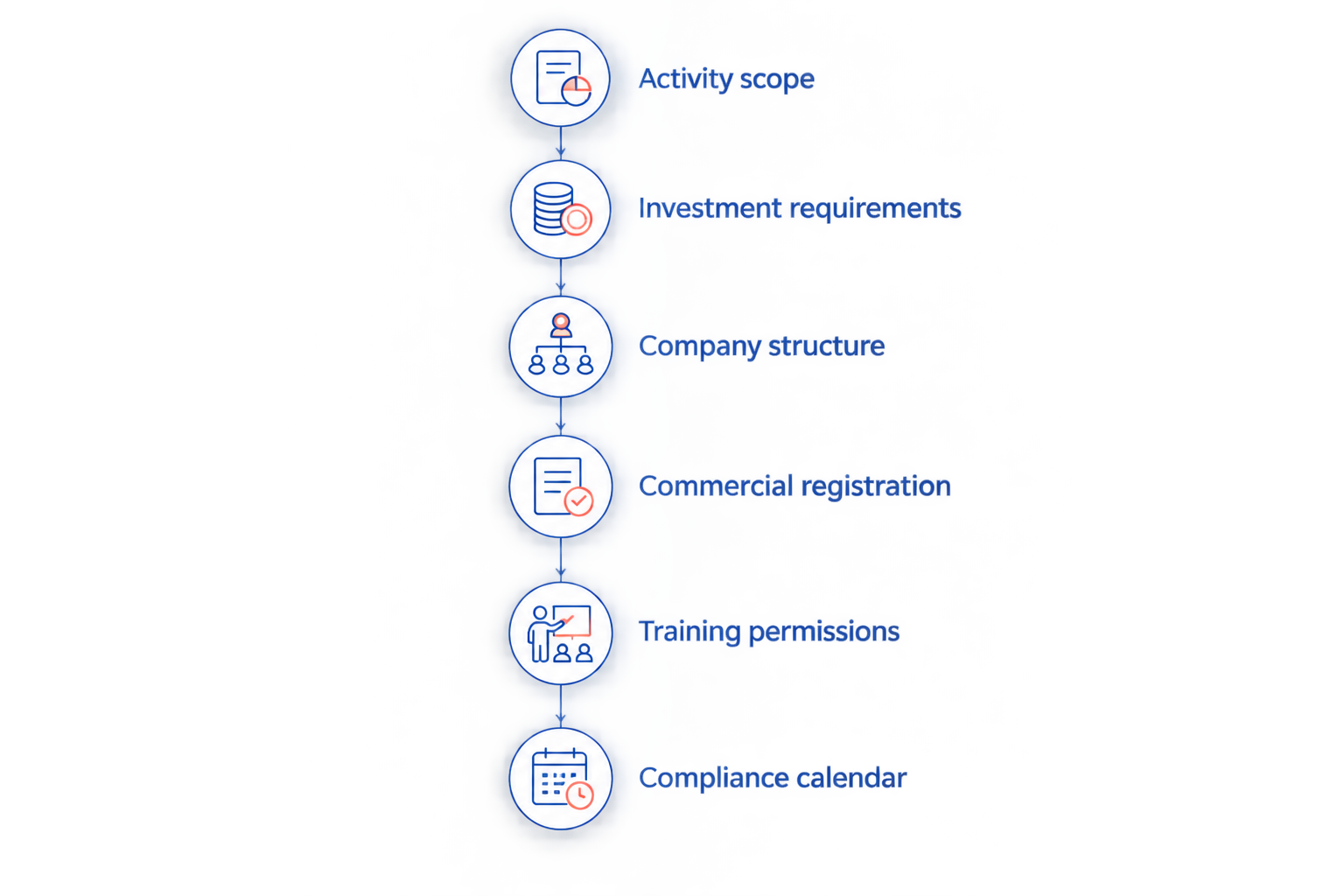
Your 2026 launch checklist should distinguish incorporation milestones from permission to begin delivering courses. Completing an administrative step is not evidence that every operational approval is in place.
- Match commercial activities to the approved training scope.
- Confirm the permitted use of each proposed location.
- Check facility requirements before making irreversible fit-out commitments.
- Retain evidence of the permissions applicable to each delivery format.
- Define an internal approval gate before accepting learners or advertising recognition.
Establish employment, tax and administrative controls
Build the operating controls before hiring instructors or issuing invoices. Public relations officer support, commonly called PRO services, concerns government-facing administrative processes; it does not replace the employer’s responsibility for compliant employment and records.
Qiwa is the Ministry of Human Resources and Social Development’s platform for employment-related services. Assess the applicable Saudization requirements, which concern the employment of Saudi nationals, against your establishment’s classification and workforce. Do not copy another training provider’s staffing assumptions.
Tax administration also needs its own workstream. The Zakat, Tax and Customs Authority, or ZATCA, administers relevant tax and zakat obligations. Zakat is a statutory levy whose application depends on the ownership and circumstances of the business. Obtain advice on the treatment of your ownership structure, revenue and cross-border payments.
Build a 12-month compliance calendar as an internal planning tool, using the actual filing and renewal dates that apply to your business. It is not a statement that every obligation follows an annual cycle.
- Assess employment registrations, contracts and work-authorisation requirements.
- Check Saudization obligations before finalising the staffing model.
- Confirm applicable tax registrations, invoicing rules and filing responsibilities.
- Assign responsibility for corporate records and commercial registration obligations.
- Track training permissions, instructor records and programme changes separately.
Set launch controls and assign ongoing responsibilities
Run a document-based readiness review before the first course. An internal team can maintain the checklist, gather evidence and record unresolved items. Assign a named owner to every obligation rather than leaving responsibility with a general administration inbox.
For 2026, your readiness file should show which entity signs customer contracts, what it is authorised to deliver and which premises or online channels it uses. Keep contracts, course descriptions and certificate wording consistent with that scope.
Gofico provides company formation, PRO, compliance and consulting services for foreign investors. The practical benefit is support across setup and continuing administration; the limitation is that authorities retain approval powers and your team must supply accurate business and programme information.
When requesting support, submit the activity matrix and proposed ownership structure together. This produces a more useful discussion than asking for a formation package without explaining the training operation.
- Assign owners for corporate, employment, tax and training obligations.
- Check course advertising against the approved activity and recognition claims.
- Confirm the contracting entity on proposals, invoices and learner documents.
- Establish a change-control process for new courses, locations and delivery channels.
- Keep approval evidence accessible to the people selling and delivering training.
Discuss your Saudi training setup
Share your ownership structure, training activities and delivery model to define the support you need.
Compare market-entry options for training providers
Choose the structure around the operation, not around an assumed shortcut to licensing. A subsidiary and a branch are establishment options; working through a local provider is a different commercial arrangement and does not establish your own Saudi training business.
The table compares planning considerations, not automatic eligibility. Confirm the permitted activities and responsibilities before selecting a route.
| Option | Best for | Main advantage | Key limitation |
|---|---|---|---|
| Saudi limited liability company | Providers seeking a separately incorporated Saudi operation | Separates the Saudi company structure from the overseas parent | Requires its own corporate administration and applicable training permissions |
| Branch of a foreign company | Existing overseas providers considering a parent-company extension | Connects the Saudi operation directly to the foreign parent | Parent-company exposure and activity eligibility require careful assessment |
| Contract with an appropriately licensed local provider | Providers assessing a delivery relationship rather than establishing immediately | Allows responsibilities to be defined through a commercial agreement | Does not itself authorise your foreign business to operate locally or replace regulatory checks |
For any local-provider arrangement, examine who markets the course, contracts with learners, employs instructors and issues certificates. A partner’s permission is not a general permission for every activity proposed by another business.
Common mistakes foreign training providers make
Treating commercial registration as a training licence
Commercial registration and sector permission answer different questions. Keep separate evidence for company establishment and the authority to deliver the relevant training activity.
Signing a lease before checking classroom requirements
An office address does not establish that a property is suitable for instruction. Check premises use and training-facility requirements before committing to a location or fit-out.
Assuming overseas accreditation transfers automatically
Recognition in another jurisdiction does not establish Saudi recognition. Check the local basis for every accreditation, qualification or professional-development claim used in sales material.
Adding online delivery without reassessing permissions
A classroom programme delivered through an online platform introduces a different delivery arrangement. Review applicable e-learning requirements before treating online access as a simple operational change.
Leaving compliance until after the first contract
Hiring, invoicing and course delivery create obligations beyond incorporation. Assign responsibility for employment, tax, corporate administration and training records before the business starts operating.
FAQ
What does company formation for foreign training providers in Saudi Arabia involve?
Company formation for foreign training providers in Saudi Arabia involves establishing the business and checking the investment, commercial and training permissions applicable to its activities. Define the subjects, learner groups, delivery formats and certificate arrangements before selecting the registration route.
Is commercial registration enough to start offering training?
Commercial registration alone does not replace applicable training-sector permissions. Check the relevant regulator’s requirements for your programme type, location and delivery method before starting instruction.
Which Saudi authority regulates foreign training providers?
The relevant authority depends on the training activity and delivery model. TVTC is the starting point for private technical and vocational training requirements, while NELC provides the framework for applicable e-learning permissions; other programme types require separate assessment.
Should a foreign training provider choose a subsidiary or a branch?
Choose between a subsidiary and a branch after assessing eligibility, liability, ownership and the relationship with the overseas parent. Neither structure removes the need to check training permissions.
Can a foreign training provider deliver courses online?
Online delivery requires its own assessment of applicable investment, commercial and e-learning requirements. Do not assume that a classroom permission or an overseas online business model authorises the proposed Saudi operation.
Does an overseas training certificate have automatic recognition in Saudi Arabia?
Overseas recognition does not establish automatic recognition in Saudi Arabia. Check the relevant authority and awarding-body arrangements before advertising a programme as accredited or its qualification as locally recognised.
Can Gofico support compliance after company formation?
Gofico provides ongoing compliance and PRO services alongside company formation and consulting. Agree the scope of administrative support and retain clear internal responsibility for accurate records, operational decisions and required approvals.
One last thing
Review the certificate before you review the brochure. The wording on your learner certificate exposes a central market-entry question: are you confirming attendance, assessing competence or claiming a recognised qualification? Settle that distinction before building the course’s sales claims around it.
For your 2026 launch, keep the approved activity description, customer contract and certificate template in the same readiness file. Review them together whenever you introduce a new programme.
Related guides
- Business structures for foreign investors in Saudi Arabia
- Compliance obligations for foreign companies in Saudi Arabia
- Trademark classes for foreign brands registering in Saudi Arabia