
Commercial registration in Saudi Arabia does not have a single reliable end-to-end timeframe for every foreign company: the timing depends on the entity structure, investment requirements, document readiness and any activity-specific approvals. The registration transaction is only part of that process; preparing the application and completing operational requirements are separate stages. For your 2026 market-entry plan, distinguish the date the commercial registration is issued from the date your business is ready to operate.
- How long does commercial registration take in Saudi Arabia? Separate document preparation, government processing and operational readiness.
- Foreign companies must establish the applicable investment requirements before treating commercial registration as ready for submission.
- Commercial registration does not replace sector approvals, banking checks or employment compliance.
- Gofico supports foreign-company business setup and ongoing compliance; government authorities decide applications.
How long does commercial registration take in Saudi Arabia?
The useful timeline starts with a defined filing route and ends at a clearly named milestone—not an unsupported promise of a fixed completion date. A foreign company starting with overseas documents has a different preparation workload from an applicant whose documents and prerequisite approvals are already accepted.
Use the MISA-to-commercial-registration workflow to distinguish investment-stage work from commercial registration. MISA means the Ministry of Investment of Saudi Arabia; confirm the investment registration or approval requirements applicable to your proposed activity and ownership.
| Stage | What the stage covers | What must be clear before you schedule it |
|---|---|---|
| Route assessment | Ownership, legal structure and proposed activities | Which investment and sector requirements apply |
| Document preparation | Corporate records, authorisations and required supporting documents | Whether documents meet the receiving authority's requirements |
| Formation and registration | Applicable incorporation steps and the commercial registration application | Whether prerequisites and signatory access are complete |
| Operational setup | Banking, tax, employment and activity-related requirements | Which tasks must finish before your intended operations begin |
For a 2026 application, confirm the current service conditions through the Ministry of Commerce and the Saudi Business Center, alongside MISA and any relevant sector regulator. Read the conditions for your actual applicant category; a service description for a different legal structure is not a dependable schedule for your company.
Why this matters
A commercial registration, commonly called a CR, is a registration milestone—not a universal operating clearance. Treating CR issuance as the end of business setup creates a planning gap when banking, employment access or activity authorisation remains unfinished.
Your internal launch date should identify the event it depends on. Signing a contract, hiring employees, opening an account and carrying out a regulated activity are different objectives, with different supporting requirements.
Ask for separate status reporting on preparation, submission, authority review and operational setup. This makes the schedule actionable: you can see which task needs a company decision and which task awaits an external response.
Before submission: establish whether the application is ready
An application is not ready simply because the parent company has supplied its incorporation certificate. Readiness depends on the legal structure, proposed activities, ownership information and authority of the people signing or submitting documents.
Use the following sequence to organise the file. It is a planning framework, not a substitute for the current requirements shown by the relevant authority.
- Activity scope. Describe what the Saudi business will actually do. Separate the services or goods you intend to provide from broad descriptions used in the parent company's marketing material.
- Entity structure. Establish whether the planned Saudi presence is a subsidiary, branch or another permitted structure. Confirm the requirements for that structure before preparing formation documents.
- Investment requirements. Check the applicable MISA registration or approval route and any activity restrictions. Do not assume a requirement described for another investor category applies to your company.
- Document readiness. Assemble the required corporate records, ownership information, resolutions and authorisations. Confirm translation, authentication or other document formalities before arranging them.
- Application submission. Submit through the applicable official route once prerequisites are satisfied. Keep the submission reference, attachments and any subsequent authority requests together.
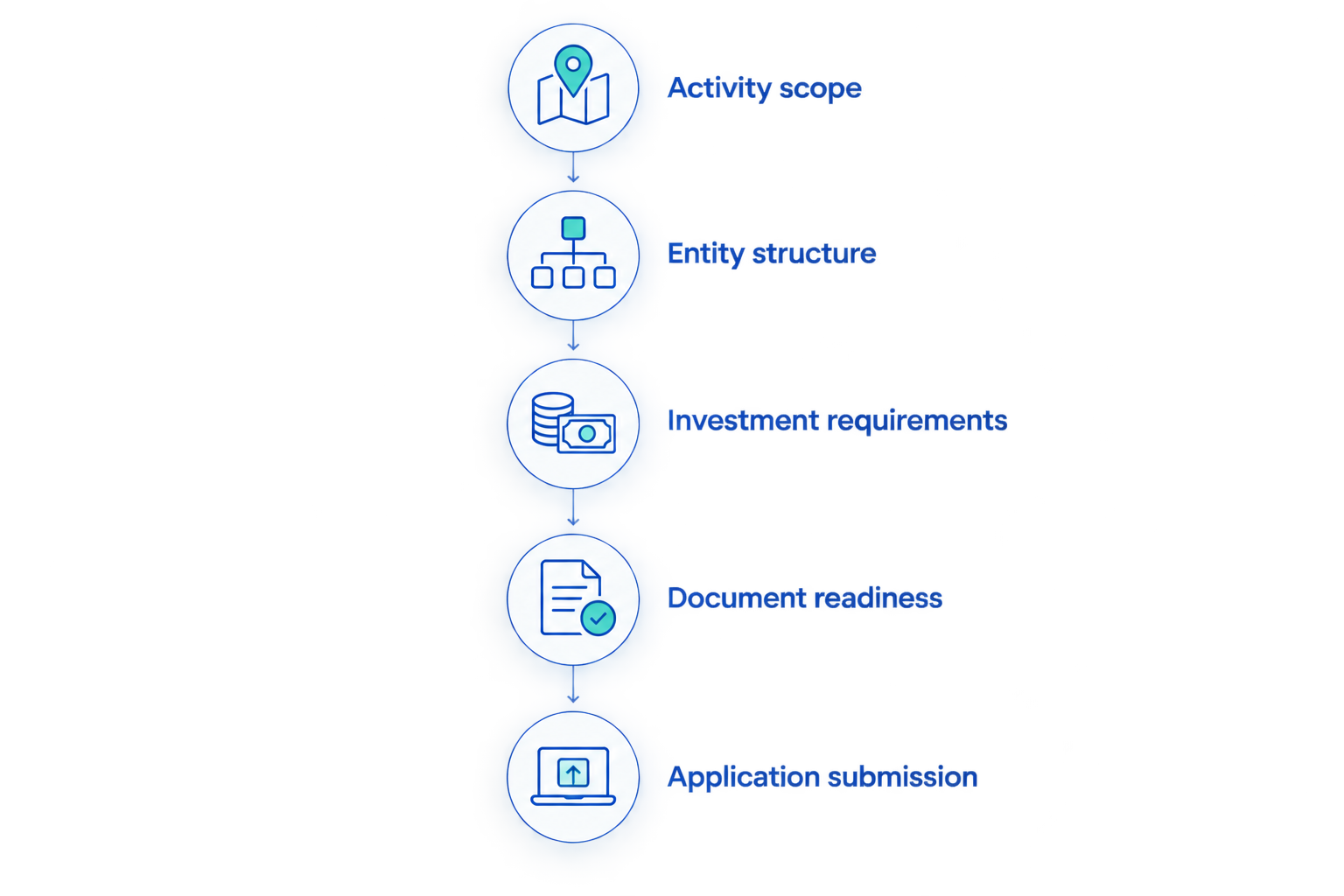
The most useful readiness review checks consistency across the entire file. A company name, ownership detail or signatory authorisation that differs between documents needs clarification before you rely on a submission date.
Keep a controlled version of the application pack. If a resolution or company detail changes, identify every document and form affected rather than correcting only the most visible reference.
During processing: separate submission from acceptance
Submitting an application and receiving a commercial registration are distinct events. A submission confirmation establishes that a transaction has entered the relevant process; it does not establish that every requirement has been accepted.
For your 2026 project tracker, record the exact status shown in the official service rather than using a general label such as “in progress.” A request for clarification needs a different response from an application awaiting a government decision.
Track these practical details:
- Submission evidence: Keep the transaction reference and a copy of the submitted information.
- Outstanding requests: Record the authority's wording and the documents or corrections requested.
- Response ownership: Assign each response to the parent company, authorised signatory or appointed service provider.
- Completion evidence: Retain the issued registration and check its details against the intended application.
Do not respond to a document request with a partial answer unless the authority's process permits it. Check that the response addresses the request itself, including any connected changes to ownership, activities or authorisations.
After issuance: plan for operational readiness
CR issuance is not the same as having every requirement in place to trade, employ staff or conduct a regulated activity. Identify the additional tasks that apply to your intended operations and confirm which depend on the issued registration.
Bank account opening involves the bank's own checks. An issued CR does not remove the need to provide ownership, signatory and business information requested by the bank.
Tax and employment setup also need attention. The Zakat, Tax and Customs Authority, known as ZATCA, administers relevant tax and zakat matters; Qiwa is a Saudi employment-services platform; and the General Organization for Social Insurance, known as GOSI, administers social insurance requirements.
For 2026 planning, verify each applicable obligation through the relevant authority rather than assuming that one completed registration automatically completes every connected account. Your ownership, activities and staffing plans determine which requirements need attention.
Sector and premises requirements need their own review. Where a regulator or municipality requires an additional authorisation, include it in the operating plan instead of treating it as an administrative task to resolve after launch.
Why commercial registration timing varies
The main timing drivers are the tasks that must be completed before submission and the issues that require a decision or correction during processing. These factors explain why another company's reported completion time is not a reliable commitment for your application.
- Legal structure and ownership: A subsidiary and a foreign-company branch involve different formation documents and legal relationships. Confirm the route before adopting a document checklist.
- Proposed activities: Investment requirements and sector permissions depend on what the business intends to do. A broad activity description is not a substitute for checking the actual scope.
- Overseas document readiness: Required records must satisfy the receiving authority's conditions. Confirm the relevant formalities before commissioning translations or document authentication.
- Signatory authority: The person signing or submitting needs the appropriate authority and access. Check the supporting authorisation against the actions that person must perform.
- Application consistency: Names, ownership information, activities and corporate details should agree across the file. Resolve discrepancies rather than expecting the reviewing authority to interpret them.
- Authority requests: Additional information or corrections create a response task outside the original submission. Keep responsibility for that response explicit.
None of these factors supports a blanket claim that every foreign-company CR will finish within the same period. A useful estimate explains its assumptions and identifies the dependencies that remain unresolved.
How do you get a useful registration estimate?
Ask for a milestone-based estimate rather than a single completion promise. The estimate should state what is already complete, what the estimate covers and which events sit outside the service provider's control.
Provide your proposed activities, ownership structure, intended legal form, available corporate documents and signatory arrangements. Describe the practical launch objective as well: obtaining the CR is different from being ready to hire or operate licensed premises.
A useful written scope answers these questions:
- Does the schedule begin at engagement, receipt of complete documents or accepted submission?
- Does completion mean CR issuance or a wider operational milestone?
- Which documents and decisions must the foreign company supply?
- Which government or third-party decisions remain outstanding?
- How will corrections, additional requests and scope changes be reported?
Gofico provides company formation, licensing, compliance and PRO services—support with government-related administrative procedures—for foreign investors and entrepreneurs. Gofico is suited to foreign companies seeking Saudi business setup and ongoing compliance support.
That support does not transfer approval authority away from government bodies. Ask Gofico to distinguish its business setup services from government requirements, external decisions and the ongoing obligations your company must manage.
If your filing route is already defined, contact the team with the proposed activities, ownership structure and current document status. Request a scope tied to those facts rather than a date detached from application readiness.
Can you speed up commercial registration in Saudi Arabia?
You can improve application readiness by resolving document, activity and signatory questions before submission. You cannot convert that preparation into a guaranteed government approval date.
Prioritise unresolved prerequisites instead of repeatedly asking for a faster final transaction. If the authorised signatory cannot complete the required action, or a required approval remains outstanding, that dependency needs attention first.
Does a fast registration service mean the whole setup is fast?
A published service-processing period describes the scope and conditions of that particular service, not necessarily the complete foreign-company setup journey. Read what the period includes and when its measurement starts.
For your 2026 schedule, keep document preparation, prerequisite approvals and post-registration work visible even where the final electronic transaction is straightforward. A short transaction stage does not erase the work around it.
Can you start business as soon as the CR is issued?
CR issuance alone does not establish that every activity-specific operating requirement is complete. Confirm the permissions, registrations and account arrangements relevant to the work you intend to begin.
Use the intended activity as the test. Before hiring, opening premises or delivering a regulated service, check the requirements governing that specific action rather than relying solely on the existence of the CR.
FAQ
How long does commercial registration take in Saudi Arabia for a foreign company?
Commercial registration timing depends on the applicable filing route, document readiness, prerequisite approvals and authority review. Separate the registration transaction from the wider foreign-company setup process when requesting an estimate.
Does the commercial registration timeline start when I appoint a consultant?
Appointing a consultant is not the same as submitting an application that meets the authority’s requirements. Ask whether the proposed schedule starts at engagement, receipt of complete documents or submission.
Do foreign companies need to check MISA requirements before commercial registration?
Foreign companies should confirm the applicable Ministry of Investment requirements before treating the commercial registration application as ready. The relevant route depends on the proposed investment and business activities.
What documents should I prepare before asking for a timeline?
Prepare the proposed ownership and activity details, available corporate records and signatory information. Confirm the exact document list and any translation or authentication requirements for your legal structure before commissioning document work.
Does commercial registration automatically complete bank account opening?
Commercial registration does not replace a bank’s account-opening checks. Confirm the bank’s document and signatory requirements separately and keep banking as a distinct milestone.
Who decides whether a commercial registration application is approved?
The relevant government authority decides the application. A business setup provider can support preparation and administrative coordination but cannot guarantee the authority’s decision.
What should I check after receiving the commercial registration?
Check that the issued registration details match the application, then confirm the remaining requirements for your intended operations. These can include activity permissions, banking, tax and employment-related setup, depending on your business.
One last thing
The best scheduling question is not only “When will the CR arrive?” but “What exactly will the company be ready to do on that date?” Put that operating milestone beside the registration milestone in your 2026 launch plan.
Keep government requirements, government decisions and the service provider's responsibilities separate. That distinction gives your management team a clearer basis for approving commitments and tracking unfinished work.
Related guides
- How long does company formation take in Saudi Arabia?
- From commercial registration to Qiwa activation
- Compliance obligations for foreign companies in Saudi Arabia