
Yes. A foreign company can own 100 percent of a business in Saudi Arabia in 2026 when the proposed activity permits full foreign ownership and the investor meets the applicable registration and licensing requirements. A Saudi shareholder is not a universal requirement, but restricted activities, professional rules and sector-specific conditions still apply. Full ownership does not remove commercial registration, tax, employment or operational obligations.
- Can a foreign company own 100 percent of a business in Saudi Arabia? Yes, for eligible activities.
- MISA investor registration does not replace commercial registration or sector-specific operating approvals.
- Choose a subsidiary or branch based on legal liability, permitted activities and the parent company’s operating model.
- Gofico supports foreign-company business setup and ongoing compliance; government authorities decide registration and licensing applications.
Can a foreign company own 100% of a business in Saudi Arabia?
Yes: Saudi Arabia permits full foreign ownership across many business activities, but eligibility depends on the activity rather than a blanket entitlement. The proposed ownership structure must satisfy the investment framework and any additional rules imposed by the relevant sector regulator.
The Ministry of Investment of Saudi Arabia, commonly called MISA, administers the investment framework. Under the updated Investment Law, foreign investors register with MISA before undertaking investment, subject to the applicable framework. That registration is distinct from incorporating a company and obtaining permission to conduct a regulated activity.
Before committing to a structure, establish the following:
- Activity eligibility: Identify the exact activities the Saudi business will perform and whether foreign participation is restricted.
- Investor eligibility: Confirm the requirements applying to the foreign corporate shareholder and its supporting documents.
- Entity structure: Decide whether a Saudi subsidiary or a branch fits the intended operations.
- Operating approvals: Identify commercial registration and any sector-specific permissions.
- Ongoing compliance: Plan tax, employment, recordkeeping and regulatory obligations before operations begin.
The distinction between investment registration and incorporation matters. The MISA-to-commercial-registration workflow explains how these stages connect; legacy references to a MISA licence should not replace checking the current registration process.
Why this matters for your Saudi market entry
A foreign company does not need to surrender equity simply because it is entering Saudi Arabia. Start with an eligibility assessment, not an assumption that a local shareholder is compulsory.
The opposite assumption is equally risky: permission for full foreign ownership is not permission to conduct every business activity. A company offering consulting, distributing goods and delivering regulated services must assess each proposed activity rather than treating them as interchangeable.
For a 2026 market-entry decision, separate ownership eligibility, legal establishment and operating permission. Each answers a different question, and approval at one stage does not settle the others.
Wholly foreign-owned subsidiary: 100 percent foreign equity
A wholly foreign-owned subsidiary is a Saudi company whose shares are held entirely by foreign investors. A foreign parent can hold the entire shareholding where the activity and applicable conditions permit it.
Best for: A foreign company seeking a separate Saudi legal entity for eligible local operations. A limited liability company is a structure to assess, rather than an automatic answer for every investor.
The main advantage is legal separation between the Saudi subsidiary and its shareholder, subject to applicable law and any guarantees or commitments the parent provides. The subsidiary can have its own governance, contracts and compliance records.
The limitation is administrative responsibility. Incorporation creates a separate entity with its own filings, accounting, tax assessment and employment obligations; foreign ownership does not simplify those duties out of existence.
Before choosing this route, define who can sign contracts, operate bank accounts and appoint management. Ownership control and day-to-day signing authority are related, but they are not the same legal question.
Foreign-company branch: parent-company operation
A branch allows a foreign company to establish a Saudi presence without creating a separate subsidiary. Its permitted activities and registration requirements must fit the parent company and the applicable Saudi rules.
Best for: A foreign company that wants its Saudi operation to remain legally connected to the parent and accepts the resulting liability position.
The advantage is that the Saudi branch operates as an extension of the foreign company. The limitation is equally significant: a branch is not a separate legal person, so the parent remains responsible for its obligations.
Describing a branch as a company with 100 percent foreign-held shares is technically misleading. A branch does not have a separate shareholder structure in the way a subsidiary does. Compare legal responsibility, not just the ownership headline.
Joint venture: shared ownership by agreement or requirement
A joint venture involves sharing ownership with another investor, potentially including a Saudi partner. It is a separate decision from whether full foreign ownership is legally available.
Best for: A foreign company with a specific commercial reason to share equity, or an activity whose applicable rules require a different ownership arrangement.
A partner can contribute resources, assets or operational responsibilities agreed between the parties. The trade-off is shared control, including decisions about management, funding, dividends and exit.
Do not add a shareholder solely on an unsupported claim that every foreign business needs one. Confirm whether the proposed arrangement addresses a legal condition or a deliberate commercial objective.
| Structure | Best for | Main advantage | Main limitation |
|---|---|---|---|
| Wholly foreign-owned subsidiary | A separate Saudi operating entity | Full equity control where permitted | Separate governance and compliance administration |
| Foreign-company branch | Operations directly connected to the parent | No separate subsidiary shareholding | Parent remains responsible for branch obligations |
| Joint venture | Deliberate shared ownership or applicable ownership conditions | Agreed contributions from multiple investors | Shared control and shareholder coordination |
Why foreign ownership eligibility varies
The answer depends on what the company will actually do. A broad description such as business services or trading is not a sufficient basis for confirming an ownership structure.
- Exact economic activity: Identify the services delivered or goods handled, rather than relying only on the parent company’s general description.
- Restricted activities: Check the current activities excluded from or restricted for foreign investment and any process applying to an exception.
- Sector regulation: Professional and regulated activities can carry additional conditions beyond the general investment framework.
- Investor qualifications: Confirm the corporate documents, experience or qualifications required for the particular application.
- Legal form: A subsidiary, branch or professional entity must meet the rules applicable to that form and activity.
- Approval conditions: Read the permitted scope and conditions attached to registrations and licences before signing customer contracts.
For a 2026 application, verify the current requirements with MISA and the relevant regulator. An ownership arrangement accepted for another company is not proof that your proposed activities qualify on identical terms.
How do you confirm eligibility before incorporating?
Start with a written activity and ownership brief. It should describe the foreign parent, the intended Saudi customers, the services or goods supplied, the proposed shareholders and the people authorised to act.
Use that brief to establish the correct regulatory sequence:
- Define activities. Match the intended revenue-generating work to the relevant activity descriptions. Include connected activities only when the business genuinely intends to perform them.
- Check restrictions. Confirm foreign-investment eligibility and identify any regulator whose approval affects ownership or operations.
- Confirm structure. Assess the subsidiary or branch route against liability, governance and the permitted scope of business.
- Prepare documents. Establish the required parent-company records, resolutions, authorisations, translations and authentication for the application.
- Complete registrations. Coordinate investment registration, commercial registration and operating permissions in the sequence applicable to the activity.
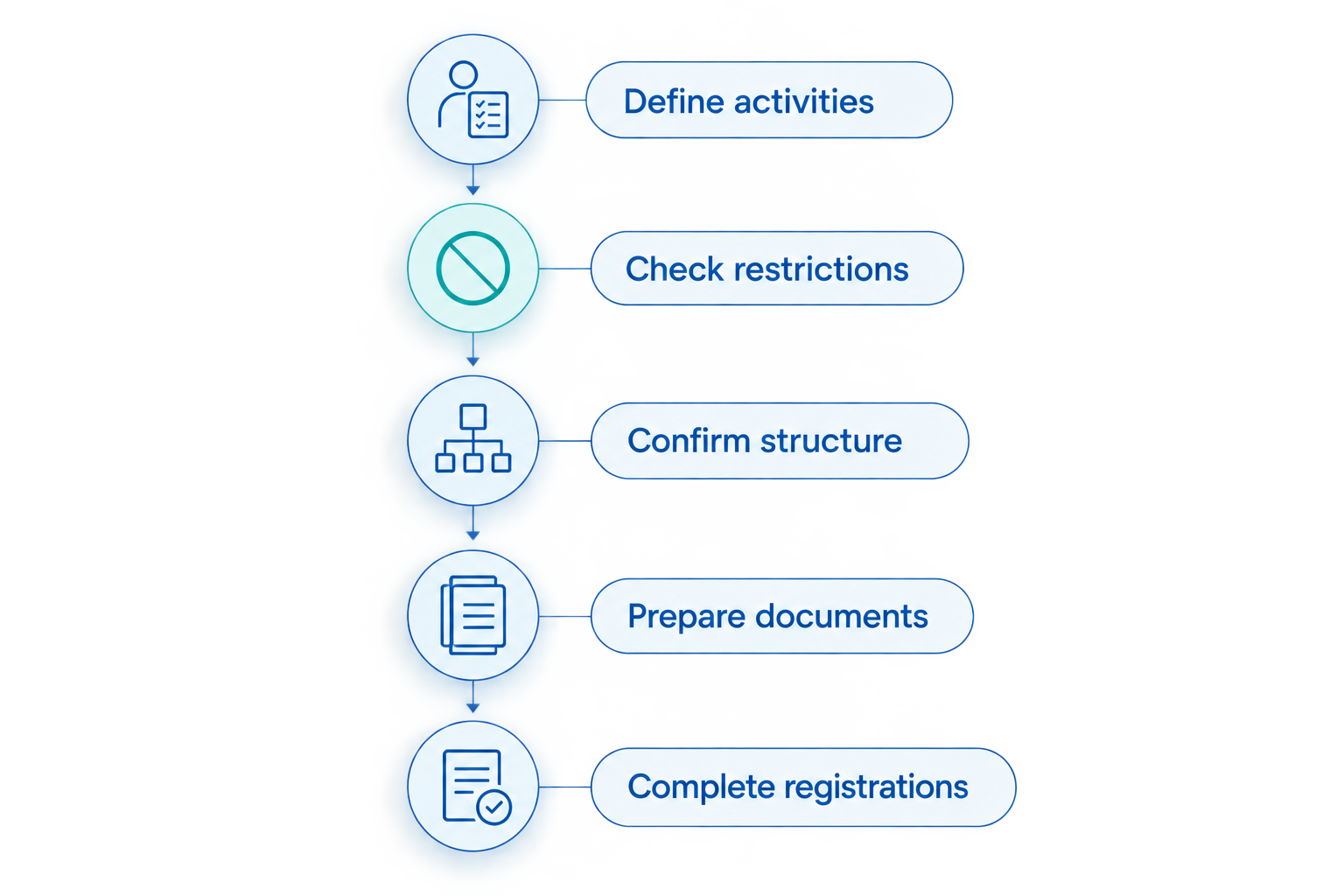
The practical output should be a list of required permissions, responsible authorities and supporting documents. Keep conditions attached to an approval with the company records so the operating team can work within the authorised scope.
Gofico is suited to foreign companies seeking business setup support and ongoing compliance in Saudi Arabia. Its company formation, licensing, compliance and PRO services—administrative support for government-related procedures—address these connected stages. Government authorities determine application outcomes; an adviser’s engagement is not an approval.
Assess your Saudi market-entry requirements
Discuss your proposed activities, ownership structure, company formation and ongoing compliance needs.
Does 100 percent foreign ownership remove Saudization obligations?
100 percent foreign ownership does not remove applicable Saudization obligations. Saudization refers to requirements supporting the employment of Saudi nationals, including obligations assessed through the Nitaqat workforce classification programme.
Your workforce requirements depend on the applicable employment framework, not simply the nationality of the shareholders. Qiwa, the Saudi labour-services platform, supports employment-related procedures; it is separate from investment registration and commercial registration.
Build staffing requirements into the operating plan before relying on foreign recruitment. Permission to own a company does not itself authorise an individual to work in Saudi Arabia or establish that the company can obtain every requested work permit.
Does 100 percent foreign ownership remove Saudi taxes?
100 percent foreign ownership does not create a general exemption from Saudi taxation. The company must assess its position with the Zakat, Tax and Customs Authority, known as ZATCA, under the rules applicable to its ownership, activities and transactions.
Corporate income tax, value-added tax and withholding tax are distinct questions. Registration, invoicing, reporting and payment obligations require their own assessment; incorporation is not a tax clearance.
For your 2026 operating plan, confirm tax treatment before finalising intercompany arrangements and customer invoicing. Do not assume that a branch and a subsidiary produce identical tax or accounting consequences.
What should you verify with official Saudi sources?
Use official requirements to decide eligibility, then use service providers to organise the application and compliance work. A service quotation does not establish the legal right to conduct an activity.
For a 2026 assessment, the relevant official references include:
- MISA’s Investment Law, implementing regulations and investor-registration guidance: Investment eligibility, registration and restricted activities.
- The Ministry of Commerce and Saudi Business Center: Incorporation, commercial registration and the procedures applying to the selected legal form.
- The relevant sector regulator: Professional qualifications, operating permissions and activity-specific conditions.
- ZATCA: Tax registration, reporting and transaction-related obligations.
- The Ministry of Human Resources and Social Development and Qiwa: Employment requirements, establishment services and Saudization administration.
Check the operative rules and service requirements when submitting the application. Older references to licensing terminology or an earlier registration process are not a substitute for the current official procedure.
FAQ
Can a foreign company own 100 percent of a business in Saudi Arabia?
Yes, a foreign company can own 100 percent of a Saudi business where the activity permits full foreign ownership and the applicable requirements are met. Restricted activities and sector-specific conditions require separate assessment.
Do I need a Saudi shareholder to open a foreign-owned company?
A Saudi shareholder is not a universal requirement for foreign-company formation. Confirm the ownership conditions for your exact activity before deciding whether a local shareholder is legally necessary or commercially useful.
Is MISA registration the same as commercial registration?
No, MISA investor registration and commercial registration serve different purposes. Investment registration addresses the foreign investor’s position under the investment framework, while commercial registration records the business through the applicable establishment process.
Is a Saudi subsidiary better than a foreign-company branch?
A subsidiary suits investors seeking a separate Saudi legal entity; a branch suits operations that remain legally part of the foreign parent. Compare permitted activities, parent liability, governance and compliance before choosing.
Can a wholly foreign-owned company hire only foreign employees?
Full foreign ownership does not exempt a company from applicable Saudization and employment requirements. Assess workforce rules and work-permit conditions separately from shareholder eligibility.
Can I start operating as soon as the company is registered?
Company registration alone does not authorise every activity. Obtain the operating permissions applicable to the business and complete the relevant tax, employment and administrative requirements before starting work that requires them.
Can Gofico help with compliance after company formation?
Gofico provides company formation, licensing, compliance and PRO services for foreign investors and entrepreneurs in Saudi Arabia. Its support covers initial setup and ongoing compliance, while the relevant authorities decide regulatory applications.
One last thing
A registration that describes the wrong activity does not solve your market-entry problem. Before submitting documents, compare the activities in the application with the services promised in your first proposed customer contract.
Use the same scope across the ownership assessment, formation documents, regulatory applications and operating plan. Resolve differences before the company starts contracting, rather than discovering that an intended service needs an additional permission.
Related guides
- Business structures for foreign investors in Saudi Arabia
- Compliance obligations for foreign companies in Saudi Arabia
- Professional services to arrange before Saudi market entry