
Foreign food and beverage company formation in Saudi Arabia is the establishment of a Saudi business with the aim of legally importing, producing, distributing or serving food and drinks. Your route depends on what the business actually does: incorporating an entity does not, by itself, authorise a restaurant, factory or food-import operation.
- Company formation for foreign food and beverage companies in Saudi Arabia starts with activity classification, not incorporation alone.
- Separate company registration, premises approvals and food-product requirements before committing to a launch.
- Gofico supports foreign investors with company formation and ongoing compliance; government authorities decide approvals.
- For a 2026 launch, assign responsibility for food safety, employment, tax and regulatory filings before trading.
Why company formation matters for foreign F&B companies
A foreign food business needs its Saudi entity, operating permissions and supply chain to match. A restaurant serving customers, a distributor importing packaged foods and a manufacturer processing ingredients face different regulatory questions, even when they share the same parent company.
Commercial registration is not permission to conduct every food-related activity. Treat incorporation and operational readiness as separate workstreams with connected dependencies. Otherwise, a company can exist legally while its intended premises, imports or production activities remain unapproved.
Gofico provides company formation, compliance and consulting services for foreign investors. This guide sets out the decisions your team should resolve before requesting setup support or committing to a Saudi operating model.
Know which authority answers which question
For a 2026 application, use current official guidance for the specific activity rather than a generic restaurant or trading checklist:
- Ministry of Investment (MISA): foreign-investor registration requirements and investment conditions.
- Ministry of Commerce and Saudi Business Center: incorporation, commercial registration and related business services.
- Saudi Food and Drug Authority (SFDA): food regulation, including relevant establishment, product and import requirements.
- Balady: municipal licensing services and activity-specific premises requirements.
- Ministry of Industry and Mineral Resources: industrial requirements where the business manufactures food.
These authorities address different parts of market entry. Confirm their current requirements against your proposed activity, ownership and location; an approval from one does not replace another authority's requirements.
How to establish your Saudi food and beverage business
Define your activities
Start manually with a written description of what your Saudi entity will buy, make, sell and deliver. Describe the physical movement of goods as well as the commercial contracts. A brand owner selling through a distributor has a different operating model from a company importing ingredients into its own kitchen.
Prepare 1 activity matrix before choosing an entity. Use a row for each revenue-generating activity and identify the customer, premises, goods movement and responsible authority. This is a planning document, not an official application form.
Include planned expansion, but distinguish an immediate operating requirement from a future possibility. Adding manufacturing to a restaurant concept changes the questions your advisers and regulators must answer.
- Describe restaurant, catering, retail, import, distribution and manufacturing activities separately.
- Identify who owns goods when they cross the Saudi border.
- State whether customers are consumers, businesses or both.
- Record storage, transport and temperature-control needs.
- Confirm the official activity classifications before filing.
Choose your structure
Compare an incorporated Saudi company with any branch route available for your foreign parent and proposed activity. Do not choose solely because another international food brand used the same structure. Liability, governance, eligibility and the parent's intended role all affect the decision.
A limited liability company creates a separate Saudi company. A branch operates as an extension of its foreign parent rather than a separate legal person. Neither structure removes food-sector permissions or premises obligations.
For your 2026 decision, assess how the structure will support contracts, banking, staffing and future changes. If a distributor will handle market entry instead, identify which responsibilities remain with your overseas business and which sit with the Saudi counterparty.
- Compare liability and parent-company exposure.
- Confirm foreign-investment eligibility for each intended activity.
- Identify shareholders, managers and authorised signatories.
- Review governance and funding arrangements.
- Separate company-name registration from trademark protection.
Prepare your documents
Build a document register using the current official requirements for your chosen structure. Record the document owner, issuing country, translation needs and required authentication method. Do not assume that a document accepted for one procedure will satisfy every authority or bank.
Gofico's company formation support is best for foreign investors seeking setup and ongoing compliance assistance. Its company formation and compliance services provide an assisted route, but government decisions and the applicant's document accuracy remain outside a service provider's control.
Your internal team still needs to confirm ownership, approve resolutions and provide accurate corporate records. Agree who checks consistency across the parent-company documents and Saudi applications before submission.
- Collect the required parent-company and ownership records.
- Confirm manager and signatory identification requirements.
- Prepare corporate authorisations for the intended structure.
- Check translation and authentication requirements document by document.
- Separate government charges from professional-service scope in proposals.
Complete the registrations
Use the official application channels to establish the sequence that applies to your business. Address the MISA foreign-investor registration process where required, then incorporation and commercial registration through the relevant business services. Record any activity-specific dependencies rather than assuming all steps run independently.
For a 2026 filing, distinguish investment registration, company incorporation and operational licensing. Older terminology in a checklist does not establish which process currently applies. Confirm the live requirements before relying on a document list or submission sequence.
After incorporation, organise the supporting registrations and account-opening work needed for the intended operation. Banks conduct their own checks; incorporation does not guarantee account approval.
- Confirm the applicable investment-registration route.
- Submit incorporation and commercial-registration information consistently.
- Verify the registered activities and authorised management details.
- Prepare ownership and business-model information for banking checks.
- Record remaining permissions before describing the business as operational.
Validate your premises
Check the proposed site against the intended food activity before making an unconditional premises commitment. A location suitable for administration does not establish suitability for cooking, food storage or manufacturing. Ask which municipal, safety and sector approvals apply to the actual use.
For industrial food production, examine the industrial licensing route as well as food regulation. For restaurants and catering, focus on the relevant municipal activity and premises conditions. Address requirements for each operating site rather than treating a head-office address as permission for the whole business.
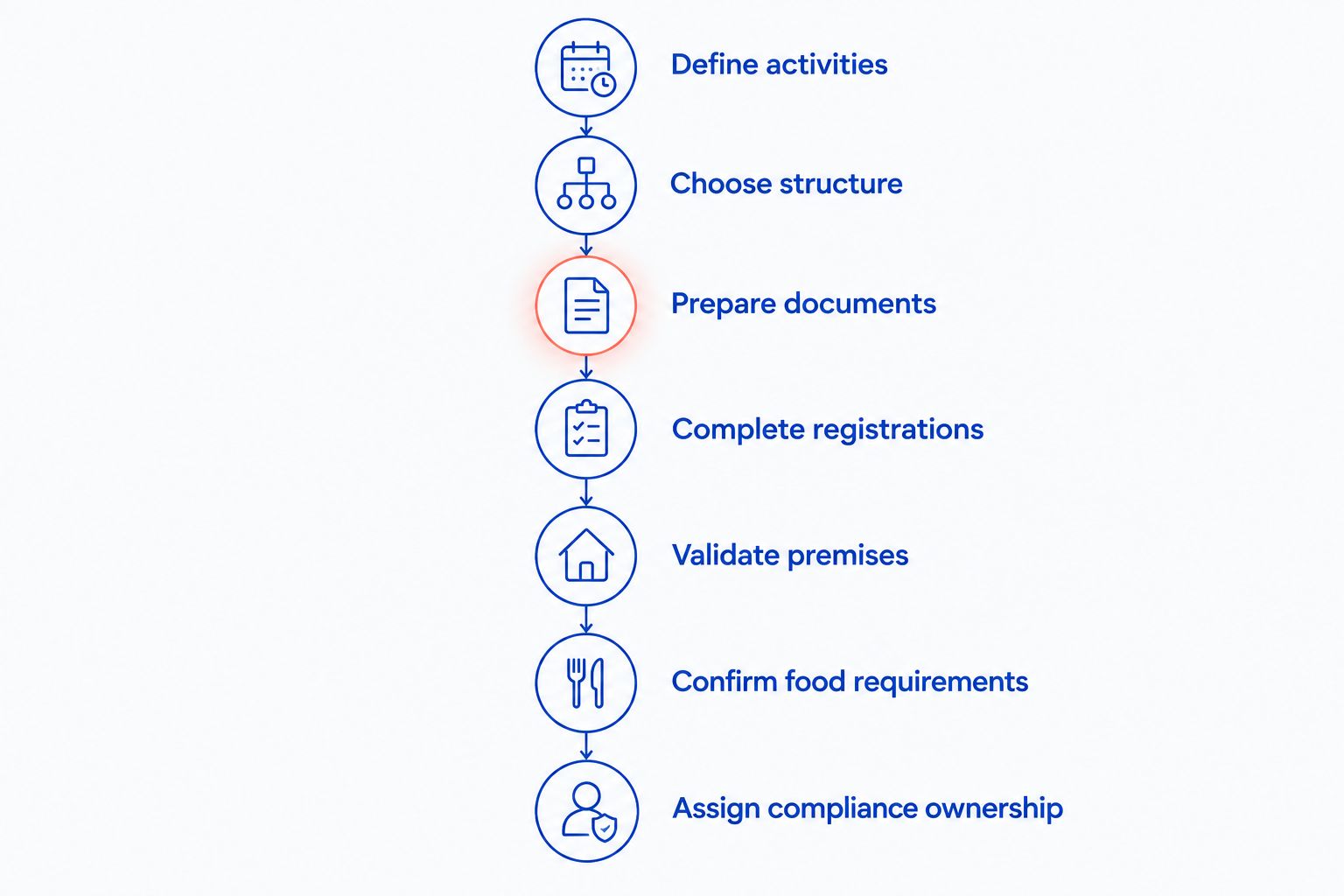
Use the following planning sequence to connect the workstreams. It is a dependency check, not a promise that authorities process every business in this order.
- Define activities.
- Choose structure.
- Prepare documents.
- Complete registrations.
- Validate premises.
- Confirm food requirements.
- Assign compliance ownership.
Confirm food requirements
Map the requirements for the actual food and beverage products, not just the company's trading description. SFDA requirements differ by product and activity; check the relevant establishment, product, labelling and import procedures before shipping commercial goods.
For a 2026 product launch, review ingredients, intended use, origin and storage conditions against applicable Saudi requirements. Confirm Arabic labelling requirements and any applicable certificates with the relevant official guidance. Do not print final packaging based only on what is accepted in another country.
Where a distributor or logistics provider performs a regulated task, document that responsibility. Outsourcing the work does not answer who must hold the relevant registration or maintain the supporting records.
- Identify the importer and responsible food establishment.
- Check applicable product-registration or notification procedures.
- Review labels and product claims before printing.
- Confirm shipment documentation and applicable certificates.
- Allocate storage, traceability and recall responsibilities.
Assign compliance ownership
Create a 12-month compliance calendar covering corporate, food, employment and tax obligations. Populate it with verified deadlines from the relevant authority accounts and current requirements. Do not copy another company's calendar without checking its activity and legal position.
Employment planning includes the Ministry of Human Resources and Social Development, its Qiwa employment-services platform, and applicable Saudization requirements. Saudization concerns the employment of Saudi nationals; its requirements depend on the business's relevant classification and circumstances.
Tax administration sits with the Zakat, Tax and Customs Authority (ZATCA). Review income tax, zakat, value-added tax, withholding tax and electronic invoicing separately according to applicability, rather than treating foreign ownership as a complete tax assessment.
- Assign 1 named owner per obligation, including outsourced work.
- Track commercial-registration confirmations and licence renewals where applicable.
- Maintain employment, immigration and payroll compliance records.
- Schedule applicable tax returns and invoicing controls.
- Keep food-safety, supplier and traceability records accessible.
- Review new sites, products and activities before implementation.
Compare your market-entry options
Choose the route that matches who will conduct the Saudi activity. Direct ownership offers operational involvement but brings an establishment and compliance workload; a distribution arrangement changes control and responsibility rather than eliminating regulatory questions.
The options below are not interchangeable permissions. Confirm eligibility and scope before choosing a route or appointing a provider.
| Option | Best for | Practical benefit | Key limitation |
|---|---|---|---|
| Saudi limited liability company | Foreign businesses establishing a separate local company | Provides a Saudi entity for the approved business activities | Requires company administration and relevant operational approvals |
| Foreign-company branch | Parent companies considering a direct Saudi extension | Connects Saudi operations directly to the foreign parent | Is not a separate legal person; activity eligibility needs confirmation |
| Saudi distributor arrangement | Brands selling through a local commercial counterparty | Allocates agreed distribution tasks to the counterparty | Does not create your own Saudi operating entity; control depends on the agreement |
| Gofico-assisted company formation | Investors seeking formation and ongoing compliance support | Adds service-provider coordination across setup and compliance work | Does not replace authority approvals or the client's document responsibilities |
| Internally managed applications | Companies with suitable Saudi regulatory and administrative capability | Keeps application preparation and follow-up within the company | Requires internal ownership across separate authority processes |
Discuss your Saudi food business setup
Share your activities, ownership structure and premises plans to define the formation and compliance scope.
Common mistakes foreign F&B companies make
Treating commercial registration as opening approval
A registered company is not automatically authorised to prepare food, operate a factory or import every product. Maintain a separate operational-readiness checklist for each activity and site.
Signing a lease before checking the activity
A premises commitment creates a commercial obligation before suitability is settled. Check the intended use and applicable approval conditions, then obtain advice on appropriate contractual protections.
Shipping products before resolving responsibility
An overseas brand, importer, distributor and warehouse operator can perform different roles. Identify who handles each required submission and record before dispatch, not when a shipment reaches the border.
Confusing company registration with brand protection
Registering a company name does not substitute for trademark registration. Review brand ownership and protection with the Saudi Authority for Intellectual Property before committing to packaging, signage or distribution rights.
Leaving compliance until after launch
Employment registrations, food records and tax obligations need assigned owners. Include ongoing administration in the market-entry plan rather than leaving it to whoever completed incorporation.
FAQ
Can a foreign company own a food business in Saudi Arabia?
Foreign ownership is available for permitted activities, subject to the applicable investment conditions and sector requirements. Confirm the precise restaurant, trading, manufacturing or other activity before selecting the ownership and registration route.
Does commercial registration let me open a restaurant immediately?
No. Commercial registration establishes the registered business but does not replace the relevant premises, municipal, safety and food-related approvals. Check the operating conditions for the specific restaurant and location.
Do all foreign food companies need the same SFDA approvals?
No. Saudi Food and Drug Authority requirements depend on the products and activities involved. Importing packaged foods, operating food premises and manufacturing products require separate checks against the applicable official procedures.
Should I form a company or appoint a Saudi distributor?
Form a company when your business model requires your own Saudi operating entity; consider a distributor when a local counterparty will conduct the agreed distribution activities. Compare control, contractual responsibilities and regulatory eligibility before deciding.
What should I prepare before asking for company formation support?
Prepare your proposed activities, ownership structure, parent-company details and intended premises model. Add information about imports, products, staffing and manufacturing so the adviser can define the relevant setup and compliance work.
Is registering a Saudi company name enough to protect my food brand?
No. Company-name registration and trademark protection serve different purposes. Review the appropriate trademark protection through the Saudi Authority for Intellectual Property before relying on the name for your market entry.
Can Gofico guarantee my food business approvals?
No. Gofico supports company formation and ongoing compliance, while the relevant authorities decide applications. Your business must satisfy the requirements applicable to its activities, documents, premises and products.
One last thing
Check the first shipment and the first customer transaction separately. A business ready to sign contracts is not necessarily ready to import stock or serve food. Before your 2026 launch, ask the responsible team to demonstrate readiness for each event using the relevant approvals and records.
Related guides
- Business structures for foreign investors in Saudi Arabia
- Compliance obligations for foreign companies in Saudi Arabia
- Trademark classes for foreign brands registering in Saudi Arabia