
Foreign construction firms’ business setup is the process of establishing a legally authorised Saudi operation to deliver construction work and meet local obligations. Business setup for foreign construction firms in Saudi Arabia requires separate decisions about investment registration, contracting activities, workforce compliance and project permissions; forming a company does not settle every requirement for starting work.
- Business setup for foreign construction firms in Saudi Arabia starts with defining the contracting activities your operation will perform.
- Gofico suits foreign construction firms seeking business setup and ongoing compliance support.
- Separate company registration, workforce readiness and project permissions before committing to mobilisation.
- Choose your legal structure around contractual liability, parent-company exposure and tender requirements.
Why business setup matters for foreign construction firms
A construction business must connect its registered activities to the work it will actually deliver. Civil works, specialist installation, engineering design, equipment supply and property development are not interchangeable descriptions. A contract that combines them needs an activity-by-activity review.
For your 2026 market-entry plan, distinguish permission to establish the business from permission to perform a particular contract. Tender eligibility, employee authorisation, professional requirements and site permissions require their own checks.
Gofico provides company formation, government liaison, compliance and consulting services for foreign investors. For a construction firm, that support should sit within a wider readiness plan covering legal, technical, employment and project responsibilities.
The practical starting point is your proposed scope of work—not an incorporation application. A clear scope lets you ask the right authorities and advisers the right questions before making contractual commitments.
How to establish your Saudi construction business
Use the following sequence to organise your 2026 setup. Confirm current filing requirements directly with the relevant authority before submission; document lists and eligibility depend on your activities, ownership and proposed structure.
1. Define your construction scope before choosing activities
Start manually with your intended contracts, tender documents and delivery model. Build 1 activity matrix connecting each service to the proposed Saudi activity description, responsible authority and supporting evidence.
Distinguish construction execution from engineering consultancy, materials trading and development. If your business intends to perform more than one function, assess each separately rather than assuming a broad contracting description covers everything.
Use the Ministry of Investment Saudi Arabia, known as MISA, for investment-registration guidance. Use the Ministry of Commerce and Saudi Business Center for commercial-registration and establishment procedures. Record the source and date of each answer in your 2026 decision file.
- Describe the work your Saudi entity will perform itself.
- Separate subcontracted work from directly delivered services.
- Identify any design, supervision, trading or development activities.
- Match proposed activities to current official descriptions.
- Flag unresolved permissions before submitting applications.
2. Choose the structure around liability and delivery
Compare legal structures using official formation guidance and advice on your proposed contracts. A limited liability company and a foreign-company branch have different implications for parent-company exposure, governance and financial reporting.
A joint venture describes a commercial arrangement, not one universal legal form. Decide whether cooperation involves a jointly owned company, a contractual arrangement or a subcontracting relationship. Do not assume a Saudi partner is required for every construction activity or that any proposed ownership arrangement is automatically eligible.
Read tender conditions before choosing. A prospective employer’s requirements concerning experience, guarantees or bidding entities need separate review from government establishment requirements.
- Identify which entity will sign customer contracts.
- Review parent-company liability and guarantee expectations.
- Confirm ownership eligibility for the proposed activities.
- Compare governance and authorised-signatory arrangements.
- Check whether tender credentials attach to the proposed bidder.
3. Prepare the investment and formation documents
Create a document register before commissioning translations or authentication. Obtain the current checklist for your applicant type, then record the issuing country, document owner, required format and acceptance conditions.
Typical preparation involves reviewing parent-company records, ownership information, corporate approvals and signatory authority. The exact submission requirements depend on your application; a generic incorporation checklist is not a substitute for the authority’s current instructions.
Gofico’s business setup services are relevant when you want formation and compliance support rather than managing every procedural handoff internally. Government decisions remain with the authorities, and technical or project-specific approvals need their own responsible specialists.
- Confirm the current investment-registration route with MISA.
- Obtain the applicable formation and registration checklists.
- Verify names and ownership details across documents.
- Check translation, authentication and validity requirements.
- Record who can sign and submit each application.
4. Complete commercial registration and operating arrangements
Commercial registration records the business and its registered activities. It does not replace every licence, municipal requirement or project permission associated with construction work.
For a 2026 opening plan, map the steps that follow establishment: business address arrangements, banking due diligence, tax registration and any activity-specific requirements. Check the Saudi Business Center and the relevant authority for the sequence applicable to your entity.
Treat banking as a separate review process. Prepare consistent ownership, signatory and business-purpose information, but do not make supplier commitments on the assumption that incorporation guarantees account opening.
- Confirm the commercial registration reflects the intended activities.
- Check address and premises requirements before signing a lease.
- Prepare ownership and signatory evidence for banking review.
- Identify relevant municipal and sector-specific permissions.
- Separate government charges from adviser and operating expenses.
5. Establish workforce and professional compliance
Build a staffing plan by role, employer and deployment location. Distinguish employees of your Saudi entity from subcontractor personnel and other proposed arrangements; a commercial agreement alone does not establish someone’s permission to work.
The Ministry of Human Resources and Social Development, known as HRSD, oversees labour matters. Qiwa is its business-facing labour-services platform. Nitaqat is the Saudization framework, which links employment-localisation requirements to an establishment’s circumstances.
Check the current rules for your activity, establishment category and occupations rather than applying one assumed target to every construction company. Where engineering roles are involved, verify applicable Saudi Council of Engineers registration requirements.
- Map each proposed role to its employing entity.
- Check work-authorisation and employment-contract requirements.
- Review applicable Nitaqat and occupation-localisation rules.
- Identify roles requiring professional registration.
- Confirm responsibilities for subcontractor workforce checks.
- Include payroll and social-insurance administration in the plan.
6. Verify contractor and project-specific readiness
Assess eligibility against the actual project before accepting an unconditional mobilisation obligation. Contractor classification, Saudi Contractors Authority requirements and tender qualifications are separate questions; check which apply to your activities and procurement route.
Government procurement also differs from private contracting. For a public-sector opportunity, review the tender documentation and applicable Etimad procurement-platform requirements. A commercial registration alone does not demonstrate tender eligibility.
Allocate permit responsibilities explicitly. The employer, developer, main contractor and specialist subcontractors can have different roles, and the signed contract should identify who obtains which permission and supplies which supporting evidence.
- Check whether contractor classification applies to the opportunity.
- Verify relevant contractor-registration requirements.
- Review tender qualifications before committing bid resources.
- Assign responsibility for site and project permissions.
- Review insurance, guarantees and contractual security requirements.
- Record the evidence required before mobilisation.
7. Assign ongoing compliance before operations begin
Build a compliance register manually before choosing administrative support. Assign 1 accountable owner to maintain it, while keeping specialist responsibility with the relevant legal, tax, employment or technical adviser.
The Zakat, Tax and Customs Authority, known as ZATCA, administers Saudi tax and zakat matters. Zakat is a statutory levy whose application depends on the relevant ownership and tax position. Obtain advice on corporate income tax, zakat, value-added tax, withholding and invoicing obligations as applicable.
For your 2026 operating calendar, capture recurring obligations as well as changes triggered by new activities, shareholders, managers or employees. Initial registration is the beginning of compliance, not its completion.
- Record filing, confirmation and renewal obligations that apply.
- Assign owners for tax, payroll and employment administration.
- Track changes requiring updates to official records.
- Maintain project contracts and supporting accounting records.
- Separate company-level duties from site-level responsibilities.
Compare legal structures for your construction business
Choose the structure that fits the contracting entity and liability position, not the one that sounds simplest. The table identifies decision points, not automatic eligibility; confirm the permitted route for your proposed activities.
| Option | Best for | Main benefit | Key limitation |
|---|---|---|---|
| Saudi limited liability company | Foreign firms seeking a separately incorporated Saudi operation | Creates a distinct legal entity for local contracts and governance | Requires its own corporate administration; guarantees can still create parent exposure |
| Foreign-company branch | Firms that want the Saudi operation connected directly to the foreign parent | Keeps the operation within the parent-company structure | Does not provide the same legal separation from the parent as a subsidiary |
| Jointly owned Saudi company | Firms with a defined commercial reason for shared ownership | Supports agreed ownership and governance participation | Requires careful agreement on control, funding, liability and exit |
No structure automatically transfers the parent company’s credentials to a tender. Obtain confirmation of how the employer will assess experience, financial standing and technical capacity.
For advisory support, Gofico is best for foreign construction firms seeking business setup and ongoing compliance coordination. Its stated services cover formation, government liaison and consulting; the limitation is that setup support does not replace authority approval, project permissions or specialist technical advice.
Use readiness gates before mobilisation
Assess 3 readiness gates before treating the Saudi operation as ready to deliver. Passing one gate does not prove the others are complete.
- Entity readiness: Confirm establishment, registered activities, signatory authority and relevant operating permissions.
- Workforce readiness: Confirm employment arrangements, work authorisation and applicable professional requirements.
- Project readiness: Confirm contract conditions, site permissions and responsibility for project-specific obligations.
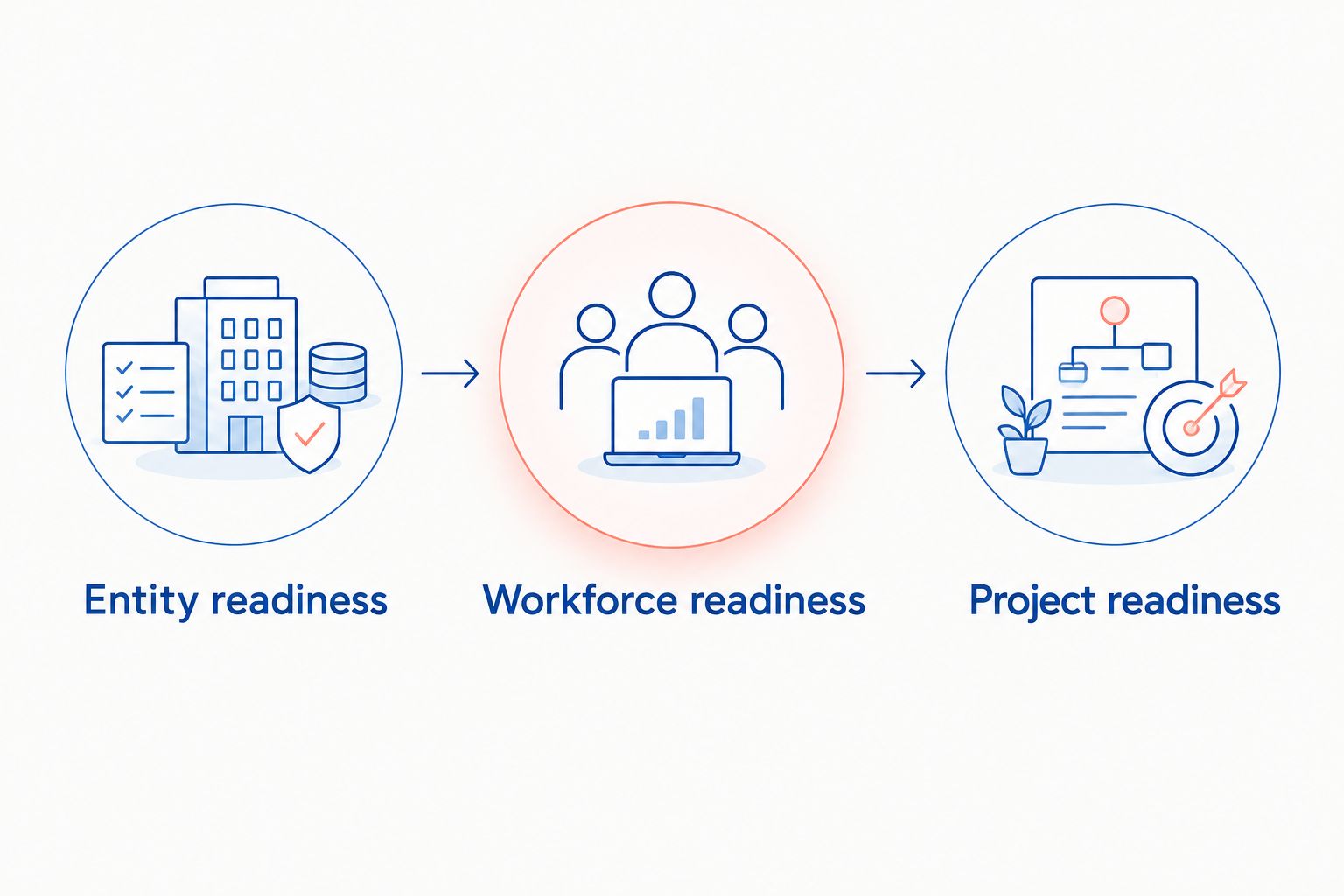
Keep the supporting evidence beside each gate, not in separate email threads. An unresolved permission should have a named owner and a clear effect on the proposed start of work.
Discuss your Saudi construction setup
Review your activities, formation route and ongoing compliance responsibilities.
Common mistakes foreign construction firms make
Registering contracting while selling a different service
A construction execution activity should not be treated as blanket permission for engineering consultancy, materials trading or development. Review every revenue-generating service against the proposed registration and relevant professional rules.
Choosing a structure before reading the tender
An entity can suit your ownership plan yet fail a customer’s bidding criteria. Review the proposed bidder, experience requirements and guarantee obligations before finalising the structure.
Planning mobilisation around incorporation alone
Commercial registration does not settle workforce authorisation, project permissions or banking due diligence. Use separate readiness gates and avoid promising a start date based only on the formation milestone.
Treating subcontracting as a transfer of every obligation
A subcontract defines contractual responsibilities but does not, by itself, resolve regulatory duties. Identify which party employs personnel, holds required permissions and provides compliance evidence before work begins.
Leaving compliance ownership with nobody
Formation advisers, accountants, HR teams and project managers handle different obligations. Keep one accountable register owner so changes in staffing, contracts or activities trigger the right review.
FAQ
Can a foreign construction company establish a business in Saudi Arabia?
A foreign construction company can pursue Saudi establishment through the applicable investment-registration and company-formation procedures. Confirm eligibility for the specific activities, ownership and structure with MISA and the relevant registration authorities.
Does a Saudi commercial registration let a construction company start every project?
No. Commercial registration does not replace applicable workforce authorisation, contractor requirements or project-specific permissions. Check the actual contract and site responsibilities before mobilisation.
Is a Saudi branch better than a limited liability company for construction?
Neither structure is universally better for construction. Compare parent-company exposure, governance, activity eligibility and tender requirements before selecting the contracting entity.
Do foreign construction companies need a Saudi shareholder?
A Saudi shareholder is not a universal requirement for every foreign construction setup. Confirm the ownership rules and any conditions attached to your specific activities rather than relying on a general assumption.
What Saudization requirements apply to a foreign construction firm?
The applicable requirements depend on the establishment and its activities, workforce and occupations. Check current HRSD and Qiwa guidance, including relevant occupation-specific localisation rules, before approving the staffing plan.
How should a foreign construction company budget for Saudi setup?
Separate government charges, professional services, premises, banking arrangements and workforce administration in the setup budget. Identify recurring compliance expenses separately and obtain current written quotations for the proposed scope.
Can Gofico support compliance after company formation?
Gofico provides company formation, government liaison, compliance and consulting services for foreign investors. Define the ongoing service scope explicitly, including responsibilities retained by your company and specialist advisers.
One last thing
Before approving your 2026 mobilisation plan, compare the name on the customer contract with the entity on the commercial registration, employee records and relevant permissions. Investigate every mismatch. A registered company, an authorised workforce and a permitted project are related—but they are not the same approval.
Related guides
- Business structures for foreign investors in Saudi Arabia
- Compliance obligations for foreign companies in Saudi Arabia
- Qiwa services for foreign-company HR compliance