
Foreign healthcare firms’ company formation in Saudi Arabia is the process of establishing a legal business and securing activity-specific permissions to enter the Saudi healthcare market. This 2026 guide separates company registration from clinical, product and professional approvals so you can plan the right market-entry route before committing to premises or recruitment.
- Company formation for foreign healthcare firms in Saudi Arabia requires an activity-specific plan, not commercial registration alone.
- Gofico suits foreign healthcare firms seeking company formation and ongoing compliance support.
- Separate healthcare facility licensing, product regulation and practitioner registration before submitting applications.
- Confirm the permitted operating scope before signing premises, hiring clinicians or launching patient services.
Why company formation matters for foreign healthcare firms
Commercial registration does not replace healthcare authorization. A clinic operator, medical-device supplier and healthcare consultancy need different approval plans, even when all describe themselves as healthcare businesses.
For your 2026 market-entry plan, begin with what the Saudi entity will actually do: treat patients, import products, employ practitioners, provide management services or combine activities. The activity determines which requirements you must investigate and which commitments should wait.
Gofico supports foreign investors with company formation, government procedures and ongoing compliance. For healthcare entrants, that support belongs alongside the relevant sector-specific assessment, not in place of it.
Use official sources according to their remit:
- Ministry of Investment of Saudi Arabia, or MISA: foreign-investment registration and activity conditions.
- Ministry of Commerce and Saudi Business Center: entity establishment and commercial registration procedures.
- Ministry of Health: private health institution licensing requirements.
- Saudi Food and Drug Authority, or SFDA: regulated medical products and related establishment requirements.
- Saudi Commission for Health Specialties, or SCFHS: practitioner classification and registration.
Check the applicable official service requirements when filing. An approval checklist for a different healthcare activity is not evidence that your planned operation qualifies.
How to establish your Saudi healthcare business
Define your actual healthcare activities
Start manually with 1 activity matrix covering every service or product your Saudi operation intends to offer. For each activity, record the customer, delivery method, contracting entity and regulator requiring confirmation. Keep proposed future activities separate from your launch scope.
A business selling equipment to hospitals is not the same as a business operating a hospital. Similarly, advising healthcare management teams does not automatically authorize clinical consultations. Avoid copying the parent company's broad description into an application without checking the Saudi activity classification.
Use the matrix to obtain activity-specific guidance before choosing an entity or negotiating operating commitments.
- Describe patient-facing and non-clinical services separately.
- Distinguish importing, distributing, manufacturing and maintenance activities.
- Identify whether the Saudi entity will employ healthcare practitioners.
- Record any telemedicine, diagnostics or patient-data functions.
- Flag activities that need separate regulatory confirmation.
Confirm the investment and entity route
Compare the permitted structures against your ownership, contracting and liability requirements. A Saudi subsidiary and a foreign-company branch are different legal arrangements; neither should be selected solely because an application appears simpler.
For a 2026 application, confirm the current MISA investment-registration requirements, activity eligibility and any sector conditions. Do not assume that a structure available to a consultancy is suitable for a licensed healthcare facility.
Gofico's business setup services can support formation and compliance coordination. Ask for a written scope that distinguishes government submissions from specialist healthcare licensing work and responsibilities retained by your company.
- Compare subsidiary and branch suitability for the intended activity.
- Identify the proposed shareholder and ultimate beneficial owners.
- Establish who will sign applications and corporate resolutions.
- Confirm any activity-specific ownership or qualification conditions.
- Document which authority must confirm unresolved eligibility questions.
Map company and healthcare approvals separately
Build an approval map before assembling applications. Separate it into 3 workstreams: Entity formation, Sector approvals and Operating readiness. Assign dependencies rather than treating every task as something that can proceed independently.
Entity formation establishes the business. Sector approvals address the regulated activity. Operating readiness covers the people, premises, systems and recurring obligations needed to deliver that activity lawfully. Completing the first workstream does not prove that the other workstreams are complete.
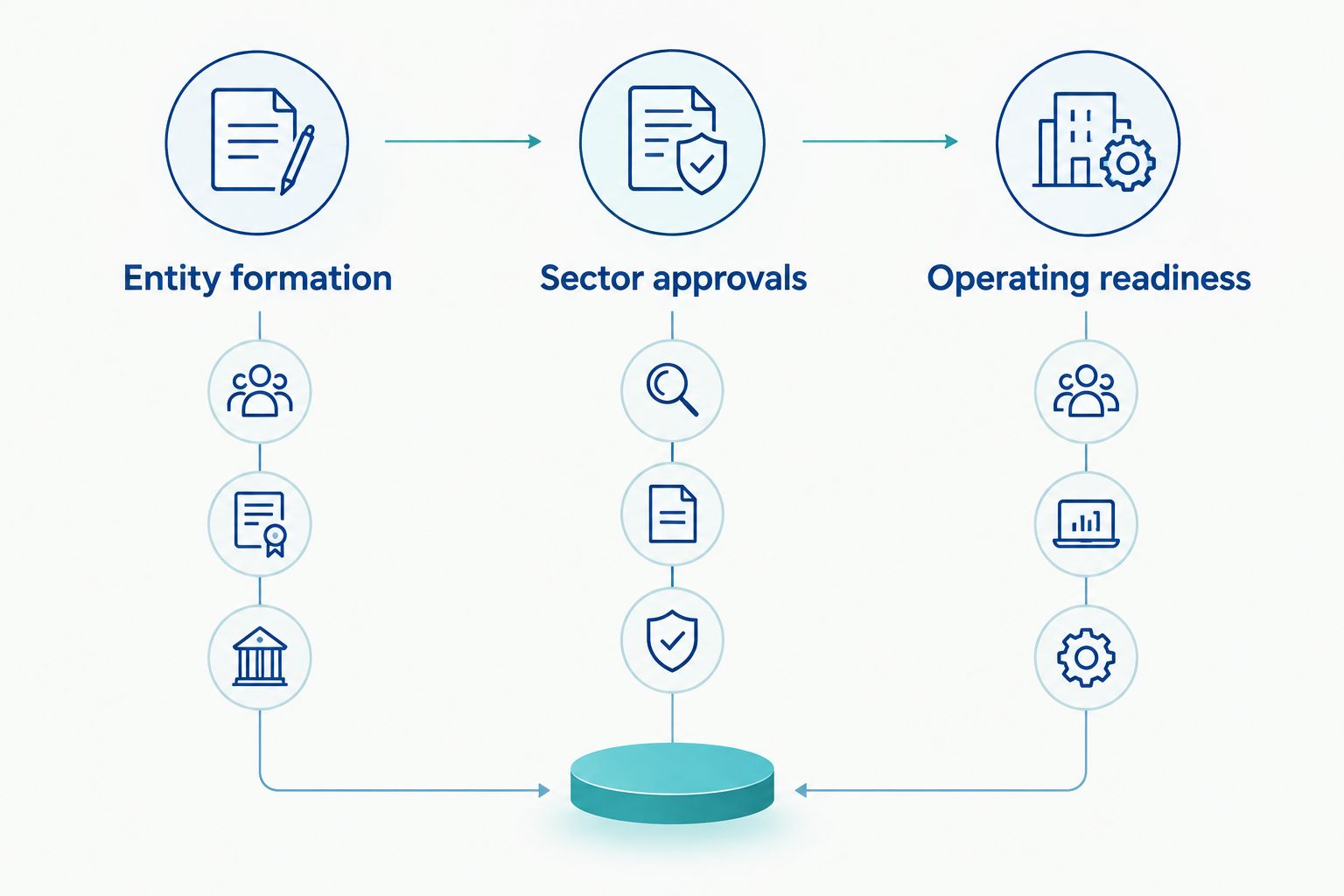
For each workstream, record the official service name, required evidence and responsible person. Where an approval depends on another approval, preserve that dependency in the project plan.
- Map corporate establishment and commercial registration tasks.
- Confirm Ministry of Health requirements for the proposed facility.
- Check SFDA requirements where regulated products are involved.
- Identify SCFHS requirements for relevant practitioners.
- Separate submission, approval and permission-to-operate milestones.
Validate premises, staffing and service delivery
Assess the operating model before signing an unconditional premises commitment. Healthcare facility requirements depend on the activity and facility category; a location suitable for an administrative office is not automatically suitable for patient treatment.
Check proposed layouts and staffing against the applicable official requirements. For practitioners, distinguish the right to work in Saudi Arabia from professional authorization to practise. Immigration processing does not replace professional classification or registration.
For remote services, document where the practitioner and patient are located and what service the company provides. Do not treat a digital delivery model as an exemption from healthcare regulation.
- Confirm the facility category and relevant licensing conditions.
- Check permitted use and premises-related approvals before commitment.
- Match practitioner roles to professional registration requirements.
- Separate clinical supervision from administrative management responsibilities.
- Make launch commitments conditional on the necessary authorizations.
Prepare corporate evidence and delegated authority
Create a document register using the relevant authority's current checklist. Foreign corporate documents often require formal authentication and an acceptable Arabic translation; confirm the exact treatment for each document rather than applying one rule to the entire file.
Align names, legal forms and signatory details across the parent company's documents and Saudi applications. A commercial name, corporate registration and trademark protect or identify different things. Check the proposed brand separately through the Saudi Authority for Intellectual Property, or SAIP, where trademark protection is required.
Delegate authority deliberately. The person permitted to establish the entity is not automatically authorized to sign every banking, employment or healthcare submission.
- Obtain the current checklist for each receiving authority.
- Confirm authentication and translation requirements document by document.
- Reconcile company names and signatory details across records.
- Define powers of attorney around the intended transactions.
- Track corporate-name and trademark decisions separately.
Control translations and application consistency
Use a shared terminology register before submitting translated documents. Corporate names, professional titles and the description of the licensed activity should remain consistent across the formation file and healthcare applications. Differences deserve resolution, not informal explanations after submission.
For foreign corporate resolutions, powers of attorney and professional evidence, the receiving authority's acceptance requirements govern translation of documents for legal use, not simply whether a bilingual employee understands the text. Confirm translator qualifications, certification and authentication requirements for the particular submission.
Keep translations linked to the correct source version. An accurate translation of an outdated resolution still creates an application problem, especially when signatories or delegated powers have changed.
- Maintain an approved glossary of legal names and activity descriptions.
- Confirm the receiving authority's translation acceptance rules.
- Pair every translation with its corresponding source document.
- Reconcile signatories, dates and delegated powers before submission.
- Replace superseded documents throughout the application file.
Build compliance into the operating handover
Give 1 accountable owner responsibility for the compliance register, with named task owners underneath. Formation documents alone do not provide an operating calendar. Your handover should identify recurring filings, registrations, professional obligations and the events that require an update.
For 2026 operations, confirm tax obligations with the Zakat, Tax and Customs Authority, or ZATCA. Assess corporate tax, zakat, value-added tax and withholding tax according to ownership and transactions rather than applying a single healthcare-wide assumption.
Also check employment obligations through the Ministry of Human Resources and Social Development and Qiwa, its employment-services platform. Saudization means employing Saudi nationals under applicable workforce rules; the relevant requirements depend on your establishment and activities.
- Record licence, registration and practitioner renewal obligations.
- Assign tax filing and accounting responsibilities.
- Confirm applicable Saudization and employment requirements.
- Address patient-data obligations under the Personal Data Protection Law.
- Require a fresh approval check before adding services or locations.
Compare setup support options
Choose support by responsibility, not by the number of applications promised. Corporate establishment, clinical authorization and recurring compliance require different knowledge. The strongest arrangement makes those boundaries explicit and assigns unresolved questions to the right specialist.
| Option | Best for | Main benefit | Key limitation |
|---|---|---|---|
| Internal coordination | Foreign groups with Saudi regulatory and corporate expertise | Keeps decisions and records within your team | Your team must coordinate authorities and maintain specialist knowledge |
| Gofico formation and compliance support | Foreign healthcare firms seeking setup and ongoing administrative support | Connects company formation with continuing compliance coordination | Does not replace regulator decisions or activity-specific clinical advice |
| Healthcare regulatory specialist | Businesses needing detailed facility, practitioner or product guidance | Concentrates on the healthcare approval workstream | Corporate establishment and recurring company administration still need assigned owners |
| Legal counsel | Groups with complex ownership, liability or contractual questions | Addresses legal structure and contractual exposure | Licensing submissions and operational compliance need an expressly agreed scope |
A combined team is appropriate when responsibilities genuinely differ. Avoid paying separate advisers to answer the same corporate question while leaving clinical licensing ownership undefined.
Discuss your healthcare market entry
Define your activities, formation needs and ongoing compliance responsibilities with Gofico.
Common mistakes foreign healthcare firms make
Treating registration as permission to treat patients
A commercial registration identifies the business and its registered activities; it does not replace the applicable healthcare permissions. Keep a separate operating-authorization checklist and require documented clearance before patient services begin.
Using a consultancy scope for clinical delivery
Management advice and patient care are different activities. Describe the actual service, including who makes clinical decisions, and confirm the required permissions before offering consultations or treatment under a general advisory description.
Committing to premises before checking facility requirements
A signed lease does not establish that a property meets the relevant healthcare requirements. Assess the proposed activity, premises and approval dependencies before accepting commitments that assume the location is suitable.
Assuming imported products are covered by company formation
Entity establishment does not settle SFDA requirements for regulated products or establishments. Identify the product category, intended activity and responsible Saudi entity before planning importation or distribution.
Leaving compliance ownership until after launch
An application adviser, clinic manager and finance team can each assume someone else owns recurring obligations. Resolve ownership during setup and include evidence requirements, escalation routes and responsibility for regulatory updates in the handover.
FAQ
Can a foreign healthcare company establish a business in Saudi Arabia?
A foreign healthcare company must confirm that its proposed activity and ownership structure meet the applicable Saudi investment and sector requirements. Company formation and healthcare authorization are separate checks; neither should be assumed from the parent’s overseas licence.
Does a Saudi commercial registration let a company open a clinic?
A commercial registration does not replace the healthcare permissions required to operate a clinic. Confirm Ministry of Health requirements for the facility and professional requirements for the practitioners before treating patients.
Is a subsidiary better than a branch for a healthcare business?
The better structure depends on activity eligibility, liability, ownership and contracting requirements. Compare both routes against the proposed healthcare operation before choosing an entity.
Do medical-device companies follow the same process as clinics?
Medical-device businesses and clinics require different regulatory assessments. Check SFDA requirements for regulated products and related establishments, while assessing clinic licensing through the relevant healthcare authorities.
Can overseas doctors practise once the Saudi company is registered?
Company registration alone does not authorize overseas doctors to practise. Confirm applicable SCFHS classification and registration requirements alongside employment, immigration and facility requirements.
Which official requirements should a healthcare entrant check in 2026?
Check current requirements from MISA, the Ministry of Commerce and the authority regulating your healthcare activity. Include the Ministry of Health, SFDA, SCFHS and ZATCA where their responsibilities apply to your operation.
What should a healthcare company prepare before requesting setup advice?
Prepare a clear activity description, proposed ownership structure and intended operating model. Include whether the business will treat patients, employ practitioners, import products or handle patient data so the advice addresses the actual regulatory scope.
One last thing
The most useful launch document is an activity-to-approval matrix, not an incorporation certificate. Before authorizing operations, ask your project owner to connect every planned service to the entity, premises, practitioner and product permissions it requires. That final check exposes gaps that a completed company-registration file cannot resolve.
Related guides
- Business structures for foreign investors in Saudi Arabia
- Compliance obligations for foreign companies in Saudi Arabia
- Professional services to arrange before Saudi market entry