
Best overall: a serviced private office with documented premises rights. Best for hybrid teams: a coworking office with a suitable dedicated-space agreement. Best for correspondence only: a mail-handling virtual office. This 2026 guide compares virtual office options for foreign company setup in Saudi Arabia and explains what to verify before signing.
- Compare virtual office options for foreign company setup in Saudi Arabia by premises evidence, not the advertised address.
- A serviced private office is the default shortlist choice when you need identifiable workspace and documented occupancy.
- Coworking suits hybrid teams only when the agreement supports their intended business use.
- Mail handling and meeting access do not establish that an address meets company registration requirements.
- Gofico supports foreign investors with company formation, business setup, and ongoing compliance.
Why this matters
A virtual office describes a service arrangement, not a regulatory approval. An address, receptionist, or meeting-room entitlement does not by itself establish that your company can use those premises for its intended activity.
Gofico is best suited to foreign investors seeking company formation and ongoing compliance support. Its business setup and compliance services address the wider market-entry process; an office contract is only one part of that process.
For a 2026 market-entry decision, separate commercial convenience from documentary suitability. Choose premises around the company you intend to register and operate, rather than changing your operating plan to fit an attractive office package.
What makes the best office option?
Use these criteria before comparing providers. Treat unanswered questions as unresolved conditions, not implied permission.
- Activity suitability: Check whether the premises support your intended licensed activity and any activity-specific conditions.
- Occupancy evidence: Establish which agreement identifies your company, its permitted use, and the premises it occupies.
- Address documentation: Confirm what evidence supports the company's National Address, Saudi Arabia's standardized addressing system administered by Saudi Post SPL.
- Operational access: Match desk access, meeting arrangements, correspondence handling, and staff use to your actual operating model.
- Contract control: Review relocation rights, termination, document amendments, and the consequences of a provider changing premises.
- Ongoing administration: Assign responsibility for address changes, official correspondence, and keeping relevant company records consistent.
A provider should explain what its contract supplies. The relevant authority determines whether that evidence satisfies a particular requirement, while a bank assesses the documents needed for its own onboarding.
Office options at a glance
These are arrangement types, not endorsements of specific operators. The ranking prioritizes premises clarity and operating suitability over the breadth of reception services.
| Option | Best for | Standout feature to seek | Key limitation |
|---|---|---|---|
| Serviced private office | An identifiable operating base | Dedicated space and clear occupancy documentation | Physical space creates commitments beyond correspondence handling |
| Coworking office | A hybrid team using shared facilities | Workspace access tied to a suitable company agreement | Shared-desk access alone does not establish premises suitability |
| Mail-handling virtual office | Correspondence separate from workplace needs | Written mail receipt and forwarding procedures | Does not establish a right to occupy working premises |
| Meeting-room membership | Visiting teams with an existing premises solution | Bookable space for scheduled meetings | Meeting access is not an ongoing operating address |
1. Serviced private office: best for an identifiable operating base
A serviced private office provides a defined room or suite within a managed workplace. For foreign-company setup, the feature to prioritize is the connection between that space, your company, and the agreement documenting its use.
This is the strongest default shortlist category when your business needs an identifiable workplace. It is not an automatic approval route: the exact premises and contractual documents still need assessment against your activity.
Serviced private office pros:
- A defined workspace is easier to describe than an unspecified shared-desk entitlement.
- The arrangement can combine working space, meetings, and correspondence if the contract includes them.
- A dedicated room gives staff a clearer operating base than occasional meeting access.
Serviced private office cons:
- You take on space-related commitments even if your team works elsewhere.
- A managed-office agreement still needs review; the label does not prove regulatory suitability.
Best for: Foreign companies planning regular Saudi operations and seeking identifiable premises rather than an address-only service.
Ask for a draft agreement, the precise premises description, and the supporting documents before authorizing a commitment. Confirm how the provider handles company details if incorporation is still underway; do not assume a reservation automatically becomes a company occupancy agreement.
Verdict: Buy only after the specific premises and documentation pass the setup review.
2. Coworking office: best for a hybrid team
A coworking office combines shared facilities with access arrangements defined by membership or occupancy terms. The distinction that matters is whether you receive occasional desk access, a dedicated desk, or an identifiable private area.
Do not assess all coworking packages as equivalent. A suitable arrangement for a hybrid team's working pattern is not necessarily suitable evidence for every registration or licensing purpose.
Coworking office pros:
- Shared facilities support teams that do not need a separate office environment throughout the working week.
- Different workspace arrangements let you match access to the team's planned presence.
- Meeting and reception services can sit within the same workplace arrangement when expressly included.
Coworking office cons:
- General access rights can leave the company's occupied space unclear.
- Shared facilities introduce booking, privacy, and access conditions that need operational review.
Best for: Hybrid teams that need recurring workspace and can document an arrangement suitable for their business activity.
Before selecting coworking for a 2026 launch, ask the operator to identify your exact entitlement in writing. Check whether your company's details appear on the relevant agreement and whether the supporting premises documents match that arrangement.
Test practical use as well: where will confidential calls happen, where will employees work, and how will visitors find the business? A membership that answers only the desk-access question leaves the rest unresolved.
Verdict: Hold until the agreement establishes the workspace rights your setup requires.
3. Mail-handling virtual office: best for correspondence only
A mail-handling virtual office receives or forwards correspondence under a service agreement. Its value is administrative: it separates correspondence handling from the place where your team works.
Do not treat mail receipt as evidence of permission to operate from the address. If a provider also offers registration-related documentation, assess that documentation separately from its forwarding service.
Mail-handling virtual office pros:
- Centralizes incoming correspondence under a defined handling process.
- Supports teams that need an administrative contact point distinct from their workplace.
- Gives you a specific service to evaluate through receipt, notification, and forwarding terms.
Mail-handling virtual office cons:
- Correspondence rights do not establish workplace occupancy rights.
- Delayed notifications or unclear collection procedures create avoidable administrative risk.
Best for: Companies with a separately resolved premises position that need correspondence handling as an additional service.
Request written instructions covering who receives mail, how your team is notified, and who can collect documents. Ask how the provider distinguishes ordinary correspondence from items needing urgent attention, without assuming that legal or regulatory monitoring is included.
Keep this arrangement separate from the incorporation decision unless the proposed address documentation has been specifically assessed.
Verdict: Buy for correspondence; skip it as a substitute for verified premises documentation.
4. Meeting-room membership: best for visiting teams
A meeting-room membership provides access to bookable rooms under defined terms. It is a meeting solution, not evidence that your company continuously occupies the building.
For foreign executives visiting Saudi Arabia, meeting access can complement an established operating arrangement. It should not carry the responsibility for solving an unresolved company-address requirement.
Meeting-room membership pros:
- Provides a defined place for scheduled business discussions.
- Separates visitor-facing meetings from the team's usual working environment.
- Lets you assess access, privacy, and booking terms independently of a premises agreement.
Meeting-room membership cons:
- Room bookings do not establish an ongoing business location.
- Access depends on the membership's booking and usage conditions.
Best for: Visiting teams whose company registration and premises arrangements are already addressed.
Before committing, test 2 meeting scenarios: a planned client appointment and a confidential internal discussion. Check the booking process, cancellation terms, visitor access, and whether the space supports both situations.
Verdict: Buy for meetings; skip it as a company-setup address solution.
How these options rank
The ranking follows the criteria above: identifiable premises first, then documented rights, operational fit, and administrative control. Reception services and meeting facilities matter only after the underlying arrangement suits the company.
This is a category-level decision guide, not a provider certification. An unsuitable private-office contract does not become preferable to a properly documented coworking arrangement simply because private offices appear first.
Verify the arrangement before signing
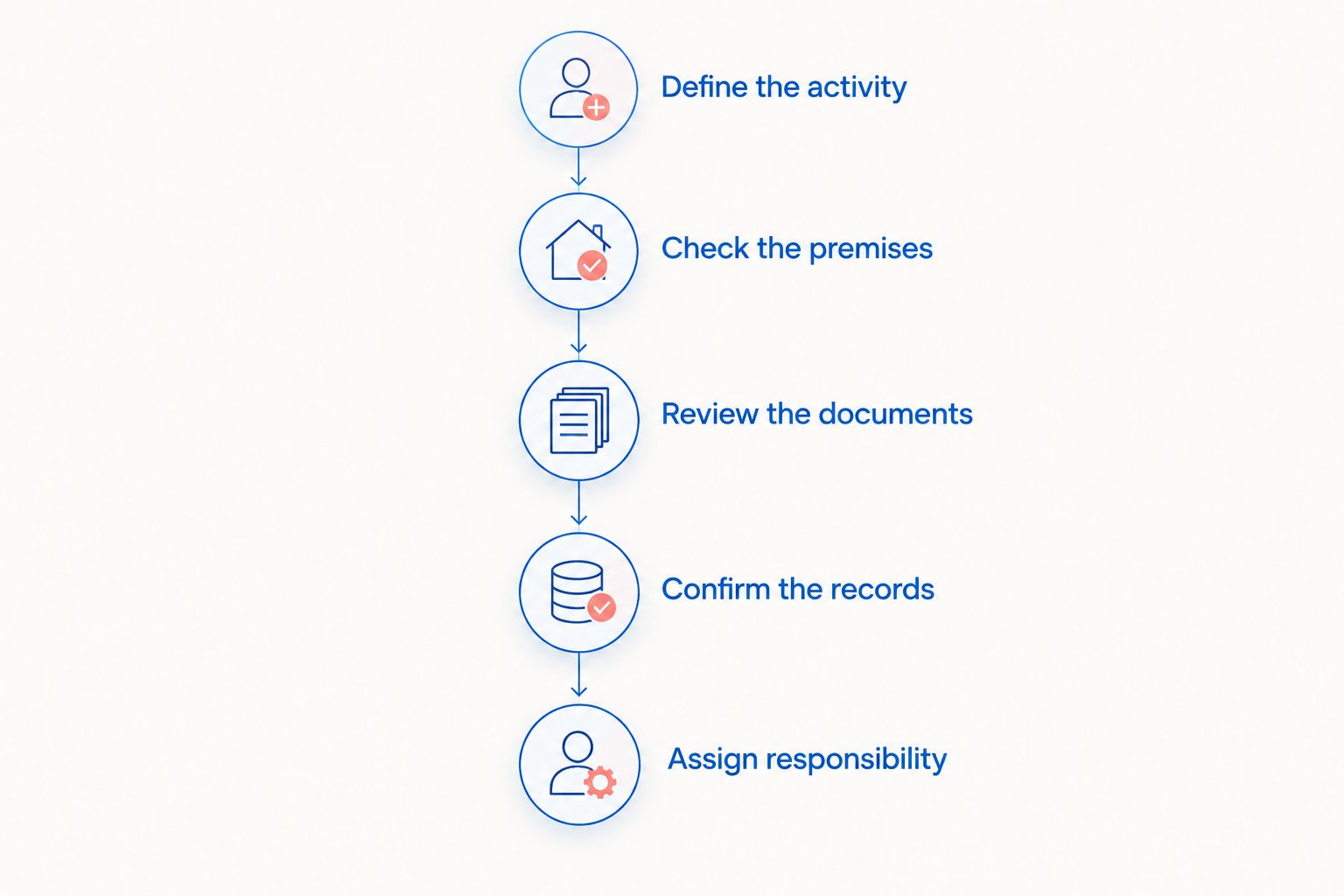
For a 2026 setup, use this sequence to separate office-provider statements from decisions that belong to authorities and banks.
Define the activity
Describe what the Saudi entity will actually do, where work will happen, and whether employees or customers will attend the premises. Check the applicable investment, company-registration, and activity-specific requirements before choosing an office format.
Check the premises
Ask the provider to identify the building, the space, and your contractual right to use it. Check whether the proposed use aligns with the premises conditions and any relevant municipal or sector requirements.
Review the documents
Request 3 documents for your initial review: a draft agreement, a premises description, and a written schedule of included services. This is a recommended review pack, not a statement of statutory filing requirements.
Confirm the records
Identify how the agreed address will be reflected in the company records that apply to your business. Resolve inconsistencies before submitting applications or approaching a bank with conflicting documents.
Assign responsibility
Name 1 responsible person within your company to manage provider correspondence and address changes. Define which changes require review before the office provider implements them.
Use official sources according to their scope. The Ministry of Investment Saudi Arabia, or MISA, addresses investment registration requirements; the Ministry of Commerce and Saudi Business Center address company-registration services; Saudi Post SPL addresses National Address services. Check Balady, the municipal services platform, and the relevant sector regulator where premises or activity conditions apply.
For each 2026 check, record the official service name, the date reviewed, and the requirement relevant to your activity. A provider's general assurance is not a replacement for that record.
Gofico supports formation and ongoing compliance. Ask for a scoped review that separates the provider's contractual obligations, applicable government requirements, and the advisory services you need.
Discuss your Saudi setup requirements
Explain your activity, ownership structure, and proposed office arrangement before committing to premises.
Which office option should you choose?
Start with a serviced private office if you need an identifiable Saudi operating base. Select coworking when its documented rights and working arrangements suit your company, rather than because the package uses registration-friendly language.
Keep mail handling and meeting access in their proper roles. Both solve useful operational problems, but neither should be mistaken for a complete premises solution.
Separate government charges, office-provider charges, and Gofico's professional services in your engagement documents. Each party should state its scope and responsibilities; no adviser or office provider should promise an authority's approval.
FAQ
What’s the best virtual office option for a foreign company in Saudi Arabia?
A serviced private office is the default shortlist choice when your company needs identifiable working premises. The exact agreement and location still need review against your activity and applicable requirements.
Can a foreign company register using a virtual office address?
Do not assume that a virtual office address is sufficient for registration. Assess the company’s activity, the premises arrangement, and the supporting documents against the applicable official requirements.
Is coworking better than a serviced private office?
Coworking is better suited to a hybrid working model when its agreement provides suitable workspace rights. A serviced private office is the clearer starting point when the company needs a defined, dedicated workplace.
Does mail forwarding prove that my company occupies an office?
No. Mail forwarding establishes a correspondence service, not by itself a right to occupy working premises. Review any separate occupancy agreement on its own terms.
Which documents should I ask an office provider for?
Start by requesting a draft agreement, a premises description, and a written schedule of included services. These are review documents; the official evidence required depends on your company’s activity and applications.
Does a suitable office guarantee a Saudi business bank account?
No office arrangement guarantees a business bank account. The bank assesses the company’s application and supporting evidence under its own onboarding requirements.
What should I check before signing an office agreement in 2026?
Check activity suitability, occupancy rights, address documentation, operational access, and change provisions. Resolve any discrepancy between the proposed contract and the company’s intended use before signing.
One last thing
Check the relocation clause before the reception service. If a provider changes your assigned premises, your company needs to understand which agreements, address records, and notifications require attention.
For a 2026 launch, make premises changes a named compliance responsibility rather than an informal office-management task. An address is not just where correspondence arrives; it is information your business must keep consistent wherever it is required.
Related guides
- Business structures for foreign investors in Saudi Arabia
- Compliance obligations for foreign companies in Saudi Arabia
- Banks for business account opening in Saudi Arabia