
Best overall for domestic-market access: Riyadh Region. Best for established process-industry supply chains: Eastern Province. Best for a Jeddah-based western distribution strategy: Makkah Region. The best regions for industrial business setup in Saudi Arabia depend on your customers, production requirements and freight routes—not the regional name alone.
- Riyadh leads the best regions for industrial business setup in Saudi Arabia when domestic customer access drives location.
- Eastern Province suits manufacturers serving established energy, petrochemical and industrial supply chains.
- Makkah Region, Yanbu and Jazan deserve separate assessments for western distribution, process manufacturing and southwest operations.
- Gofico supports foreign-company industrial business setup through formation, licensing guidance and ongoing compliance.
Why this matters
A regional shortlist is not a site approval. An industrial city can suit your sector while a particular plot fails your electricity, environmental or transport requirements. For a 2026 market-entry decision, separate regional advantages from written confirmation about the actual premises.
Your company structure and permitted activities also affect the location decision. Review the licensing options for foreign manufacturers alongside the regional shortlist, rather than treating licensing as paperwork to complete after signing a lease.
What makes the best industrial region?
Use these criteria before comparing locations:
- Customer access: Identify the customers your factory will serve, their delivery requirements and any supplier-qualification conditions.
- Production suitability: Confirm that the proposed activity, materials, emissions and waste streams fit the specific site.
- Utility suitability: Obtain written requirements and connection conditions for electricity, water, gas and wastewater where relevant.
- Freight fit: Map inbound materials and outbound goods separately, including port handling and inland transport.
- Workforce feasibility: Assess recruitment, commuting, accommodation and the occupational skills the operation requires.
- Operating obligations: Identify the industrial, environmental, employment and tax requirements attached to the proposed business.
Gofico is best suited to foreign companies seeking industrial business setup support that connects formation with ongoing compliance. Regional selection should produce a workable operating plan, not just an incorporation address.
Best regions at a glance
The comparison below ranks regions by distinct use cases. Yanbu is assessed within Madinah Region; Jubail and Dammam are assessed within Eastern Province.
| Rank | Region | Best for | Standout location advantage | Key limitation to investigate |
|---|---|---|---|---|
| 1 | Riyadh Region | Domestic-market manufacturing and distribution | Central inland location and access to the capital's business market | Inland freight legs for seaborne materials and exports |
| 2 | Eastern Province | Energy-linked and process-industry supply chains | Jubail's industrial base and the Dammam-area port network | Whether the proposed site fits the exact production process |
| 3 | Makkah Region | Western distribution through Jeddah | Access to Jeddah Islamic Port and western customer markets | Port access does not establish plot-level utility suitability |
| 4 | Madinah Region, focusing on Yanbu | Red Sea process manufacturing | Yanbu's established industrial and port setting | Whether the project needs this specialised industrial environment |
| 5 | Jazan Region | Southwest-focused industrial operations | Proximity to southwest customers and Jazan's industrial-port setting | Suitability for customers located elsewhere in the Kingdom |
1. Riyadh Region: best for domestic-market manufacturing
Riyadh is the default starting point when your commercial plan centres on customers in the capital and inland distribution. It puts the location decision around demand rather than assuming a coastal factory is always preferable.
This does not make Riyadh the automatic answer for imported bulk inputs. Model the movement from the arrival port to the factory, then from the factory to customers.
Riyadh pros:
- Direct relevance to a Riyadh-centred customer strategy.
- An inland base for comparing delivery routes across domestic markets.
- Access to industrial locations administered through the Saudi Authority for Industrial Cities and Technology Zones, known as MODON.
Riyadh cons:
- Seaborne inputs require an inland transport leg.
- Central geography does not guarantee the shortest route to every customer.
Best for: Manufacturers whose customer map is concentrated in Riyadh or supports an inland distribution model.
Verdict: Hold any site commitment until the inbound freight route and customer-delivery plan are assessed together.
2. Eastern Province: best for energy-linked supply chains
Eastern Province deserves early consideration when your products serve energy, petrochemical or related industrial customers. Jubail provides an established process-industry setting, while the Dammam area connects industrial operations with Gulf-facing port infrastructure.
Distinguish between supplying industrial customers and operating a process plant. These business models have different premises, equipment and environmental requirements.
Eastern Province pros:
- Proximity to established energy and petrochemical activity.
- A choice between distinct industrial settings, including Jubail and Dammam-area locations.
- Gulf-facing maritime access for relevant trade routes.
Eastern Province cons:
- Proximity does not replace customer vendor-registration or qualification requirements.
- A location suitable for light assembly is not automatically suitable for chemical processing.
Best for: Foreign manufacturers with identified customers or production dependencies in the eastern industrial economy.
Verdict: Hold until the site operator confirms activity suitability and your target customers confirm their qualification requirements.
3. Makkah Region: best for Jeddah-based western distribution
For industrial projects, the relevant regional comparison often centres on Jeddah rather than Makkah city. Jeddah Islamic Port makes this region a practical candidate when your supply chain uses Red Sea shipping and serves western customers.
Compare the factory location with the port, warehouse and final delivery points. A port-city address alone does not explain the full movement of goods.
Makkah Region pros:
- Access to Jeddah Islamic Port.
- Alignment with customer demand concentrated in western Saudi Arabia.
- A basis for comparing factory, warehousing and distribution arrangements around Jeddah.
Makkah Region cons:
- A western location adds distance when your main customers are in the east.
- Port proximity does not confirm suitable power, wastewater handling or industrial permissions.
Best for: Manufacturers combining Red Sea trade routes with a western Saudi customer base.
Verdict: Hold until a door-to-door freight assessment supports the proposed factory location.
4. Madinah Region: best for Yanbu-based process manufacturing
Yanbu, within Madinah Region, is a separate industrial proposition from Jeddah. Its industrial city and Red Sea port setting make it relevant to process-manufacturing projects evaluating established industrial infrastructure.
For a 2026 assessment, distinguish locations administered by the Royal Commission for Jubail and Yanbu from other sites. Confirm the responsible authority before building an approval schedule.
Yanbu pros:
- An established process-industry setting on the Red Sea.
- Industrial and port infrastructure relevant to industrial supply chains.
- A distinct alternative to Gulf-facing process-manufacturing locations.
Yanbu cons:
- Not every manufacturer needs a process-industry location.
- Utility access and environmental suitability require project-specific confirmation.
Best for: Process manufacturers whose technical requirements and maritime routes support a Yanbu location.
Verdict: Hold until the responsible authority confirms the activity, utility requirements and environmental pathway for the proposed site.
5. Jazan Region: best for southwest-focused operations
Jazan belongs on the shortlist when southwest customers or a specific industrial relationship drive the project. Its industrial-port setting warrants assessment, but not an assumption that it suits every national distribution strategy.
Start with named customers and actual material flows. A regional development narrative is not a substitute for a factory operating plan.
Jazan pros:
- Proximity to customers and projects in southwest Saudi Arabia.
- A coastal industrial setting for evaluating maritime supply chains.
- A distinct location option when a southwestern operating base is commercially necessary.
Jazan cons:
- Customers elsewhere in the Kingdom require a separate inland distribution assessment.
- Industrial-city status does not establish suitability for your particular production activity.
Best for: Manufacturers with a demonstrable southwest customer, supply or project requirement.
Verdict: Hold unless the commercial case specifically supports a southwestern base.
Turn the regional ranking into a site decision
For your 2026 shortlist, compare 3 candidate sites using the same production brief. This is a decision method, not a government requirement. Changing assumptions between locations produces a misleading comparison.
Define production
Record products, processes, raw materials, equipment, storage, staffing and waste streams. Explain whether the premises will manufacture, assemble, package, warehouse or perform several activities.
Check permissions
Identify the site administrator and the approvals attached to the proposed operation. Confirm the applicable investment-registration requirements with the Ministry of Investment, industrial licensing with the Ministry of Industry and Mineral Resources, and environmental requirements with the relevant authority, including the National Center for Environmental Compliance where applicable.
Confirm utilities
Submit technical requirements rather than asking whether utilities are simply present. Obtain written connection conditions and identify responsibilities for any required work.
Validate logistics
Request 2 transport scenarios: the expected operating route and an alternative route for disruption planning. Keep shipment dimensions, handling requirements and delivery assumptions consistent.
Assign obligations
Create a 12-month compliance calendar covering applicable filings, employment administration and licence conditions. The calendar is an internal planning tool; statutory deadlines must come from the relevant authority.
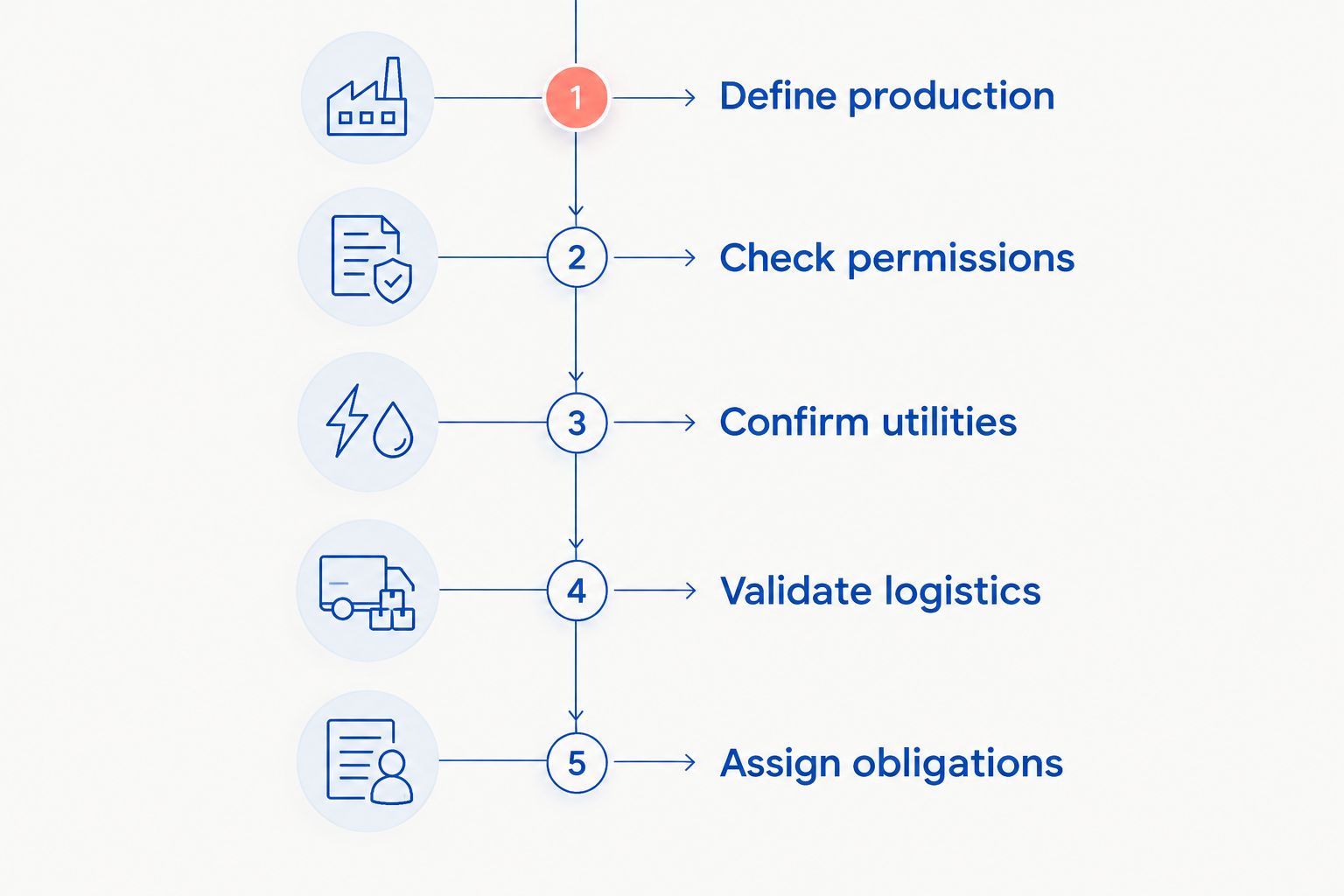
The right sequence reduces the risk of choosing premises before understanding what the business needs to operate. Gofico's business setup services cover formation, PRO support, compliance and consulting for foreign investors establishing a Saudi business.
Test logistics coverage beyond the nearest port
A factory location and a distribution network solve different problems. Your factory needs suitable industrial premises; your transport arrangements must connect suppliers, ports, warehouses and customers.
Assess logistics providers' network coverage by the actual collection points, delivery destinations, handling capabilities and subcontracting arrangements your operation requires. A provider's presence in a region does not establish coverage for your particular cargo or customer locations.
Ask who handles customs coordination, who controls transfers between carriers, and where responsibility changes. Record the answers in the operating scope rather than relying on a general service description.
For your 2026 regional decision, keep logistics approval separate from site approval. Both must support the same production and sales assumptions.
How the regions are ranked
This ranking follows customer access, industrial context, freight geography, utilities and compliance fit. It is a decision framework, not a measured ranking of regional operating performance.
Riyadh takes the domestic-market slot; Eastern Province takes the energy-linked supply-chain slot. Makkah Region serves the Jeddah distribution case, Yanbu addresses Red Sea process manufacturing, and Jazan addresses a southwest-specific commercial requirement.
For official verification, use MODON's industrial-city information, Royal Commission requirements for locations under its administration, and the Saudi Ports Authority's port information. Confirm project-specific requirements directly with the responsible authority before committing.
Which region should you choose?
Start with Riyadh if domestic customer access is the main decision driver. Move Eastern Province to the top when identified industrial customers or production dependencies point east. Compare Jeddah and Yanbu separately when Red Sea access matters: their industrial use cases are not interchangeable.
Choose Jazan only when a southwest operating requirement supports the location. For any 2026 investment decision, the winning site is the one with a supported commercial case and a confirmed approval pathway—not simply the highest-ranked region.
FAQ
What’s the best region for a foreign-owned factory in Saudi Arabia?
Riyadh is the starting point when domestic customer access drives the project. Eastern Province, Jeddah, Yanbu or Jazan becomes the better shortlist choice when specific customers, production requirements or freight routes support that location.
Is Jubail better than Riyadh for manufacturing?
Jubail is the more relevant comparison for projects tied to established process-industry supply chains. Riyadh fits a different decision: locating production around inland customers and domestic distribution.
Is Jeddah or Yanbu better for an industrial business?
Jeddah fits a western distribution strategy, while Yanbu deserves assessment for process manufacturing. Compare the actual activity, utilities, port movements and customers before selecting either location.
Does choosing an industrial city guarantee factory approval?
No, choosing an industrial city does not guarantee approval for your factory. The proposed activity, premises, environmental requirements and other applicable permissions still need confirmation.
What should a foreign manufacturer check before signing a lease?
Confirm permitted use, the responsible authority, utility conditions and the applicable approval pathway before signing. Check the lease conditions against the approvals needed for your intended operation.
How does Saudization affect industrial location selection?
Saudization affects workforce planning and the employment obligations of the business. Assess recruitment and the applicable Nitaqat classification, Saudi Arabia’s workforce-localisation framework, alongside the factory’s staffing requirements.
Can Gofico support setup and ongoing compliance?
Gofico supports foreign investors with company formation, PRO, compliance and consulting services. Government approvals remain decisions for the relevant authorities.
One last thing
Use one production brief for every authority, site operator and logistics provider. Conflicting descriptions of the same factory make comparisons unreliable and leave responsibilities unclear. Before committing, reconcile the activity description across your formation documents, premises arrangements and approval applications.
Related guides
- Business structures for foreign investors in Saudi Arabia
- Compliance obligations for foreign companies in Saudi Arabia
- Saudization strategies to meet Nitaqat requirements