
Best default for operating your own factory: a Saudi subsidiary with the required industrial approvals. Best for shared ownership: a joint venture. Best for an established parent retaining direct control: an eligible branch. Best for outsourced production: contract manufacturing. These licensing options for foreign manufacturers in Saudi Arabia serve different operating models; this 2026 guide explains what each requires and where each stops.
- A Saudi subsidiary is the default manufacturing route when you want a locally incorporated factory operator.
- Foreign investment registration, industrial licensing, and site approvals serve different purposes; none replaces the others.
- Joint ventures suit shared ownership; eligible branches keep the Saudi operation connected to the foreign parent.
- Contract manufacturing outsources production; it does not give your business permission to operate a factory.
- Gofico supports foreign manufacturers with business setup and ongoing compliance planning in Saudi Arabia.
Why this matters
A commercial registration does not, by itself, authorise factory production. Your ownership structure, investment registration, industrial permissions, premises and product requirements must fit the same operating plan.
Gofico provides company formation, compliance and consulting support for foreign investors entering Saudi Arabia. Gofico is best suited to foreign manufacturers seeking business setup and ongoing compliance support.
Before choosing a route, separate 3 decisions: who owns the business, who operates the factory, and who places the finished goods on the market. Combining these decisions into a single request for a manufacturing licence obscures obligations that belong to different entities.
What makes the best manufacturing licensing route?
Use these criteria before comparing structures. The best route is the one that matches your actual activities, not the one with the shortest document list.
- Operating responsibility: Identify which entity controls production, employs factory staff and holds the relevant permissions.
- Ownership and liability: Decide whether you need a separately incorporated company, direct parent-company exposure or shared ownership.
- Activity eligibility: Confirm foreign-investment conditions and any restrictions applying to the exact manufacturing activity.
- Site suitability: Check industrial land use, environmental requirements, utilities and safety obligations before committing to premises.
- Product regulation: Identify sector approvals and conformity requirements separately from permission to establish a factory.
- Ongoing administration: Assess corporate filings, tax, employment and permit obligations alongside initial registration.
The best business structures for foreign investors in Saudi Arabia depend on ownership and operating responsibilities. A structure decision comes before a meaningful comparison of licensing requirements.
Manufacturing routes at a glance
These are operating-model choices, not interchangeable government licences. A joint venture can use a Saudi company, while an industrial licence concerns the manufacturing activity rather than the ownership arrangement.
| Rank and route | Best for | Standout feature | Key limitation |
|---|---|---|---|
| 1. Saudi subsidiary | An independently incorporated local factory operator | Separates the Saudi company from its foreign shareholder | Requires company administration alongside factory approvals |
| 2. Joint venture | Shared investment and operating responsibilities | Documents ownership and cooperation between partners | Partner governance does not replace regulatory permissions |
| 3. Foreign-company branch | An eligible parent-led Saudi operation | Operates as an extension of the foreign company | Does not create the same legal separation as a subsidiary |
| 4. Contract manufacturing | Production without operating your own factory | Allocates production to another manufacturer | Does not authorise you to manufacture independently |
1. Saudi subsidiary: best for a dedicated factory operator
A Saudi subsidiary is a locally incorporated company owned by the foreign investor, subject to the rules for its activity and ownership. For a manufacturer planning its own premises, employees and production operations, it provides a distinct entity around which to organise contracts and approvals.
Best for: A foreign manufacturer establishing a dedicated Saudi production business under its own ownership.
The company formation process and the factory approval process remain separate. Confirm the Ministry of Investment requirements, company registration and the Ministry of Industry and Mineral Resources requirements before treating incorporation as permission to produce.
Saudi subsidiary pros:
- Creates a locally incorporated entity for operating contracts.
- Supports a defined ownership and management structure.
- Separates the subsidiary's legal identity from its shareholder, subject to applicable law and commitments.
Saudi subsidiary cons:
- Requires corporate administration as well as industrial compliance.
- Does not remove activity-specific restrictions or approvals.
- Guarantees and other commitments can expose the parent beyond its shareholding.
For a 2026 project, describe the intended production process before selecting registered activities. Manufacturing, importing equipment, selling finished goods and servicing customers are connected commercially, but their regulatory treatment requires separate checking.
Verdict: Hold until the proposed activity, ownership and factory location have been checked together; then use this as the default own-factory route.
2. Joint venture: best for shared investment and responsibilities
A joint venture is an ownership and cooperation arrangement, not a substitute for an industrial licence. Foreign and Saudi participants can structure a company around agreed capital contributions, management rights and operating responsibilities, subject to applicable requirements.
Best for: Manufacturers that have a commercial reason to share ownership, investment or operational responsibilities with another investor.
Do not select a joint venture solely on the assumption that every foreign manufacturer needs a Saudi shareholder. Check the specific activity and investment conditions instead. Equally, a partner's existing permissions should not be treated as transferable to a new company or factory.
Joint venture pros:
- Allows partners to document shared investment obligations.
- Allocates management, commercial and production responsibilities.
- Creates a framework for contributing assets, expertise or intellectual property.
Joint venture cons:
- Requires agreement on control, funding and distributions.
- Introduces deadlock and exit issues absent from sole ownership.
- Still requires the operating entity to obtain its own applicable approvals.
Settle governance before filing. Address additional funding, authorised signatories, technology rights, quality responsibilities and what happens if a partner wants to leave. These provisions do not belong in a verbal understanding outside the incorporation documents and supporting agreements.
Verdict: Hold until ownership, management, intellectual property and exit terms are documented; choose this route for genuine shared investment.
3. Foreign-company branch: best for an eligible parent-led operation
A branch carries on the foreign company's permitted business in Saudi Arabia rather than creating a separate subsidiary. Its suitability depends on the parent's status, the proposed activities and the registrations and approvals available for that case.
Best for: An established foreign manufacturer that wants its Saudi operation directly connected to the parent and has confirmed branch eligibility.
A branch is not a shortcut around industrial licensing. If the branch will operate a factory, the proposed activity, premises and production permissions still require assessment.
Foreign-company branch pros:
- Maintains a direct organisational connection to the parent.
- Avoids introducing a separate shareholder arrangement.
- Supports parent-led oversight of the Saudi operation.
Foreign-company branch cons:
- Does not provide the same separate legal identity as a subsidiary.
- Requires parent-company documentation and authorisations.
- Is unsuitable where the intended activities or commercial arrangements require another structure.
Review who signs customer contracts, employs personnel and assumes production liabilities. Parent-led control is useful only when it matches the company's intended legal and financial responsibilities.
For 2026 planning, compare a branch and subsidiary using the same activity description. Comparing different scopes produces a misleading conclusion about which route is simpler.
Verdict: Hold until branch eligibility and parent-company liability are confirmed; choose this route only when direct parent operation is intentional.
4. Contract manufacturing: best for outsourced production
Contract manufacturing means another manufacturer produces goods under an agreement. It is an alternative to operating your own factory, not a manufacturing licence issued to your business.
Best for: Foreign companies that want outsourced production rather than responsibility for running a Saudi factory.
The agreement must distinguish the factory operator from the brand owner, seller and any importer. Outsourcing production does not automatically settle product registration, conformity, labelling, distribution or tax obligations.
Contract manufacturing pros:
- Assigns production operations to the contracted manufacturer.
- Avoids making your business the factory operator where the arrangement genuinely reflects that division.
- Lets the agreement specify quality, tooling and production responsibilities.
Contract manufacturing cons:
- Gives you less direct control over production operations.
- Requires careful treatment of confidential processes and intellectual property.
- Does not remove obligations attached to your own sales or market activities.
Check the manufacturer's authorisations against the actual products and processes involved. A general assurance that a factory is licensed is not enough to establish that your proposed production falls within its permitted scope.
Verdict: Hold until the manufacturer's permissions and contractual responsibilities are verified; choose this route when outsourcing is the intended model.
Separate the approvals before you submit
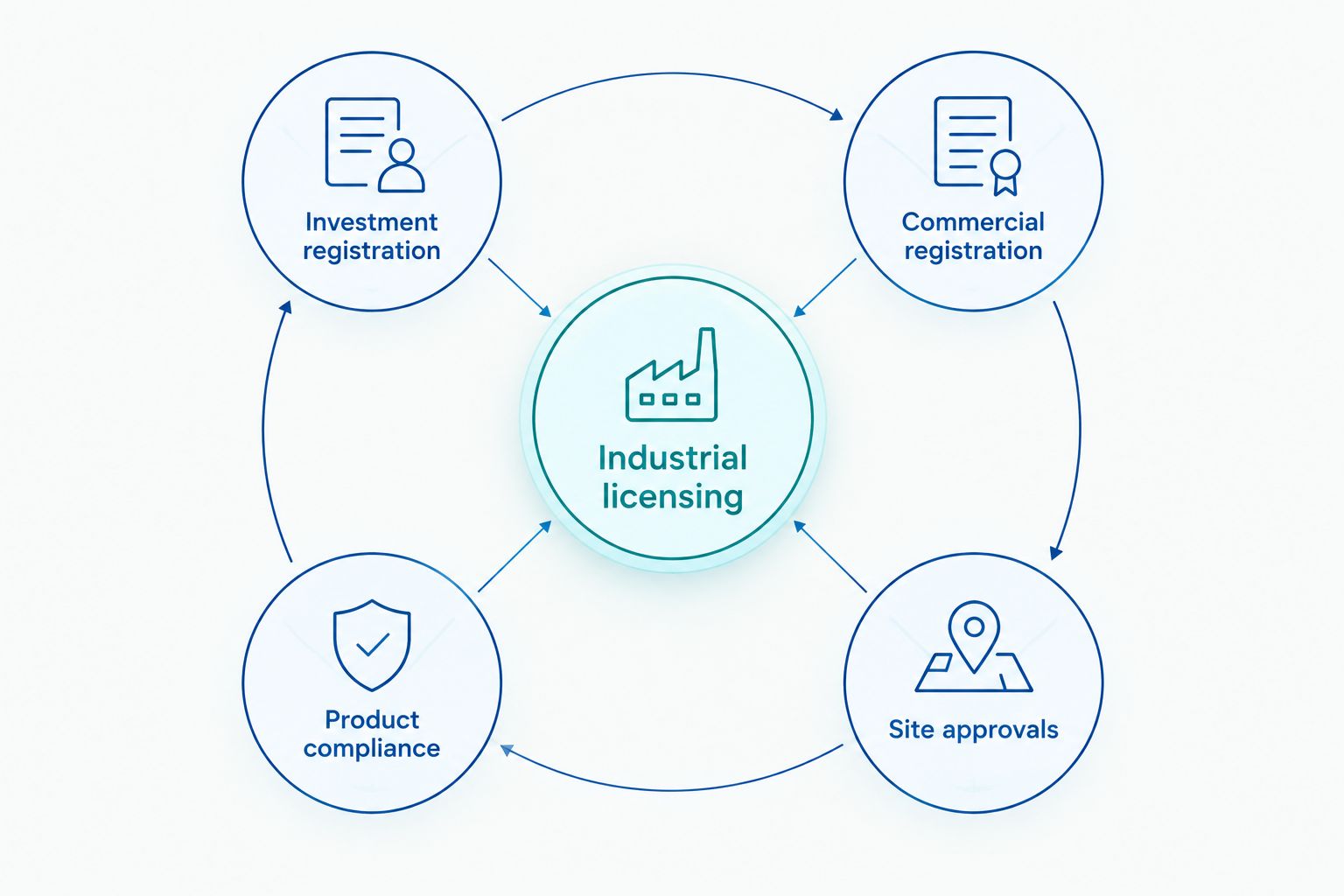
For a 2026 manufacturing project, organise the work into 5 approval areas. This is a planning framework, not a universal filing sequence: dependencies vary with the activity, location and responsible authority.
Investment registration
The Ministry of Investment, commonly called MISA, administers the foreign-investment framework. Confirm the current registration requirements and whether the proposed activity carries additional conditions; do not assume older references to investment licensing describe the current procedure.
Commercial registration
Commercial registration records the business and its registered activities. Align the legal entity, authorised representatives and activity descriptions with the intended manufacturing operation.
Industrial licensing
The Ministry of Industry and Mineral Resources administers industrial licensing. Check the scope and stage of the permission required for establishing and operating the proposed factory; an initial administrative milestone is not proof that production can begin.
Site approvals
Confirm permitted land use, environmental requirements and safety obligations with the relevant authorities and site operator. A suitable building commercially is not necessarily an authorised location for your production process.
Product compliance
Identify the authority responsible for the finished goods. Saudi Food and Drug Authority requirements apply to products within its remit; Saudi Standards, Metrology and Quality Organization requirements and relevant conformity procedures require separate assessment for applicable goods.
Build an application brief before committing to premises
Prepare a written scope that an adviser, authority and proposed site operator can assess consistently. Include these 4 items:
- Ownership chart: The proposed shareholders, parent entities and authorised decision-makers.
- Production description: Products, processes, raw materials, equipment and any regulated outputs.
- Site requirements: Intended location, utility needs, storage and environmental considerations.
- Sales model: Who manufactures, owns inventory, imports, sells and contracts with customers.
Keep technology and trademark ownership explicit. Registering a company name is not the same as securing trademark protection, and a manufacturing agreement should state who can use the brand and production know-how.
Gofico's business setup and compliance services cover initial formation and ongoing obligations. Use an enquiry to define the project scope, rather than requesting a generic licence package before the operating model is settled.
Discuss your manufacturing setup
Define your ownership, manufacturing activity and compliance scope before choosing a setup route.
How the routes are ranked
The ranking prioritises a dedicated factory operator, clear responsibility and fit with the intended ownership model. It does not rank government approval speed or promise that one structure receives preferential treatment.
For official verification in 2026, use MISA guidance for foreign-investment registration, Ministry of Commerce guidance for company registration, and Ministry of Industry and Mineral Resources guidance for industrial licensing. Check environmental, municipal, safety and product requirements with the authorities responsible for the actual site and goods.
Which manufacturing route should you choose?
Choose a Saudi subsidiary as the starting point when you intend to own and operate a dedicated local factory. Select a joint venture for shared ownership, consider a branch for an eligible parent-led operation, and use contract manufacturing when another business will operate production.
Gofico supports the connection between formation and ongoing compliance; that support does not replace government approval. Your final route should follow a documented activity and responsibility assessment.
FAQ
What’s the best licensing option for a foreign manufacturer in Saudi Arabia?
A Saudi subsidiary with the required industrial approvals is the default starting point for a dedicated, locally incorporated factory operator. The final choice depends on activity eligibility, ownership, premises and product requirements.
Do foreign manufacturers always need a Saudi partner?
No, a Saudi partner is not a universal requirement for every foreign manufacturing investment. Check the exact activity and applicable investment conditions before deciding whether shared ownership is necessary or commercially useful.
Is commercial registration enough to start manufacturing?
No, commercial registration alone does not authorise factory production. Industrial, site, environmental, safety and product requirements must be assessed for the proposed operation.
Can a foreign-company branch operate a Saudi factory?
A branch is an option only where its proposed activities and required approvals are permitted. Confirm eligibility and industrial requirements before choosing it, and assess the foreign parent’s liability.
Does contract manufacturing remove the need for compliance?
No, contract manufacturing changes who operates production but does not remove every obligation from the commissioning business. Product compliance, branding, sales and import responsibilities depend on the actual arrangement.
Which authorities should a foreign manufacturer check in 2026?
Start with the Ministry of Investment, Ministry of Commerce, and Ministry of Industry and Mineral Resources for their respective requirements. Additional authorities depend on the factory location, environmental impact and product category.
What ongoing obligations follow manufacturing setup?
Ongoing obligations include applicable corporate, tax, employment, permit and product requirements. Assess Zakat, Tax and Customs Authority obligations and Saudization requirements, meaning rules governing employment of Saudi nationals, against the company’s circumstances.
One last thing
Write down who operates the factory before asking which licence to obtain. That single distinction separates an own-factory investment from outsourced production and prevents a contract manufacturer’s permissions from being mistaken for your own authorisation.
Before signing premises or equipment commitments, make the agreement's conditions reflect the approvals your project requires. Commercial readiness and regulatory permission are different milestones.
Related guides