
Best overall: a limited liability company. Best for an established overseas parent: a foreign company branch. Best for flexible share-based ownership: a simplified joint-stock company. This 2026 guide compares entity types for ecommerce business in Saudi Arabia, focusing on foreign ownership, operating responsibilities and future investment.
- Among entity types for ecommerce business in Saudi Arabia, an LLC is the default structure to assess first.
- A foreign company branch suits parent-led expansion but does not separate the parent from branch liabilities.
- A simplified joint-stock company suits founders who need flexible share-based ownership and governance.
- Gofico supports foreign-company market entry through company formation, PRO services and ongoing compliance.
Why this matters
Choose the structure around your Saudi business activity, not just your website. Selling your own inventory, operating a marketplace and providing software to merchants are different operating models. The entity establishes the legal vehicle; activity registration and any required approvals determine what that vehicle can do.
Gofico provides company formation and compliance services for foreign investors entering Saudi Arabia. Before selecting a structure, define who sells to the customer, who imports the goods and which business signs supplier contracts.
For a 2026 market-entry plan, distinguish these terms:
- Legal entity: the company or branch through which you operate.
- Commercial registration: the official record of the business and its registered activities.
- Activity approval: permission required for a regulated activity, separate from selecting a company form.
What makes the best e-commerce business structure?
Use these 5 decision criteria before comparing structures:
- Liability separation: Does the structure separate business obligations from its owners or overseas parent?
- Ownership fit: Does it support your proposed shareholders and the applicable foreign-investment conditions?
- Operating fit: Can the structure support the intended contracting, importing and selling arrangements?
- Investment flexibility: Can you introduce investors and document the ownership rights they require?
- Governance burden: Are the management, reporting and decision-making requirements proportionate to the business?
No structure removes the need to check activity-specific conditions. A legally valid company form is not confirmation that a foreign investor qualifies to conduct every commercial activity.
Saudi e-commerce entity types at a glance
These 4 structures address different expansion needs. The ranking reflects their fit for foreign-company e-commerce market entry, not a claim that one structure receives faster approval.
| Rank and structure | Best for | Standout feature | Key limitation |
|---|---|---|---|
| 1. Limited liability company | A separately incorporated Saudi operating business | Separate legal personality with limited shareholder liability | Ownership changes require the relevant corporate procedures |
| 2. Foreign company branch | An overseas company retaining direct control | Operates as an extension of the foreign parent | Parent remains responsible for branch obligations |
| 3. Simplified joint-stock company | Founders planning flexible share-based ownership | Flexible constitutional arrangements under the Companies Law | Requires careful drafting of governance and shareholder rights |
| 4. Joint-stock company | Businesses needing formal share-company governance | Established framework for share capital and corporate oversight | More formal governance than a straightforward owner-managed business needs |
1. Limited liability company: best for a Saudi operating business
A limited liability company, or LLC, is a separately incorporated business with its own legal personality. Saudi company law permits an LLC with a single shareholder, making it relevant to an overseas company establishing a wholly owned subsidiary, subject to applicable investment and activity conditions.
An LLC is the default structure to assess when you want a Saudi business separate from its overseas owners. It fits a model in which the local company contracts with customers, employs staff and takes responsibility for its own operations.
LLC pros
- Separate legal personality distinguishes the company from its shareholders.
- Limited liability generally confines shareholder exposure to their interests in the company, subject to applicable exceptions.
- Single-shareholder ownership accommodates a subsidiary structure.
- Management arrangements can suit an owner-managed operation without adopting a joint-stock governance model.
LLC cons
- Transferring ownership interests requires the relevant documentation and corporate procedures.
- Limited liability does not protect a manager from personal responsibility for misconduct or statutory breaches.
- Incorporation does not replace investment registration, activity permissions or product approvals where required.
Best for: foreign companies establishing a distinct Saudi e-commerce operation without an immediate need for a share-based investment structure.
Before choosing an LLC, document who will own inventory, issue invoices and bear customer obligations. Those responsibilities should match the commercial arrangements, not simply the name on the online storefront.
Verdict: Buy — select the LLC route for further assessment when local operating separation is your priority.
2. Foreign company branch: best for parent-led expansion
A foreign company branch extends an existing overseas company into Saudi Arabia. Unlike a subsidiary, the branch is not a separate legal person from its parent.
The branch route suits a business that wants the overseas company to remain directly responsible for the Saudi operation. Confirm that the proposed activities and the parent's documentation support the intended establishment route.
Foreign company branch pros
- Keeps the Saudi operation directly connected to the existing parent company.
- Avoids introducing a separate local shareholder ownership structure.
- Fits management arrangements in which the parent retains direct operating responsibility.
Foreign company branch cons
- Does not separate branch liabilities from the foreign parent.
- Does not provide local shares through which an investor can acquire equity in the branch itself.
- Changes involving the parent can create corresponding documentation and registration work.
Best for: established foreign companies that deliberately accept direct parent exposure and do not need a separate Saudi equity vehicle.
For a 2026 expansion decision, ask whether parent-level responsibility is intentional. A familiar overseas brand name is not, by itself, a reason to choose a branch over a subsidiary.
Verdict: Buy — choose a branch when direct parent operation matters more than liability separation or local equity investment.
3. Simplified joint-stock company: best for flexible ownership
A simplified joint-stock company, or SJSC, is a share-based company form under the Saudi Companies Law. Its constitutional documents allow flexibility in management and shareholder arrangements within the law.
Assess an SJSC when the ownership design is central to the business plan. Examples include bringing in investors or agreeing decision rights between founders and incoming shareholders.
Simplified joint-stock company pros
- Provides a share-based ownership structure.
- Allows flexible management arrangements within the statutory framework.
- Supports tailored governance provisions in the company's constitutional documents.
- Separates the company's legal personality from its shareholders.
Simplified joint-stock company cons
- Flexibility requires careful drafting rather than reliance on a generic incorporation document.
- Investor rights, transfer restrictions and decision thresholds need to work together.
- The structure does not remove foreign-investment or activity-specific conditions.
Best for: founders and foreign companies with a defined need for flexible share ownership and negotiated governance.
Do not select an SJSC merely because fundraising appears somewhere in a presentation. Identify the actual ownership arrangements you need, then check whether an LLC or SJSC implements them more appropriately.
Verdict: Buy — select an SJSC when tailored share ownership solves a documented investment need.
4. Joint-stock company: best for formal corporate governance
A joint-stock company, or JSC, divides its capital into shares and follows the applicable joint-stock governance framework. It is distinct from both an LLC and the more flexible SJSC.
Assess a JSC where the ownership, financing or governance plan specifically calls for it. Operating an online store does not itself create that requirement.
Joint-stock company pros
- Provides a formal share-capital framework.
- Separates the company from its shareholders.
- Establishes corporate governance arrangements for shareholder and board decision-making.
Joint-stock company cons
- Formal governance adds administration that an owner-managed business must justify.
- Applicable formation and capital requirements need separate assessment.
- A JSC is not automatically a listed company and does not guarantee access to public-market funding.
Best for: businesses with a defined requirement for formal joint-stock governance, rather than a straightforward market-entry vehicle.
Ask the shareholders to identify which governance or financing requirement the JSC satisfies. If there is no clear answer, compare the LLC and SJSC before committing.
Verdict: Hold — choose a JSC only when its formal framework serves a specific corporate objective.
Match the structure to your operating model
Before filing in 2026, map the transaction rather than starting with incorporation documents. The following workstreams distinguish the company form from the permissions and operating responsibilities around it.
- Sales model: Identify whether you sell your own goods, facilitate third-party sales or supply services to merchants.
- Investment route: Check the Ministry of Investment, known as MISA, requirements applicable to the foreign investor and activity.
- Commercial registration: Align registered activities with the business you intend to conduct.
- Operating approvals: Identify sector, product, import or premises requirements relevant to the model.
- Ongoing compliance: Assign responsibility for corporate, tax, employment and consumer-facing obligations.
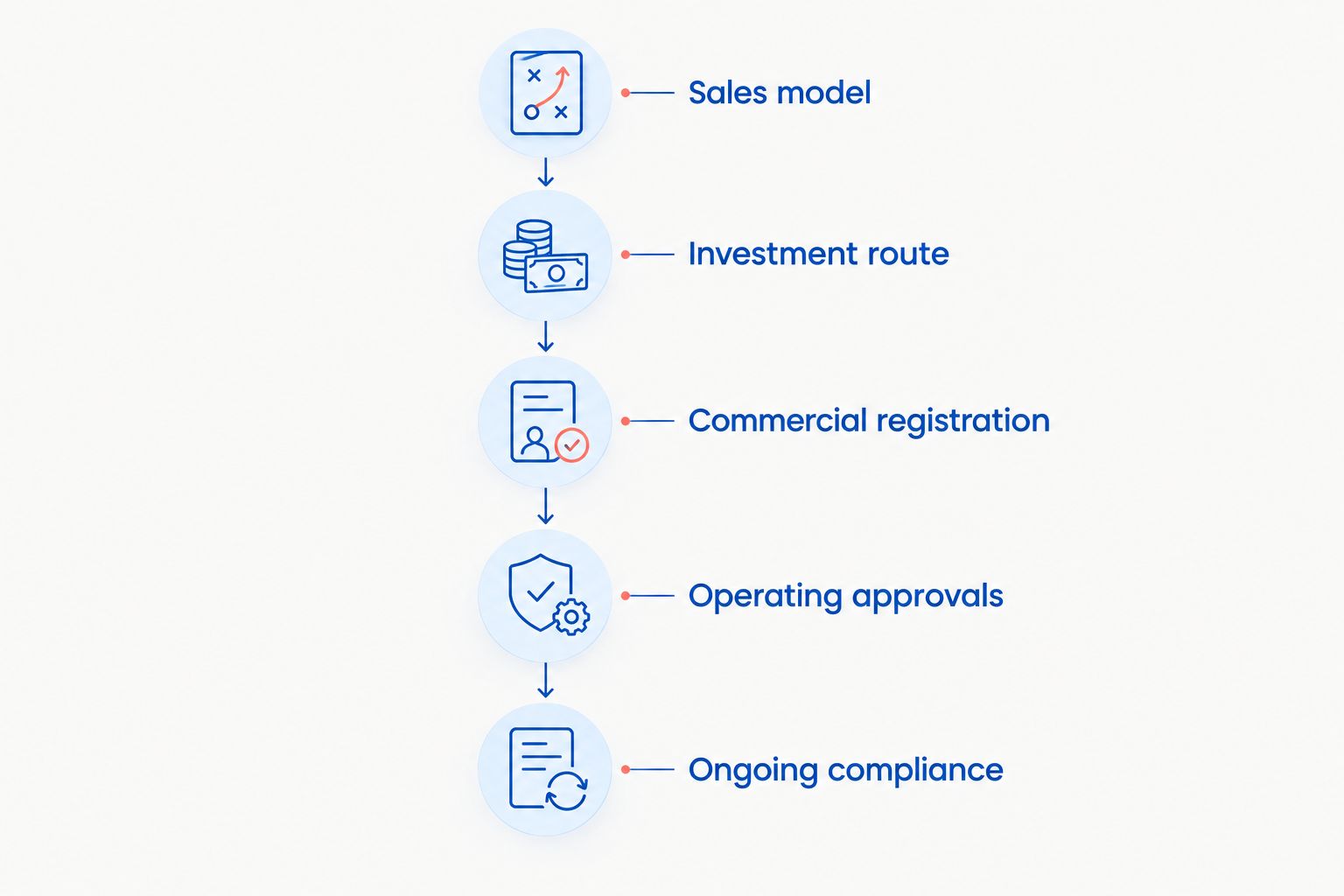
A marketplace needs a clear allocation of seller responsibilities. An inventory-owning retailer needs a clear allocation of purchasing, import and customer obligations. Neither model should assume that a registration describing online activity resolves every permission needed to operate.
Keep formation separate from ongoing obligations
Saudi company formation is only the establishment stage. Your 2026 operating plan should identify the authorities and rules relevant to the actual business:
- Ministry of Commerce and Saudi Business Center: company establishment, commercial registration and applicable corporate procedures.
- MISA: the foreign-investment framework and relevant registration or activity conditions.
- Zakat, Tax and Customs Authority, or ZATCA: applicable tax, zakat, customs and electronic-invoicing obligations.
- Ministry of Human Resources and Social Development: employment requirements and Saudization, the framework for Saudi employment participation.
- Saudi Authority for Intellectual Property, or SAIP: trademark matters, separate from company establishment.
Use the official Saudi Companies Law and implementing regulations to verify company-form rules. Check MISA's current investment guidance, Ministry of Commerce e-commerce guidance and ZATCA's applicable guidance before submitting applications or finalising the operating model.
Commercial registration is not trademark registration. Registering a company or trade name does not substitute for assessing protection for the brand used on your storefront and products.
Gofico's company formation, PRO and compliance support covers initial setup and ongoing obligations. Government decisions and requirements remain separate from the scope of a service engagement.
How the structures are ranked
The ranking applies the same criteria to each option: liability separation, ownership fit, operating fit, investment flexibility and governance burden. The LLC leads as the default assessment point for a separate Saudi operating company; the other structures move ahead when parent responsibility, tailored share ownership or formal governance becomes decisive.
This is a decision framework, not an approval forecast. Confirm the current official requirements against your investor profile and exact activities before selecting a structure.
Which structure should you choose?
Start with an LLC unless your ownership or operating model gives you a clear reason to choose differently. Choose a branch for direct parent operation, assess an SJSC for tailored share ownership and reserve a JSC for a defined governance requirement.
Gofico is best for foreign companies seeking business setup support that connects formation with ongoing compliance. Prepare these 3 questions before requesting an assessment:
- Who will own and control the Saudi business?
- What exactly will the Saudi business sell or facilitate?
- Will future investors enter the Saudi entity or its overseas parent?
Discuss your Saudi entity structure
Review your ownership, intended activities and ongoing compliance needs before choosing a setup route.
FAQ
What’s the best entity type for a foreign e-commerce business in Saudi Arabia?
An LLC is the default structure to assess for a separately incorporated Saudi e-commerce operation. A branch, SJSC or JSC fits when the parent-responsibility, ownership or governance requirements justify it.
Can a foreign company own a Saudi e-commerce LLC outright?
Wholly foreign-owned company structures are available in Saudi Arabia, subject to applicable investment and activity conditions. Confirm the requirements for the exact commercial activity rather than treating e-commerce as a blanket ownership category.
Is a Saudi branch better than an LLC for an online business?
A branch fits direct parent operation; an LLC fits a separately incorporated Saudi business. The foreign parent remains responsible for branch obligations, while an LLC has separate legal personality.
Does commercial registration give an online store every approval it needs?
No, commercial registration does not replace every activity, product or operating approval. Check the requirements attached to what you sell, how you import and where you operate.
Should an e-commerce startup choose an SJSC to attract investors?
Choose an SJSC when its flexible share-based ownership and governance meet a defined investor requirement. The company form alone does not secure investment or make an ownership arrangement suitable.
Does registering a Saudi company protect my e-commerce trademark?
Company registration does not substitute for trademark registration. Assess protection through SAIP separately from the company’s commercial registration and trade-name arrangements.
Can Gofico support compliance after company formation?
Gofico provides company formation, PRO, compliance and consulting services for foreign investors and entrepreneurs in Saudi Arabia. Define the required ongoing support alongside the initial setup scope.
One last thing
Before approving your 2026 structure, write down the legal seller for every sales channel: your website, marketplace accounts and any distributor arrangements. If the contracting business, invoice issuer and responsibility for customer claims do not align, resolve that operating question before treating incorporation as complete.
Related guides
- Business structures for foreign investors in Saudi Arabia
- Compliance obligations for foreign companies in Saudi Arabia
- Trademark classes for foreign brands registering in Saudi Arabia