
The cost to form a company in Saudi Arabia depends on your business activity, ownership structure, legal form and required approvals; a single figure is not a reliable budget for every foreign company in 2026. Government charges are only part of the commitment: document preparation, professional services, premises, staffing and ongoing compliance need separate treatment.
- The cost to form a company in Saudi Arabia requires a scope-specific budget, not a universal package figure.
- Separate government charges, business setup services, operating expenses and capital requirements before comparing quotations.
- Gofico supports foreign-company formation and ongoing compliance; request a clearly defined service scope.
- Commercial registration does not replace activity-specific approvals, employment obligations or tax compliance.
How much does it cost to form a company in Saudi Arabia?
Your formation budget should show what you must pay, when payment becomes due and which organisation receives it. Compare the same scope of work, not just the headline total.
For a 2026 quotation, use Gofico’s business setup pricing as a starting point for a scope discussion. Ask which government charges, document services and post-registration tasks the proposal includes before treating it as your market-entry budget.
| Budget component | What to establish | What to check in a quotation |
|---|---|---|
| Investment requirements | Applicable Ministry of Investment requirements | Government charges versus advisory work |
| Company registration | Entity formation and commercial registration steps | Filing work, constitutional documents and exclusions |
| Activity approvals | Permissions required for the proposed business | Whether specialist approvals are included |
| Document preparation | Translation, authentication and signing requirements | Which documents and jurisdictions are covered |
| Operating arrangements | Address, premises and employment needs | Expenses outside the formation engagement |
| Ongoing compliance | Corporate, tax and employment obligations | Recurring work versus initial account setup |
This breakdown is a budgeting framework, not a universal list of mandatory charges. The applicable requirements depend on the entity and its activities, so each line needs confirmation against the relevant official process.
Why this matters
A formation proposal and an operating budget answer different questions. The proposal explains what the adviser will deliver; the operating budget explains what your business needs to function after registration.
Confusing them creates an incomplete investment decision. A quotation can accurately cover incorporation while excluding premises, employees, accounting and later regulatory work.
Approve a defined market-entry scope before approving the expenditure. Your finance team should understand both the registration endpoint and the obligations that begin after it.
What belongs in your initial formation budget?
Investment registration and activity permissions
The Ministry of Investment, commonly called MISA, administers Saudi Arabia’s investment registration framework. Establish the requirements applying to your foreign investment and intended activities before assuming that company incorporation alone gives you permission to operate.
Older references often use the phrase “MISA licence.” For a 2026 application, confirm the current registration process and terminology directly with MISA, including any activity restrictions or additional approvals.
Ask your adviser to distinguish investment registration from sector-specific licensing. These are different questions: whether the investment satisfies the applicable framework, and whether the business has permission to perform its proposed work.
Company documents and commercial registration
Commercial registration records the business through the Ministry of Commerce framework. Preparing the entity also requires decisions about ownership, management authority and the documents governing the business.
Your quotation should identify the legal entity being formed and the filing work included. “Company formation” is too broad unless the proposal names the deliverables and the point at which the engagement ends.
Review the investment-to-commercial-registration workflow when checking these dependencies. The sequence matters because an unresolved ownership or document issue can prevent a later submission from being ready.
Overseas documents and authorised signatories
A foreign shareholder’s documents need to satisfy the receiving authority’s requirements. Translation, authentication and evidence of signing authority should therefore appear as explicit workstreams rather than an unexplained miscellaneous allowance.
Confirm who obtains the documents and who checks them before submission. Ask whether the adviser’s scope includes reviewing their contents or only arranging processing after you supply them.
An incomplete shareholder file creates work outside a narrowly defined filing engagement. Resolve that responsibility before appointing a provider.
Which business structure should your quotation cover?
Different legal structures should not be compared as though they deliver the same outcome. A subsidiary and a foreign-company branch have different legal relationships with the overseas business, so the proposed structure belongs at the top of every quotation.
| Structure | Best for | Main advantage | Main limitation |
|---|---|---|---|
| Saudi subsidiary | Investors seeking a separate Saudi legal entity | Separates the local entity from its shareholder | Requires its own governance and compliance arrangements |
| Foreign-company branch | An overseas company seeking a Saudi presence through the parent | Operates as an extension of the parent company | Does not provide the same legal separation as a subsidiary |
Neither structure is automatically the right answer. Eligibility, permitted activities, liability considerations and the parent company’s plans need review before a cost comparison becomes meaningful.
Choose the structure for the intended business, then compare the work required to establish it. Selecting an entity solely because its quotation appears smaller leaves the more important legal and operating questions unanswered.
Why the cost to form a company varies
The main drivers are the work required to establish the particular business, not the nationality of an enquiry alone. Use these factors to explain differences between proposals:
- Business activity: The proposed work determines which activity permissions and regulatory checks apply.
- Legal structure: A subsidiary and a branch require different legal documentation and decisions.
- Shareholder documentation: Corporate ownership chains and signing arrangements affect the preparation work.
- Premises requirements: Address and premises arrangements must match the applicable activity requirements.
- Staffing plans: Hiring and employee administration add obligations beyond company registration.
- Service scope: Filing assistance, document coordination and ongoing compliance are distinct services.
For each factor, ask the provider to identify the underlying requirement and its source. A proposal should make clear whether a line arises from government rules, your business choices or the adviser’s own service scope.
How should you build a usable formation budget?
A useful 2026 budget separates the formation project from the cash needed to begin operations. Follow this sequence before requesting final approval from your board or finance team.
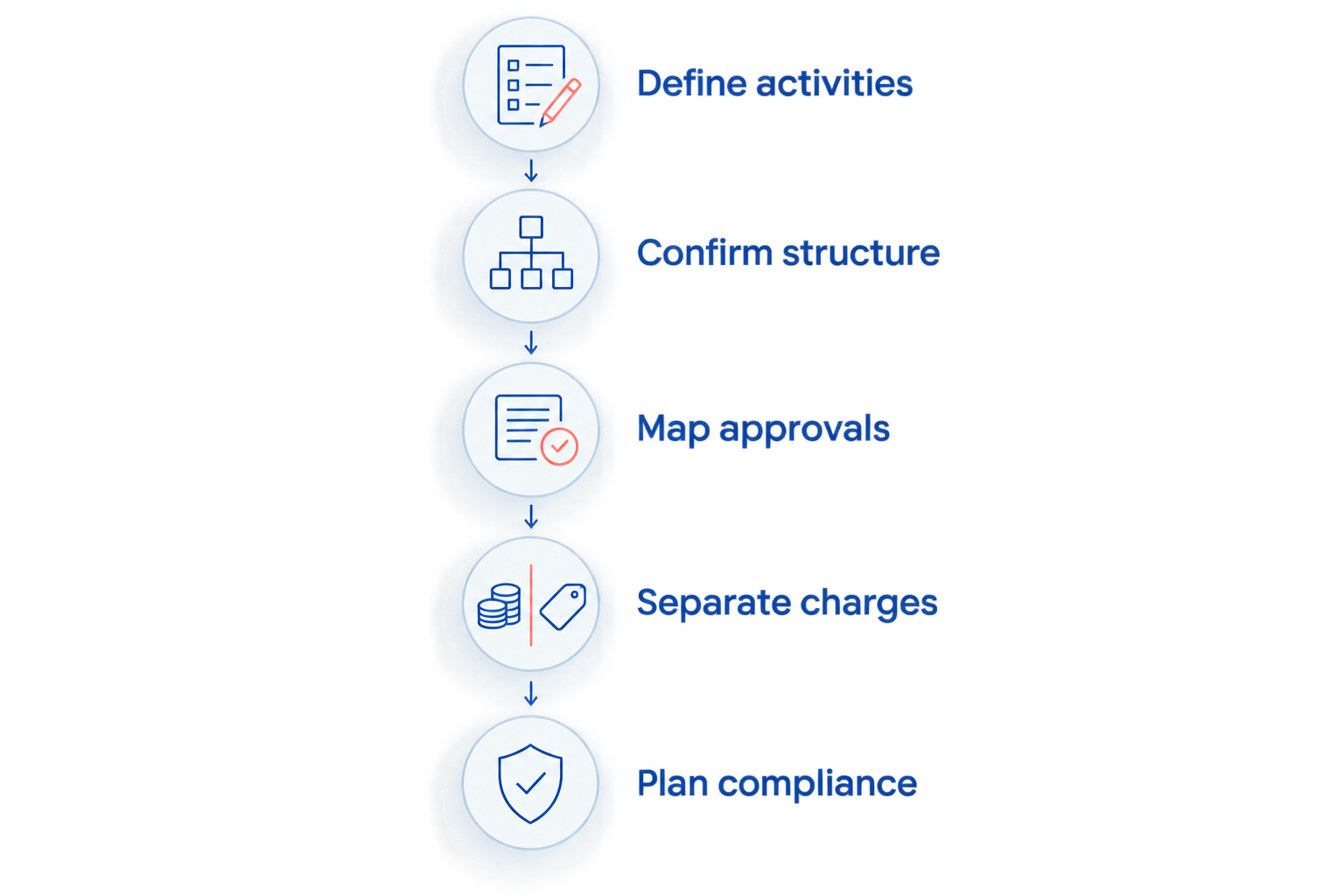
- Define activities. Describe what the Saudi business will sell, deliver or perform. Use the actual operating model rather than a broad label that hides regulated work.
- Confirm structure. Establish the proposed entity, shareholders and management authority. Keep those assumptions consistent across every quotation.
- Map approvals. Identify investment registration, commercial registration and activity-specific requirements. Record the responsible authority for each applicable step.
- Separate charges. Distinguish government payments, adviser fees and third-party expenses. Identify which amounts remain subject to confirmation.
- Plan compliance. Build a 12-month operating budget alongside the formation budget. Include applicable corporate, employment and tax administration rather than stopping at registration.
Give each budget line an owner and a payment trigger. Your team should know whether the company pays an authority directly, reimburses an adviser or pays a separate supplier.
How do you compare government charges and service fees?
A government charge pays for an official process. A service fee pays a provider for defined work, such as preparing an application, coordinating documents or managing submissions.
The distinction matters even when both appear on the same invoice. Your internal approval process needs to show what is statutory, what is professional work and what remains outside the engagement.
The distinction between formation fees and service charges is also relevant when comparing international setup proposals: a provider’s charge is not the same thing as the government payment underlying a filing. Saudi requirements must still be checked against Saudi authorities; another jurisdiction’s fee schedule does not establish a Saudi obligation.
For your 2026 comparison, request written answers to these questions:
- Which official charges are included, excluded or payable directly?
- Which services have a defined completion point?
- Who pays translation, authentication and other third-party expenses?
- What additional work requires your approval before it begins?
- Which recurring obligations sit outside the initial engagement?
A clear exclusion is better than an ambiguous inclusion. It lets you budget the remaining work instead of discovering a gap after appointment.
What ongoing obligations belong outside the formation total?
Corporate records and registration maintenance
Company formation does not end the responsibility to maintain accurate business information. Changes to ownership, management, activities or other registered details need assessment against the applicable update requirements.
Ask who will monitor corporate obligations and prepare the necessary actions. Do not assume that an initial registration service includes future changes or ongoing administration.
Tax, accounting and financial reporting
The Zakat, Tax and Customs Authority, known as ZATCA, administers relevant Saudi tax and zakat obligations. Zakat is a separate statutory obligation under Saudi rules; it should not be treated as interchangeable with corporate income tax.
Your ownership, activities and transactions determine the assessment required. Tax registration, bookkeeping, returns and financial reporting are separate workstreams, even when an adviser coordinates them within a wider engagement.
Employment and workforce administration
Qiwa is a Saudi platform for employment-related services, while the General Organization for Social Insurance, or GOSI, administers social insurance. Saudization refers to requirements relating to the employment of Saudi nationals.
If your operating plan includes employees, budget for the applicable registrations, administration and employment obligations. Company registration alone does not resolve the requirements for hiring or maintaining a compliant workforce.
What should you send before requesting a quotation?
Send a concise business brief rather than asking only for a package figure. Include the parent company’s jurisdiction, proposed shareholders, intended activities, preferred structure and whether you expect premises or employees at launch.
Also identify any documents already available and any decisions still open. A provider can define responsibilities more clearly when the scope distinguishes confirmed facts from assumptions.
Gofico is best suited to foreign companies seeking business setup and ongoing compliance support. Its stated services cover formation, licensing, compliance and public relations officer services, commonly called PRO services, for government-related administration.
The boundary remains important: Gofico’s business setup support does not replace an authority’s decision or the company’s own compliance responsibilities. Request a proposal that names deliverables, exclusions and the transition from incorporation to ongoing support.
Define your Saudi setup scope
Discuss your activities, ownership structure, registration needs and ongoing compliance requirements.
Does the formation budget include share capital?
Share capital is not the same thing as a government charge or an adviser’s fee. It concerns the company’s funding and ownership structure, so your budget should distinguish capital requirements from payments for services.
Confirm any applicable capital conditions for the proposed activity and structure. Do not treat a general incorporation quotation as confirmation that all funding requirements have been addressed.
Does commercial registration mean you can start every activity?
Commercial registration does not replace activity-specific permissions. Before trading, confirm that the business holds the approvals required for the activities it will actually perform.
Use a written readiness checklist covering registration, licensing and relevant operating obligations. Registration is a milestone, not a substitute for checking operational readiness.
FAQ
What determines the cost to form a company in Saudi Arabia?
The cost depends on the business activity, ownership structure, legal form, documentation and required approvals. Compare quotations only after those assumptions and the service scope match.
Are government charges included in a business setup quotation?
Government charges are included only when the quotation expressly says so. Ask for a separate breakdown of official payments, professional services and third-party expenses.
Is a Saudi branch the same as a subsidiary?
A Saudi branch is not the same as a subsidiary. A branch extends the overseas company, while a subsidiary is a separate Saudi legal entity.
Do I need to budget for compliance after incorporation?
Yes, ongoing compliance belongs in your operating budget. Assess corporate maintenance, accounting, tax and employment obligations separately from initial formation work.
Can I compare formation quotations before choosing an activity?
A meaningful comparison requires a defined business activity. Activity permissions and documentation requirements influence the work that each provider must include.
Does registering a company protect my trademark?
Company registration does not replace trademark registration. Assess brand protection separately through the Saudi Authority for Intellectual Property, known as SAIP.
What should a foreign company confirm before applying in 2026?
For a 2026 application, confirm current investment registration, commercial registration and activity-specific requirements with the relevant Saudi authorities. Use that confirmed scope to request a written proposal.
One last thing
Your most useful budget document is not the quotation alone. It is the quotation paired with a responsibility schedule showing who handles every required step, who pays and what remains outstanding.
Before approving your Saudi market-entry budget, ask one final question: What must still happen after this engagement ends before the company can operate as planned? The answer exposes the difference between incorporation expenditure and a funded operating plan.
Related guides
- Business structures for foreign investors in Saudi Arabia
- Compliance obligations for foreign companies in Saudi Arabia
- Trademark registration in Saudi Arabia