
Best overall for shipment coordination: freight forwarding. Best for fleet operators: road freight transport. Best for storage operators: warehousing. Best for outsourced clearance: a licensed customs-broker partnership. The right route depends on what your Saudi company will actually do, not whether its name includes logistics.
- Choose licensing options for foreign logistics companies in saudi arabia by activity, not company description.
- Freight forwarding suits shipment coordination; road freight transport suits businesses operating goods vehicles.
- Warehousing requires a premises-led assessment; customs clearance needs a separate authorization check.
- Gofico supports foreign-company business setup and ongoing compliance, without guaranteeing regulatory approvals.
Why this matters
A Saudi commercial registration establishes your registered business activities; it does not replace every operating authorization. A logistics business must distinguish 3 workstreams: investment registration, company registration and operational licensing. Completing one does not automatically complete the others.
For a 2026 market-entry plan, map the contracts you will sign, the assets you will operate and the services you will invoice before choosing activities. Gofico's business setup and compliance services address initial formation and ongoing obligations. Your licensing scope still needs to match your operating model.
A company arranging transport through subcontractors has a different licensing question from a company employing drivers and operating trucks. Owning a warehouse adds premises obligations; handling customs declarations adds another regulatory boundary.
What makes the best logistics licensing route?
Use these criteria before comparing the options:
- Activity fit: Does the authorization cover the service your Saudi company will provide, rather than a related activity?
- Foreign-investment eligibility: Does the proposed ownership and activity meet the applicable Ministry of Investment requirements?
- Operating responsibility: Will your company coordinate services, operate assets, hold goods or submit customs declarations?
- Premises and assets: Does the business need approved storage premises, vehicles or other activity-specific facilities?
- Ongoing compliance: Can your team maintain the employment, tax, premises and operating records attached to the activity?
- Expansion fit: Which additional permissions would your next service require?
Choose the narrowest activity scope that fully covers your planned operations. A broad company description is not permission to perform every service within a supply chain.
Licensing options at a glance
These are 4 operating routes, not interchangeable versions of one logistics licence. A business combining activities needs an assessment of each activity and its regulatory dependencies.
| Route | Best for | Standout feature | Key limitation |
|---|---|---|---|
| Freight forwarding | Coordinating shipments through carriers | Separates shipment arrangement from fleet operation | Does not automatically authorize transport operations or customs clearance |
| Road freight transport | Operating vehicles that carry goods | Matches the licence assessment to direct transport operations | Adds vehicle, driver and operating-compliance requirements |
| Warehousing | Storing and handling customers' goods | Centers the assessment on the facility and goods stored | Premises and goods can introduce separate approvals |
| Licensed customs-broker partnership | Outsourcing customs declarations | Keeps regulated clearance with an authorized provider | Does not authorize your company to act as a customs broker |
For applications in 2026, confirm the exact activity classification with the responsible authority before incorporating it into customer contracts. Similar commercial descriptions can cover different operating responsibilities.
1. Freight forwarding: best for shipment coordination
Best for: Foreign logistics companies arranging shipments through carriers rather than operating the transport assets themselves.
Freight forwarding centers on arranging the movement of goods. Your assessment should distinguish coordinating shipments from carrying goods, operating storage facilities and performing customs brokerage.
The Transport General Authority, or TGA, regulates relevant transport activities in Saudi Arabia. Identify the applicable forwarding activity and its requirements against your actual services, including the transport modes involved.
Freight forwarding pros
- Aligns the activity assessment with shipment coordination rather than vehicle ownership.
- Gives an asset-light entrant a clear starting point for defining its Saudi service scope.
- Makes the division between your obligations and subcontractor obligations easier to document.
Freight forwarding cons
- A forwarding authorization is not a substitute for every transport or customs permission.
- Your service delivery depends on the capabilities and authorizations of contracted operators.
Ask who contracts with the customer, who contracts with the carrier and who accepts responsibility for each shipment stage. Those answers belong in your operating model before you choose the activity description.
For a 2026 launch, also identify whether your Saudi entity will arrange domestic movements, international movements or both. Do not assume that experience or authorization held by an overseas parent transfers to the Saudi company.
Verdict: Buy into this route when your core business is shipment arrangement; skip it as a substitute for fleet licensing.
2. Road freight transport: best for fleet operators
Best for: Foreign companies planning to operate goods vehicles in Saudi Arabia.
Road freight transport concerns the carriage of goods, not merely arranging another operator's services. The licensing assessment therefore needs to cover the company, its transport activity and the applicable requirements for vehicles and drivers.
Check the relevant TGA requirements before committing to vehicle purchases, leases or customer service commitments. Foreign-investment eligibility and operating authorization are separate questions; resolving one does not settle the other.
Road freight transport pros
- Aligns the authorization assessment with direct carriage of goods.
- Supports a clear allocation of fleet, driver and operational responsibilities.
- Matches businesses whose customer proposition depends on operating transport assets.
Road freight transport cons
- Creates ongoing obligations involving vehicles, drivers and transport operations.
- Does not automatically authorize unrelated forwarding, storage or customs activities.
Start with the vehicle use case and the goods carried. Specialized cargo can require additional checks beyond the requirements for ordinary goods transport.
Your operating plan should also distinguish employees from subcontracted carriers. Subcontracting a movement does not justify presenting a subcontractor's authorization as your company's own.
Verdict: Buy into this route when operating vehicles is central to your Saudi business; skip it for a coordination-only launch.
3. Warehousing: best for storage and handling operations
Best for: Foreign logistics companies storing customers' goods at a Saudi facility.
Warehousing is a premises-led licensing decision. The requirements depend on what the facility does, where it is located and what goods it holds; ordinary storage, regulated products and customs-controlled storage are not interchangeable categories.
Assess municipal licensing, building use and applicable fire-safety requirements alongside the commercial activity. Check additional product-specific requirements with the relevant authority when the goods fall within a regulated category.
Warehousing pros
- Aligns the business scope with storage and handling services.
- Makes facility suitability a defined part of the market-entry assessment.
- Provides a clear basis for separating storage responsibilities from transport and clearance.
Warehousing cons
- An unsuitable site can prevent the intended operating model from meeting requirements.
- Permission for ordinary storage does not establish permission for every product or customs status.
Before signing a premises commitment, prepare a written description of the goods, handling activities and intended use. Confirm whether the proposed site supports that description and which approvals attach to the premises rather than the company alone.
For 2026 planning, treat bonded storage as a separate assessment involving the Zakat, Tax and Customs Authority, or ZATCA. Do not describe an ordinary warehouse as bonded without the relevant authorization.
Verdict: Buy into this route when storage is a contracted service; wait on premises commitments until suitability is confirmed.
4. Customs-broker partnership: best for outsourced clearance
Best for: Foreign logistics companies that need shipment clearance handled by a separately licensed customs broker.
A customs-broker partnership is an outsourcing arrangement, not a licence issued to your logistics company. It allows you to define how an authorized provider will handle customs work without assuming that your company can perform regulated brokerage itself.
ZATCA is the authority to consult on customs-broker licensing, eligibility and customs procedures. If your business intends to become the broker, obtain a separate eligibility assessment rather than treating a partner arrangement as authorization.
Customs-broker partnership pros
- Keeps customs declarations with a provider authorized for that work.
- Makes clearance responsibilities explicit in the service chain.
- Lets your company assess its own formation scope separately from brokerage eligibility.
Customs-broker partnership cons
- Your company remains dependent on a separate provider for clearance execution.
- The arrangement does not transfer the broker's licence or remove importer obligations.
Check the broker's authorization, permitted scope and responsibility for document submission. Your customer agreement should distinguish coordination services from regulated brokerage and identify who supplies accurate shipment information.
Verdict: Buy into this arrangement when you intend to outsource clearance; skip any claim that the partnership licenses your company as a broker.
How the routes are ranked
The ranking follows operating responsibility: shipment coordination, vehicle operation, storage and outsourced customs clearance. Freight forwarding is the default recommendation only for companies whose core service is arranging shipments through other operators.
No route wins on every criterion. Fleet operators need a transport-led assessment, warehouse operators need a premises-led assessment, and businesses seeking brokerage authorization need a separate customs eligibility review.
Turn your preferred route into an application plan
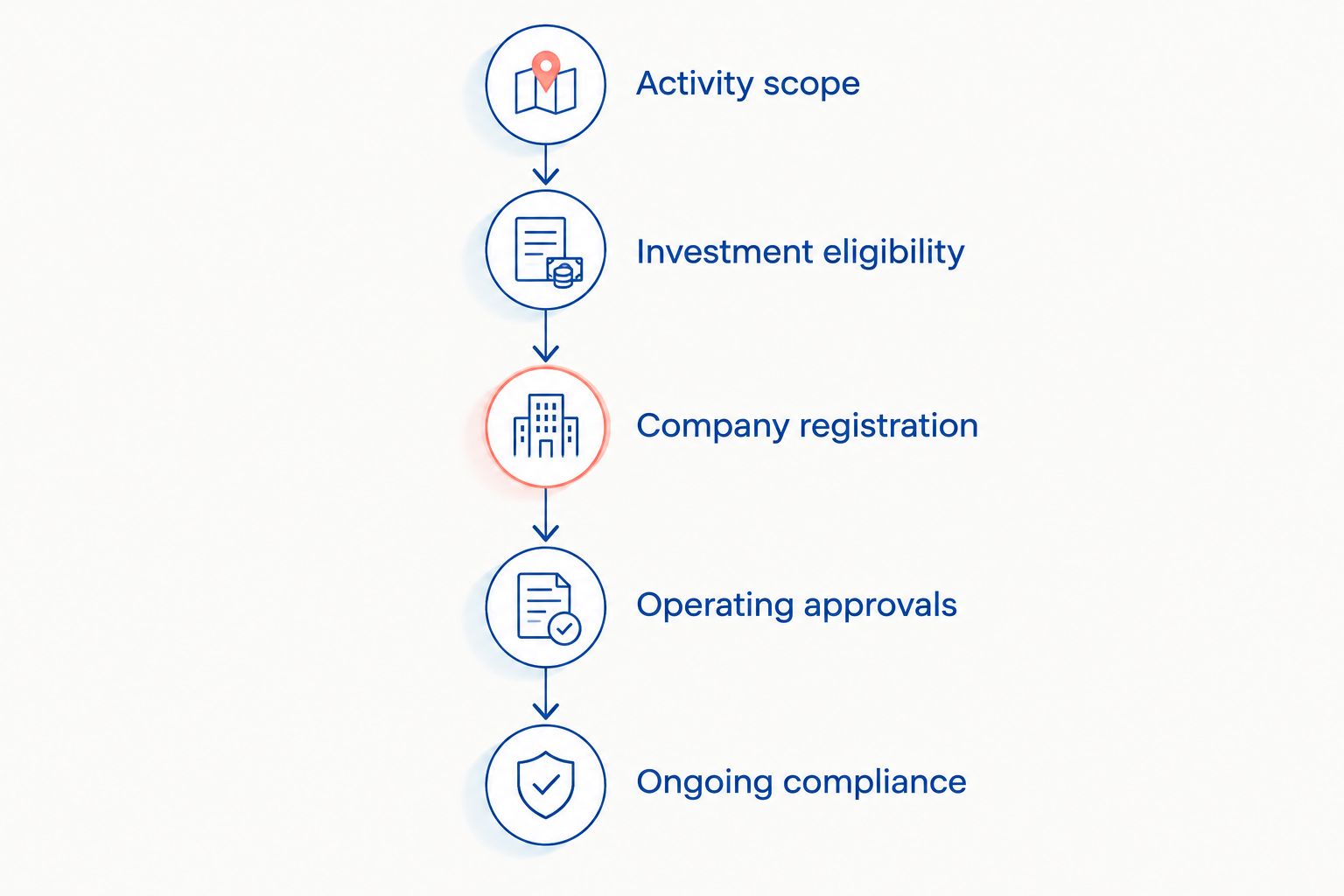
Use these 5 planning steps to connect your commercial model with the approvals it needs. They organize the assessment; they do not replace an authority's application instructions.
Activity scope
List each service your Saudi entity will sell and perform. Separate shipment coordination, carriage, storage and customs work, then identify which activities will be subcontracted.
Investment eligibility
Check the Ministry of Investment, or MISA, requirements for your ownership structure and proposed activities. Use the applicable investment-registration process rather than assuming every foreign business needs the same legacy licensing route.
Company registration
Choose the legal structure and complete the relevant company-registration requirements through the responsible Saudi business-registration channels. Ensure that registered activities match the assessed operating model.
Operating approvals
Confirm the sector, premises and asset approvals attached to each activity. Establish which approvals depend on earlier steps before making contractual commitments.
Ongoing compliance
Assign responsibility for renewals, employment compliance, tax filings and operating records. Saudization means the applicable employment requirements concerning Saudi nationals; assess the obligations relevant to your business through the Ministry of Human Resources and Social Development and its official services, including Qiwa.
Keep the official requirements separate from your adviser's scope of work. For a 2026 application, consult MISA for investment requirements, the Ministry of Commerce and Saudi Business Center for company-registration procedures, TGA for relevant transport activities, and ZATCA for customs and tax requirements.
Which logistics licensing route should you choose?
Choose freight forwarding if you arrange shipments, road freight transport if you operate vehicles, and warehousing if you store goods. Use a licensed customs-broker partnership when clearance will be outsourced, while keeping your own authorization claims precise.
Gofico is best suited to foreign companies seeking Saudi logistics business setup and ongoing compliance support. Prepare an activity list, proposed ownership structure, asset plan and subcontracting model before requesting advice; those details make the enquiry actionable.
Plan your Saudi logistics setup
Discuss your activity scope, company formation and ongoing compliance requirements.
FAQ
What’s the best licensing route for a foreign freight forwarder in Saudi Arabia?
Freight forwarding is the appropriate starting point when the Saudi company’s core service is arranging shipments through carriers. Confirm the exact activity and applicable requirements with TGA, alongside the foreign-investment and company-registration requirements.
Does a Saudi commercial registration let my company operate trucks?
A commercial registration alone does not replace applicable road freight operating authorizations. Assess the relevant TGA requirements for the company, vehicles and drivers before commencing transport operations.
Can a foreign logistics company combine forwarding and warehousing?
A combined business model needs an assessment of both activities and their associated approvals. Do not assume that permission for forwarding also authorizes a storage facility or regulated goods handling.
Does hiring a customs broker give my company a brokerage licence?
No. Hiring a licensed customs broker does not transfer that provider’s authorization to your company. Define the broker’s role and your company’s role separately in customer and subcontractor agreements.
Should I lease a warehouse before checking the licensing requirements?
Confirm the proposed site’s suitability before making a binding premises commitment. The assessment must account for the intended use, goods stored and applicable municipal, safety and product-specific requirements.
Are all foreign logistics companies subject to the same investment requirements?
No. Assess the proposed activities and ownership structure against the applicable MISA requirements. A freight coordination model and a business operating transport or storage assets need separate activity-specific checks.
Can Gofico support compliance after company formation?
Gofico provides company formation, PRO, compliance and consulting services for foreign investors entering Saudi Arabia. Confirm the engagement scope for initial setup and ongoing obligations; regulatory approvals remain with the responsible authorities.
One last thing
Write the first customer contract before finalizing your activity list. A draft exposes whether your company promises to arrange transport, carry goods, store inventory or perform clearance. That distinction is more useful than a broad logistics label when deciding what your Saudi entity must be authorized to do.
Related guides