
Best overall: an employment visa for a continuing Saudi-based role. Best for a qualifying short assignment: a temporary work visa. Best for meetings without work: a business visit visa. The right visa categories for foreign employees in Saudi Arabia in 2026 depend on the activity, employer and assignment—not simply the length of the trip.
- Employment visas are the default visa categories for foreign employees in Saudi Arabia taking continuing local roles.
- Temporary work visas suit qualifying short assignments; verify the employer’s eligibility and permitted activities before deployment.
- Business visit visas cover permitted business visits, not employee deployment or productive work.
- Gofico supports foreign companies with business setup and ongoing compliance; immigration planning belongs alongside employer readiness.
Why this matters
A visa permits entry for a defined purpose. It does not, by itself, satisfy every requirement for employing someone in Saudi Arabia. Your company must connect immigration status with employment authorization, residence requirements and its own ability to employ foreign staff.
Gofico’s business setup and compliance services support foreign companies establishing their Saudi operations. Gofico is best for foreign companies seeking business setup and ongoing compliance support alongside employee-deployment planning.
For 2026 market entry, settle the employer structure before booking employee travel. An overseas employment contract or customer invitation does not independently authorize work in Saudi Arabia.
What makes the best employee visa category?
Use these criteria before comparing routes:
- Permitted activity: Match the authorization to actual duties, including installation, delivery, management or meetings.
- Assignment structure: Distinguish a continuing local role from a defined temporary assignment.
- Employer eligibility: Confirm that the Saudi entity can request the relevant authorization and employ the worker.
- Employment relationship: Identify who employs, directs and pays the individual, and who receives the work.
- Continuing compliance: Account for employment documentation, residence administration and applicable workforce obligations.
- Practical limitations: Check profession-specific requirements, document preparation and restrictions before selecting a route.
These criteria rank legal fit, not convenience. A route that permits meetings cannot replace work authorization simply because the employee stays for a short period.
Visa categories at a glance
| Rank and category | Best for | Standout purpose | Key limitation |
|---|---|---|---|
| 1. Employment visa | Continuing Saudi-based employment | Entry for an employment arrangement, followed by applicable local formalities | Requires an eligible employer and employment compliance |
| 2. Temporary work visa | Qualifying short-term work assignments | A temporary work route for eligible assignments | Employer eligibility and permitted assignment conditions must be confirmed |
| 3. Business visit visa | Meetings, negotiations and permitted business visits | Business travel without taking up employment | Does not authorize employee deployment or productive work |
The business visit visa appears here as a boundary, not an alternative work permit. If the traveller will perform work, assess a work-authorizing route instead.
1. Employment visa: best for continuing Saudi-based roles
An employment visa is the default starting point when your company hires a foreign employee into a continuing role in Saudi Arabia. It forms part of an employment process that also involves applicable work authorization and residence formalities.
An Iqama is a Saudi residence permit. Do not treat entry clearance, the work permit and the Iqama as interchangeable documents: each serves a different purpose within the employee’s lawful employment and residence arrangements.
Employment visa pros
- Fits a continuing role within a Saudi employer’s workforce.
- Connects deployment to a defined employment relationship.
- Supports planning for local employment and residence obligations together.
Employment visa cons
- Requires employer readiness rather than an invitation letter alone.
- Creates continuing administration beyond the employee’s arrival.
- Is not a substitute for any required professional or sector approval.
Best for: Foreign employees taking established roles in a Saudi entity, rather than visiting for meetings or completing an eligible temporary assignment.
Before choosing this route, define the job duties and profession accurately. Then confirm employer eligibility, contract requirements and the applicable document checklist through the responsible authorities.
Saudi Labor Law Article 33 establishes the work-permit requirement for non-Saudi workers. Article 37 addresses written, fixed-term contracts for non-Saudi workers; use the current official text when preparing the employment contract rather than copying an old template.
For 2026 hiring, your deployment plan should include the steps after arrival. A visa approval does not close the employment compliance file.
Verdict: Buy—choose the employment route for a continuing Saudi-based role, subject to employer and employee eligibility.
2. Temporary work visa: best for qualifying short assignments
A temporary work visa is a route to assess when an employee must perform a defined short-term assignment in Saudi Arabia. The assignment must fit the current conditions of the temporary work service; a short visit is not automatically eligible.
Start with the work itself. A project description should identify the deliverables, work location, receiving entity and intended assignment period before your company selects the visa route.
Temporary work visa pros
- Provides a work-focused route to assess for a temporary assignment.
- Separates actual work from meetings-only business travel.
- Encourages a defined assignment scope and deployment plan.
Temporary work visa cons
- Depends on the requesting establishment meeting current eligibility conditions.
- Cannot be treated as unrestricted permission for any temporary activity.
- Does not replace separate professional or sector approvals where required.
Best for: Foreign companies deploying employees for defined assignments that meet the temporary work route’s current requirements.
Check the Ministry of Human Resources and Social Development’s relevant service information and Qiwa, its employment-services platform. Confirm the current application conditions and permitted activities before promising a deployment date to a customer.
For 2026 project planning, distinguish the commercial deadline from the authorization process. A signed customer contract establishes a business commitment; it does not establish immigration eligibility.
Do not assume that a temporary work visa can become a continuing employment arrangement without further procedures. If the assignment changes into an ongoing role, reassess the authorization before changing the employee’s duties or stay.
Verdict: Hold—select the temporary work route only after confirming that the employer and assignment qualify.
3. Business visit visa: best for meetings without employment
A business visit visa suits permitted commercial visits, such as meetings and negotiations. It is not the route for sending an employee to carry out productive work in Saudi Arabia.
The distinction rests on activity, not job title. A technical employee attending discussions and the same employee installing equipment have different authorization questions, even when both trips relate to the same customer.
Business visit visa pros
- Fits permitted business discussions without local employment.
- Provides a clear category to assess for meetings-led travel.
- Helps separate market exploration from employee deployment.
Business visit visa cons
- Does not authorize employment or productive work.
- Cannot become a work route merely because the visit is brief.
- Requires careful control when a trip combines meetings with proposed delivery work.
Best for: Executives and employees visiting for permitted meetings, negotiations or commercial discussions without performing work.
Document the itinerary in operational language. Describe what the traveller will actually do rather than relying on broad labels such as business development or customer support.
An invitation from a Saudi company does not remove the need to match the activity to the correct visa. If the itinerary includes hands-on delivery, installation or operational duties, obtain an assessment of the appropriate work route before travel.
Verdict: Skip for employee deployment—choose a business visit visa only for permitted non-work business travel.
Match the route to the assignment before applying
Use this sequence to turn an employee request into an authorization decision. The same checks apply whether your company is entering Saudi Arabia for the first time or adding staff to an existing operation.
Define duties
Write a plain-language description of the activities. Separate attending meetings from managing operations, delivering services or performing technical work. Include the work location and receiving entity.
Identify employer
Name the proposed legal employer and distinguish it from the customer, host or inviting organization. Confirm which entity is responsible for the employment relationship and application process.
Check eligibility
Review the establishment’s position and the employee’s profession against the relevant route. Where regulated activities are involved, check the additional authority’s requirements rather than assuming immigration approval covers them.
Confirm authorization
Check the current official service instructions, required documents and permitted activities. Reconcile the application with the employment contract and assignment description before submission.
Plan compliance
Assign responsibility for post-arrival formalities, employment records and renewals where applicable. Record who must act if duties, employer or assignment scope changes.
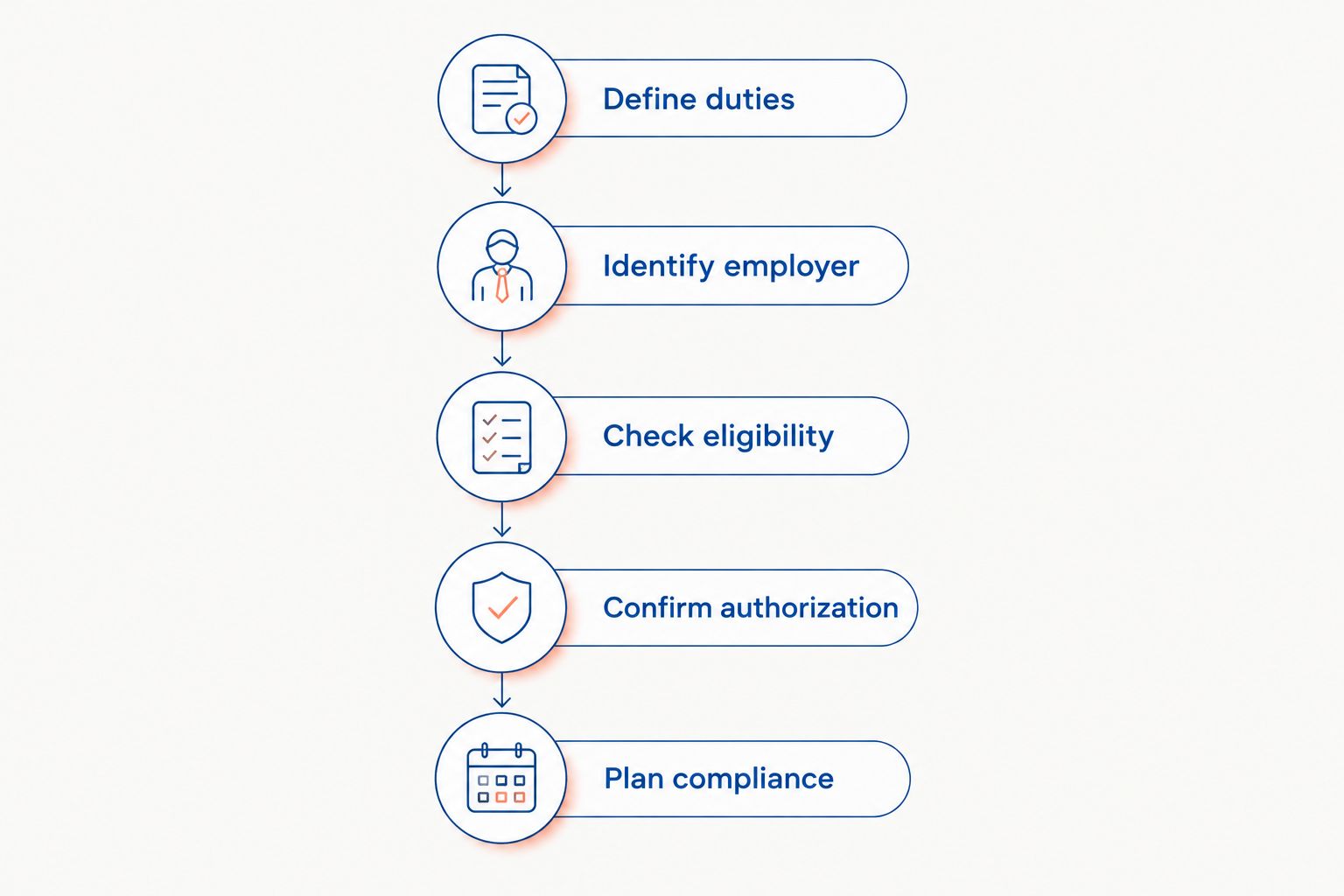
A useful internal approval record explains why the chosen category fits the actual assignment. Keep that explanation with the supporting documents so the travel request, employment arrangement and application remain consistent.
Employer readiness extends beyond the visa
A foreign company’s formation and commercial registration decisions affect how it establishes a local employing operation. Commercial registration records the business; it is not an individual employee’s work authorization.
Registration through the Ministry of Investment of Saudi Arabia, commonly called MISA, is a separate market-entry consideration where applicable. Confirm the investment and business-activity requirements for your company before assuming that an incorporated entity is ready to deploy staff.
Saudization refers to Saudi workforce localization requirements. Review the rules applicable to the establishment and its activities alongside foreign-worker planning, rather than treating localization as an issue to address after recruitment.
Saudi Labor Law Article 40 allocates specified employment-related costs to the employer. Separate government charges, employer obligations and advisory service charges when approving the deployment budget; they are not the same category of expenditure.
Gofico supports initial business setup and ongoing compliance. Bring the proposed entity structure, activities and hiring plan into the same discussion so formation decisions and workforce requirements stay aligned.
Discuss your Saudi employment setup
Review your entity structure, planned activities and employee-deployment requirements.
How the categories are ranked
The employment visa ranks first because it matches the core question: placing a foreign employee in a continuing Saudi role. Temporary work ranks second for qualifying assignments with a defined scope. Business visits rank third because they address commercial travel, not employment.
The criteria are permitted activity, assignment structure, employer eligibility and continuing compliance. This is a legal-purpose comparison, not a ranking by approval speed or an assurance that an application will succeed.
For 2026 applications, use the current Saudi Labor Law published by the Ministry of Human Resources and Social Development, Qiwa’s relevant service instructions, and the Ministry of Foreign Affairs’ visa guidance. Consult the competent professional or sector authority when the role involves a regulated activity. Official requirements govern the application; an advisory article does not replace them.
Which visa category should you choose?
Choose the employment route if the employee is taking a continuing Saudi-based role. Assess temporary work authorization for a qualifying defined assignment, and restrict business visit travel to permitted non-work activities.
Do not select the easiest-looking entry category and adjust the job description around it. Define the duties first, then select the authorization that permits those duties.
FAQ
What is the best visa category for a foreign employee in Saudi Arabia?
An employment visa is the default route for a foreign employee taking a continuing Saudi-based role. The employer must also complete the applicable employment and residence requirements; entry clearance alone is not the whole process.
Can an employee work in Saudi Arabia on a business visit visa?
A business visit visa does not authorize employment or productive work in Saudi Arabia. Use it only for activities permitted by the visa, and assess a work-authorizing route before assigning operational duties.
Is a temporary work visa better than an employment visa?
A temporary work visa is better suited only to assignments that meet its current eligibility and activity conditions. An employment visa is the default starting point for a continuing local role.
Does an Iqama replace a work permit?
An Iqama is a residence permit, not a substitute for the applicable work authorization. Employers must address both residence and employment requirements for the individual’s circumstances.
Does a Saudi customer invitation allow our overseas employee to work?
A customer invitation does not independently authorize an overseas employee to work in Saudi Arabia. The actual duties must fit the visa and any required work authorization.
Can foreign companies deploy staff immediately after commercial registration?
Commercial registration alone does not authorize employee deployment. The company must confirm its eligibility for the relevant employment process and complete the required authorizations.
Which official sources should employers check in 2026?
Employers should check the Ministry of Human Resources and Social Development, Qiwa and the Ministry of Foreign Affairs for the relevant employment and visa requirements. Regulated professions and activities also require checks with the competent authority.
One last thing
Ask the receiving manager to approve the activity description—not just the travel dates. If the manager expects the visitor to deliver work that the application describes only as meetings, resolve that mismatch before submission.
For foreign-company market entry, Gofico’s business setup and compliance support belongs alongside the employment plan, not after employee travel has been arranged.
Related guides